The harbour is quiet at dawn in a way that surprises first-time visitors. There are no diesel fumes, no engine rumble rolling across the water, just the sound of gulls and the soft clink of rigging against masts. Then a yacht slips out of her berth, a long white hull with a low glass superstructure, and the only sound is the water parting at her bow. Guests on the aft deck talk in normal voices. Nobody has to shout. This is the promise of the luxury electric yacht: a boat that moves through the world without announcing itself, and a kind of quiet that diesel never allowed.
Electric yachts have moved quickly from experiment to serious luxury. A decade ago, an electric yacht meant a small day boat with a short range and a nervous owner watching the battery gauge. Today, the largest electric yachts are over thirty metres long, with battery banks the size of shipping containers, solar panels across the roof, and diesel generators that run only when they are needed. They are bought by owners who want silence, clean air, and the freedom to anchor in a bay without a generator humming through the night.
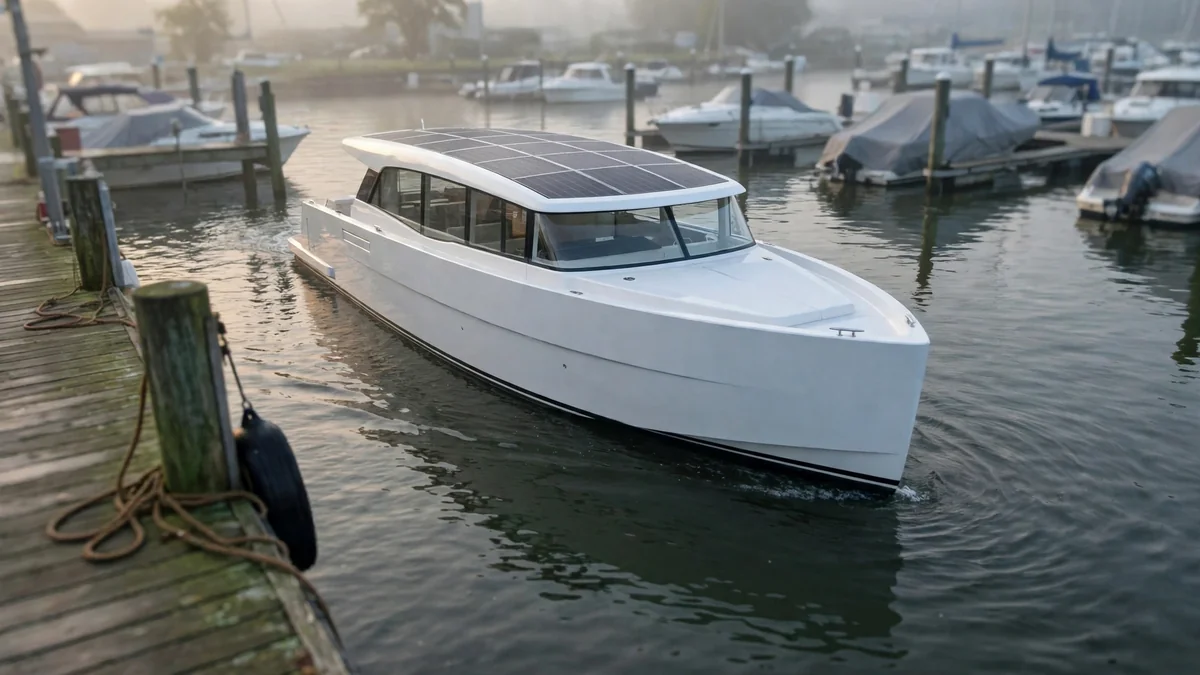
How It Works
A luxury electric yacht works by turning stored electricity into motion, and by making its own electricity whenever it can. The system has four main parts: the battery bank, the electric motors, the power generation, and the management system that decides how energy is spent. Each part is simple on its own. The skill is in how they work together. Here is how the system works, step by step.
1. Batteries store the energy. The heart of the yacht is a bank of lithium batteries, usually housed low in the hull where their weight keeps the boat stable. The batteries are kept cool by a liquid system, monitored cell by cell, and sealed in fire-resistant compartments, because a battery fire at sea is one of the few emergencies a crew cannot walk away from. The weight of the batteries is a trade-off: more storage means more range, but also a heavier boat that needs more power to move.
2. Electric motors turn the propellers. The batteries feed electric motors that drive the propellers, either directly or through pods that can rotate to steer the boat. There is no gearbox, no exhaust, and almost no vibration, which is why guests notice the silence first. Most luxury electric yachts have two motors, one for each propeller, so the boat can still move if one side fails. The way electric yacht propulsion is arranged is the clearest difference between these boats and their diesel ancestors: fewer moving parts, and far less noise.
3. Generators and solar panels make more power. Because a yacht cannot plug in at sea, it carries its own generators, usually compact diesel units that run at a steady, efficient speed to recharge the batteries. The key difference from a conventional yacht is that the generator does not drive the propellers directly. It only makes electricity, and it runs only when the management system decides the batteries need it, which means it spends much of its life switched off. Solar panels on the roof add a steady trickle of power during the day, enough to run the lights, refrigeration, and air conditioning without touching the batteries.
4. The energy management system decides. The most important part of an electric yacht is the software that manages the energy. At eight knots, a large electric yacht may run for many hours on batteries alone. The system shows the crew a simple display: how far the boat can go at the current speed, and how long the batteries will last. The battery specifications of an electric yacht are what set these limits, and experienced crews plan their passages around them, the way sailors once planned around the wind.
5. Silent running at anchor. The most loved feature of an electric yacht is not how it moves but how it sits still. Guests sleep without the vibration, the crew works without the noise, and the bay stays quiet. Owners describe this as the single biggest change electric power has brought to yachting, bigger than the fuel saving and bigger than the clean air. It is the difference between camping beside a generator and sleeping in a quiet house.
6. Charging in port. When the yacht returns to a marina, it plugs into shore power on a much larger scale than a caravan at a campsite. A high-power shore connection can recharge the batteries overnight, and some modern marinas offer fast charging that can add a useful amount of range in a few hours. The crew also uses the time in port to check the battery cooling, inspect the motors, and update the management software. Because an electric drivetrain has far fewer moving parts than a diesel, the maintenance list is shorter: no oil changes, no fuel filters, no exhaust system to service.

The range question is the one every buyer asks first, and the honest answer is that it depends on speed. A buyer who wants to cross an ocean at twenty knots is still better served by a conventional yacht, and the best electric yacht builders are open about that. The market is growing fastest among owners who value silence and clean air over outright speed, and among charter guests who have tried one quiet night at anchor and do not want to go back.
Specifications
| Detail | Typical figure |
|---|---|
| Length overall | 20 to 40 metres |
| Battery capacity | 500 kWh to 3 MWh |
| Propulsion | Twin electric motors with pods |
| Cruising speed | 7 to 10 knots on batteries |
| Top speed | 15 to 20 knots with generator assist |
| Solar array | 5 to 30 kilowatts |
| Silent range at anchor | 12 to 24 hours on batteries |
| Guests | 8 to 12 people |
Price
A luxury electric yacht is estimated at roughly $5 million to $30 million, depending on its size, battery capacity, and level of finish. These are estimates, not quotes, and the battery bank alone can account for a large share of the price, because marine-grade lithium storage is still expensive and must be built to survive salt, vibration, and heat.
Running costs are estimated at roughly $300,000 to $1 million a year, covering berthing, crew, insurance, and maintenance. Fuel costs are lower than on a comparable diesel yacht, because the generator runs far less often and the solar panels cover much of the daily power use, but the saving is partly offset by the cost of battery care and eventual replacement. Batteries are usually replaced after eight to twelve years, and owners budget for that as a known cost, the way a diesel owner budgets for an engine rebuild. The quiet, owners say, is worth the arithmetic.

A Rare Fact
The first electric boats appeared more than a century ago, and in the 1890s an electric launch was considered the height of luxury, because it was silent and did not smell of petrol. Diesel and petrol engines took over because they could go further on a tank of fuel, and electric boats were forgotten for decades. Today the same silence that made them fashionable in the age of top hats and parasols is bringing them back, and the newest electric yachts use batteries and motors that the Victorian pioneers could not have imagined, to recover a pleasure their generation already knew.


