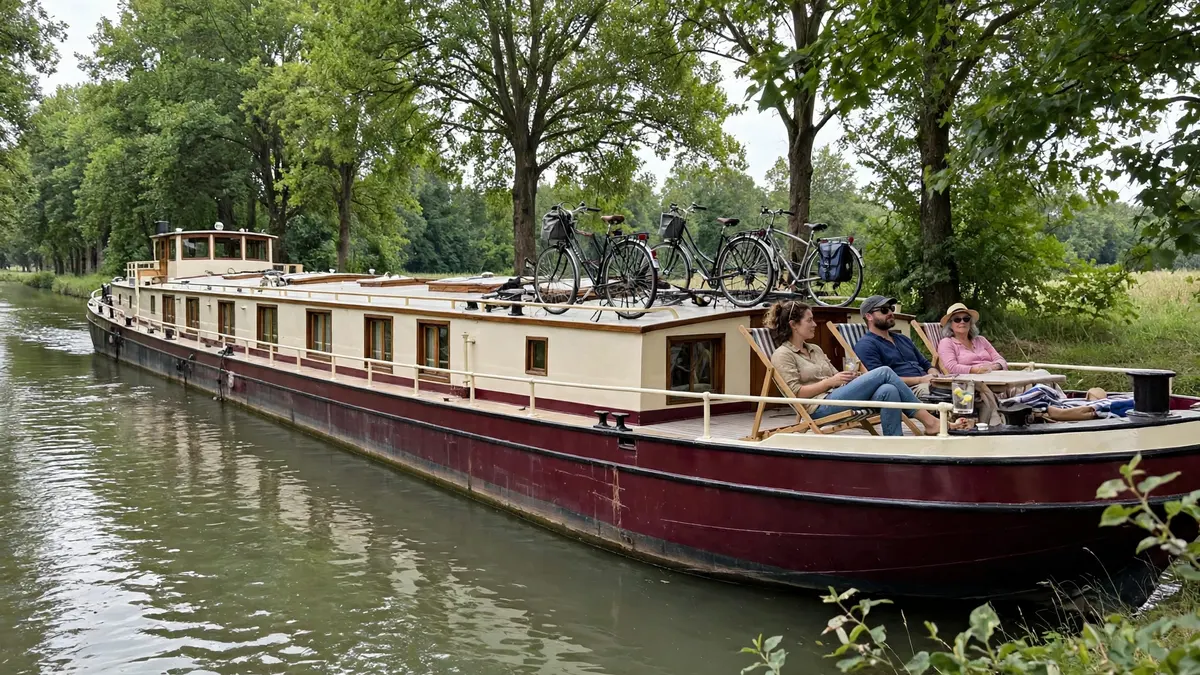
The barge moved so slowly through the canal that a cyclist on the towpath kept pace for half a mile, and nobody on board minded. That is the whole point of a hotel barge. Where a yacht rushes between ports, a luxury barge drifts through French countryside at walking speed, past vineyards and stone villages, six guests on deck, a chef in the galley, a captain who knows every lock keeper. The journey is measured in days and locks, not miles: the boat is a floating hotel that happens to move.
Under the polished wood and linen tablecloths, it is a serious piece of engineering. A barge must fit canals built two centuries ago, pass under bridges with centimetres to spare, turn in a basin barely longer than itself, and carry guests, crew, food and water for a week. The spec sheet is the document that says whether it can do all of that. Read it well and you know which canals it can cruise, which locks it can pass, and how comfortable the week will be. Read it badly and you buy a beautiful boat that cannot get under the first bridge.
What a luxury barge actually is
A luxury barge is usually a converted cargo barge or a purpose-built hotel barge, 30 to 40 metres long, carrying four to twelve guests with a crew of three or four. The best-known grounds are the canals of Burgundy, the Canal du Midi and the waterways of Holland and Belgium, where locks, tunnels and low bridges set hard limits. Everything about the boat — length, width, draught, wheelhouse height — is a negotiation with infrastructure laid down before the steam engine.
Life aboard runs on a different rhythm. The boat cruises a few hours in the morning, ties up for lunch, cruises again in the afternoon, then moors for the night, often in a village with no marina. Guests cycle the towpaths, visit markets and vineyards, and return to a boat that has moved on to the next mooring. It is a story of tiny scale: a hotel for six needs a chef, a captain, a host and a deckhand, all living aboard for the season. The luxury barge and why it costs so much starts with that crew, and the spec sheet is where their working conditions are written down.
How a luxury barge is made
Step 1 — The hull is shaped for shallow canals. A barge hull is flat-bottomed with a shallow draught, often under 1.5 metres, so it floats in canals where a yacht would ground. Steel plates run five to eight millimetres thick, because canal walls, lock gates and stone piers are unforgiving. New builds are welded in a yard; conversions start with an old cargo hull, surveyed and replated where needed.
Step 2 — The engine and steering go in. A single diesel of 150 to 300 horsepower is typical, driving one propeller. Speed is not the goal — four knots is plenty — so the engine is chosen for quiet running and economy. Many barges add a bow thruster, a small propeller in a tunnel at the bow that pushes the boat sideways in a tight basin.
Step 3 — Tanks and services are fitted. Fresh water, fuel, grey water and black water tanks are sized for a week away from a marina. A generator powers the galley, air conditioning and cabins, and a water maker or large tankage keeps the showers running. Everything is plumbed and wired for maintenance, because the nearest engineer may be a day’s cruise away.
Step 4 — The wheelhouse is built to fold or lower. This is the barge’s signature trick. The wheelhouse, the boat’s highest point, is often mounted on hydraulics so it can sink into the deck to pass under a low bridge, then rise again. The same goes for chimneys, masts and railings: anything above the cabin roof folds flat.
Step 5 — The hotel interior is fitted out. Cabins match a good boutique hotel: proper beds, en suite bathrooms, air conditioning, sound insulation and storage for a week’s luggage. The saloon gets a dining table for all guests, a small library and a bar, and the galley is fitted for a chef cooking three meals a day. Joinery is solid wood, and every fitting is chosen to survive vibration and damp.
Step 6 — Trials on the real canal. Before the season the barge runs its home waterway: locks, tunnels, low bridges and tight turns, checking draught, air draught and handling at every step. The figures that survive go on the spec sheet — and the captain relies on them all season.

Reading the spec sheet
| Specification | Typical figure | What it means |
|---|---|---|
| Length overall | 30–40 metres | Which locks and moorings it fits |
| Beam | 4–5.5 metres | Decides which canals it can enter |
| Draught | 1.2–1.6 metres | How shallow the water can be |
| Air draught | 2.8–3.5 metres | Height above water; decides the bridges |
| Engine | 150–300 hp diesel | Power for four knots, quietly |
| Guests and crew | 4–12 guests, 3–4 crew | Hotel scale and service ratio |
| Water and fuel | 5,000–10,000 litres water | A week away from a marina |
| Hull material | Steel, 5–8 mm plate | Built to touch lock walls |
The number that catches first-time buyers is air draught — height from the waterline to the highest fixed point. Length and beam are obvious, but a barge ten centimetres too tall cannot pass a bridge, and no money fixes that on the day. Check whether air draught is measured with the wheelhouse raised or lowered, and whether chimneys and rails are included. The second trap is summer draught: canals run low in a dry August, and a boat that floats in May can touch bottom in September.
What it costs
A new purpose-built luxury hotel barge typically costs an estimated $1.5 million to $6 million, depending on size, cabins and fit-out. A converted cargo hull with a modest interior sits near the lower end; a new-build with six en suite cabins, a chef’s galley and a hydraulic wheelhouse reaches the top. A week’s charter runs to tens of thousands of dollars, covering crew, food, wine and fuel — the boat is hotel, restaurant and transport in one. Reading a luxury paddle steamer’s specs shows the same logic on a grander river scale: on inland waterways, the infrastructure decides the boat, not the other way round.

A rare fact
Some hotel barges still carry the original cargo hold doors of the working boats they were converted from — heavy steel hatches that once covered holds of grain or coal, now decking over the cabins below. The wheelhouse trick has an older cousin: on the Canal du Midi the earliest barges were pulled by horses, and their towpaths are still there, now cycled by guests while the boat putters along below. A luxury electric yacht may be quieter and cleaner, but no yacht has ever folded itself flat to get under a bridge.
A luxury barge’s spec sheet looks modest next to a superyacht’s: a few metres here, a few hundred horsepower there, no speeds worth boasting about. But every number is a limit set by a canal dug by hand two hundred years ago, and the boats that respect those limits are the ones still cruising. The sheet does not describe a fast boat or a big boat. It describes a boat that fits — and on a canal, fitting is everything.