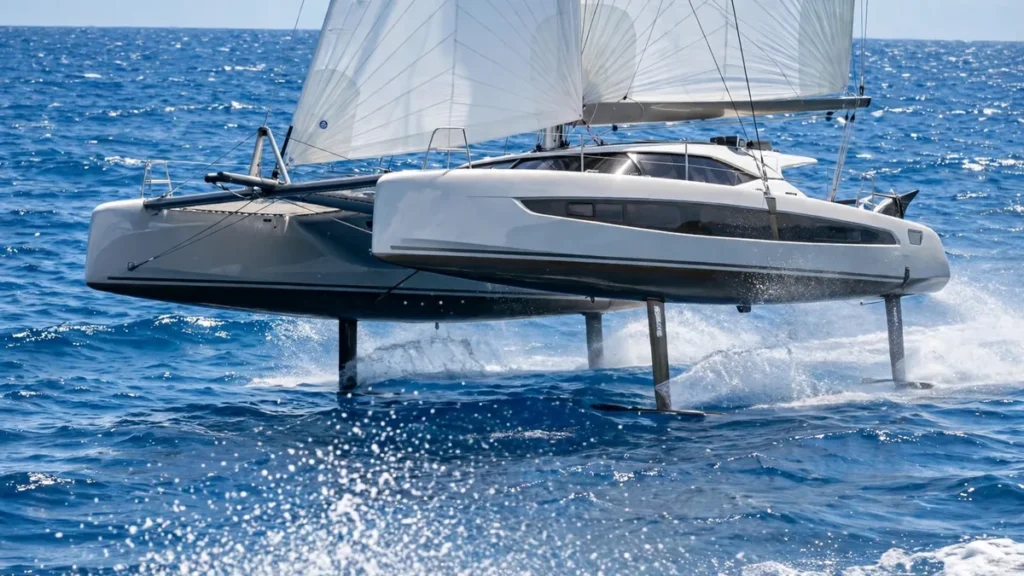
From the shore it looks impossible. A catamaran the size of a small house is skimming across the bay, both hulls clear of the water, held up by nothing visible at all. There is no roar, no bow wave, no spray tearing off the bows. The boat simply flies, a few feet above the sea, as calm as a train on a track.
That moment is the payoff for months of work that looks nothing like ordinary boatbuilding. A foiling catamaran is not a normal catamaran with foils bolted on. Every part of it is designed around one idea: the boat should spend as little time as possible touching the water. This is how a luxury foiling catamaran is made, from the first sheet of carbon to the day it lifts off.
Step 1: Designing a Boat That Wants to Fly
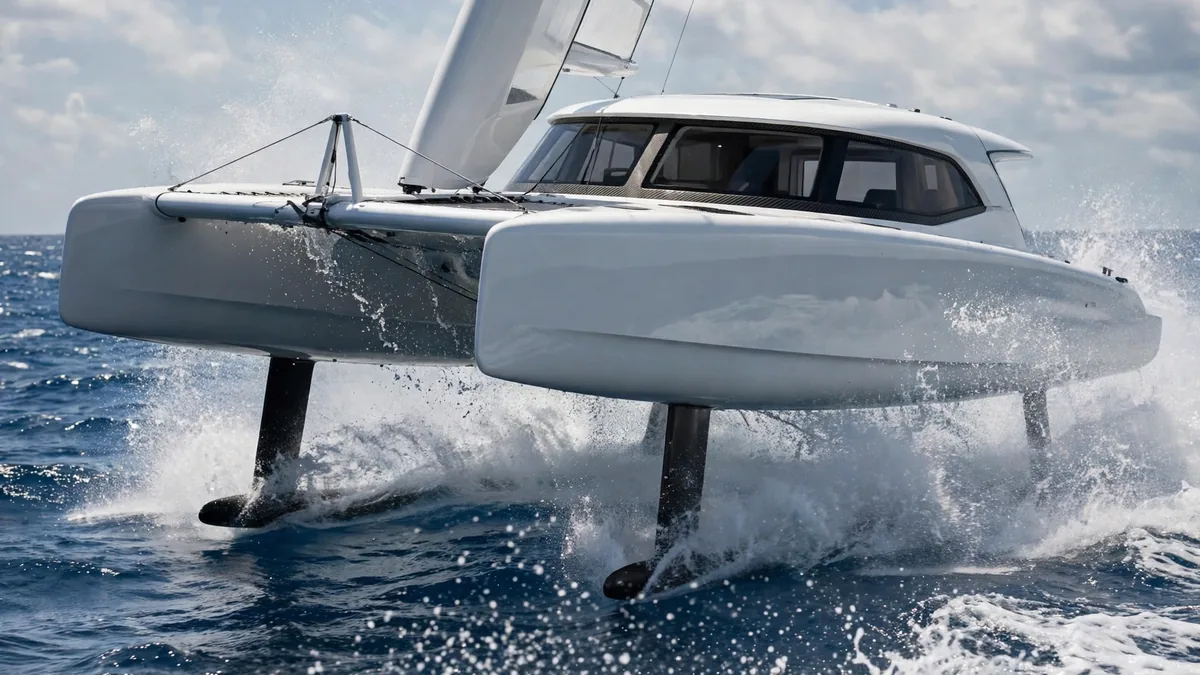
Everything starts on a computer, long before anyone touches a tool. Naval architects model the two hulls, the crossbeam that joins them, and the foils that will carry the whole weight of the boat. The team runs hundreds of simulations, changing the foil shape by millimetres and watching how the lift changes. The balance they chase is a boat that takes off smoothly and stays level without the crew fighting the helm. For a sense of how the finished numbers read, the specifications of a luxury foiling catamaran show what all that simulation turns into on the water.
Step 2: Laying Up the Carbon Hulls
The two hulls are built in moulds, layer by layer, from carbon fibre cloth and epoxy resin. Workers cut the cloth to patterns, lay it into the mould, and wet it out with resin before a vacuum bag squeezes out the air and the whole thing is cured with heat. Carbon is chosen because a foiling boat lives or dies by its weight: every kilogram saved is a kilogram the foils do not have to lift. The hulls also get a foam core between carbon skins, which makes them stiff without adding much mass. When the hulls come out of their moulds they are pale grey, rough at the edges, and surprisingly light.
Step 3: Building the Foils
The foils are the most precise parts on the whole boat, and they are built like aircraft wings rather than boat parts. Each foil is laid up from carbon in its own mould, with the fibre running in carefully planned directions so the foil is stiff where it bends and strong where it twists. The surface is faired to a mirror smoothness, because even a small bump creates drag that slows the boat and can make it shudder. Two main foils sit under the hulls, and a smaller foil at the back keeps the boat level, like the tail of an aeroplane.
Step 4: Joining the Hulls and Fitting the Crossbeam
With the hulls cured, the yard cranes them into a cradle and sets them at exactly the right distance apart. The crossbeam, a wide carbon structure that carries the cabin and the mast, is lowered between them and bonded into place. This is a slow, careful job: the beam must sit perfectly square, or the foils on one side will fly at a different angle from the foils on the other, and the boat will never trim level. The joints are bonded with structural adhesive and wrapped in extra carbon until the whole platform is one rigid shape. By the end of this step the boat finally looks like a catamaran, even though it still sits on cradles in the shed.
Step 5: Installing the Foil Controls
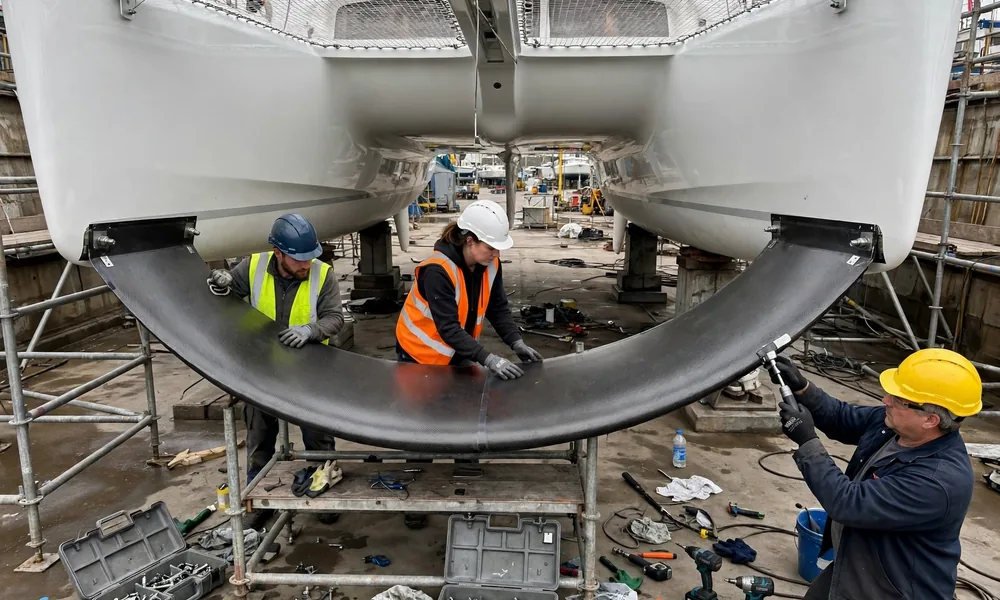
A foiling catamaran cannot be steered by feel alone, so the build includes a control system that constantly adjusts the foils. Sensors measure the height of each hull above the water and the angle of the boat, and small hydraulic rams tilt the foils a fraction of a degree at a time to keep everything level. The crew sets a target ride height on a display at the helm, and the system holds it there through gusts and waves. The hydraulics run on electric pumps fed by the battery bank, with a manual backup so the foils can be raised or lowered by hand if the power fails.
Step 6: Fitting Out the Luxury Interior
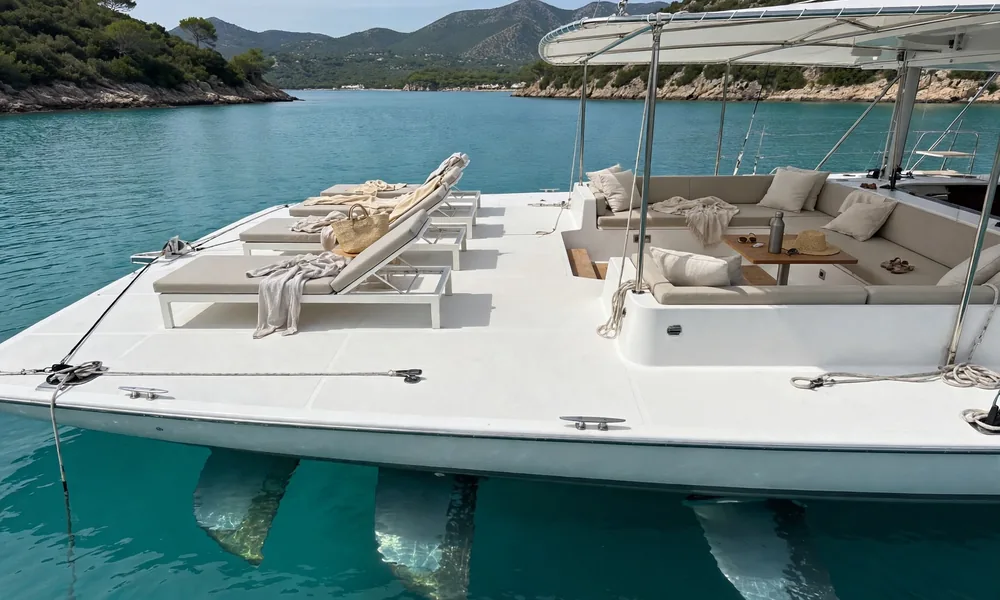
Only now does the boat start to look luxurious. The interior of a foiling catamaran is a puzzle: it must feel like a floating apartment, but it must also be light, because weight is the enemy of flight. The yard uses pale woods, thin stone veneers, and foam-cored panels that look solid and weigh almost nothing. The saloon gets a low table, soft seating, and windows that run almost to the deck so the sea is always in view. The cabins are fitted with real beds, not bunks, and a galley with a proper stove and fridge. The build of a conventional boat makes a useful comparison, and how a luxury catamaran is made shows how much of that craft carries over here.
Step 7: Sea Trials and the First Flight
Launch day is only the halfway point. The boat is towed to open water, the foils are lowered, and the crew begins the slow process of sea trials. First they sail it as an ordinary catamaran, checking the engines, the steering, and the rig. Then, on a calm morning, they push the speed up and watch the ride height. The moment the hulls break clear of the water is unmistakable: the noise drops, the motion smooths out, and the speed jumps. Only when the boat takes off cleanly, flies steadily, and lands softly does the yard sign it off.
| Specification | Typical figure |
|---|---|
| Length overall | 14 to 18 metres |
| Beam | 7 to 8.5 metres |
| Hull material | Carbon fibre with foam core |
| Foils | Two main foils plus rear stabiliser |
| Take-off speed | Around 12 to 15 knots |
| Cruising speed foiling | 20 to 28 knots |
| Cabins | 3 to 4 double cabins |
| Build time | 12 to 18 months |
What One Costs
A luxury foiling catamaran is priced like the specialist machine it is. As an estimate, a new build of this size typically costs between two and five million dollars, depending on the length, the level of interior finish, and how much of the foil system is automated. The foils and their controls are a large part of that price, as is the carbon construction, which takes far more labour than a fibreglass hull.
A Rare Fact
Here is something few people know: the first thing a foiling catamaran does when it takes off is get quieter, not louder. The slap and hiss of water against the hulls disappears in a second, and the only sound left is the wind and a faint hum from the foil controls. To see how the rest of the system behaves once the boat is flying, how a luxury catamaran works is a good next read, because the sailing and steering ideas underneath are closely related.
Building a luxury foiling catamaran is really two crafts in one: the quiet, careful work of a carbon boatyard, and the precise, almost aviation-like discipline of foil engineering. When both are done well, the result is a boat that does something no ordinary catamaran can. It leaves the water behind, and it takes its crew with it.