Watch a foiling yacht at full speed and the first thing you notice is what is missing. There is no hull in the water at all. The boat hangs in the air, a metre or so above the waves, held up by two thin blades and a rudder foil, and only a small part of it still touches the sea. The sails are full, the crew is leaning out, and the boat is moving faster than any ordinary yacht could, because it has stopped sailing through the water and started flying above it.
This is how a luxury foiling yacht works, from the first push through the water to take-off, the balancing act that keeps it in the air, the steering, and the landing when the wind drops.

Step 1: It starts like an ordinary yacht
A foiling yacht begins every sail the same way as any other yacht: the sails go up, the crew sheets in, and the boat moves through the water on its hull. The crew watches the speed, not the foils, because everything that follows depends on going fast enough. For a plain definition of the boat itself, the guide to what a foiling yacht is sets out the parts and the idea behind them.
Step 2: Speed builds lift on the foils
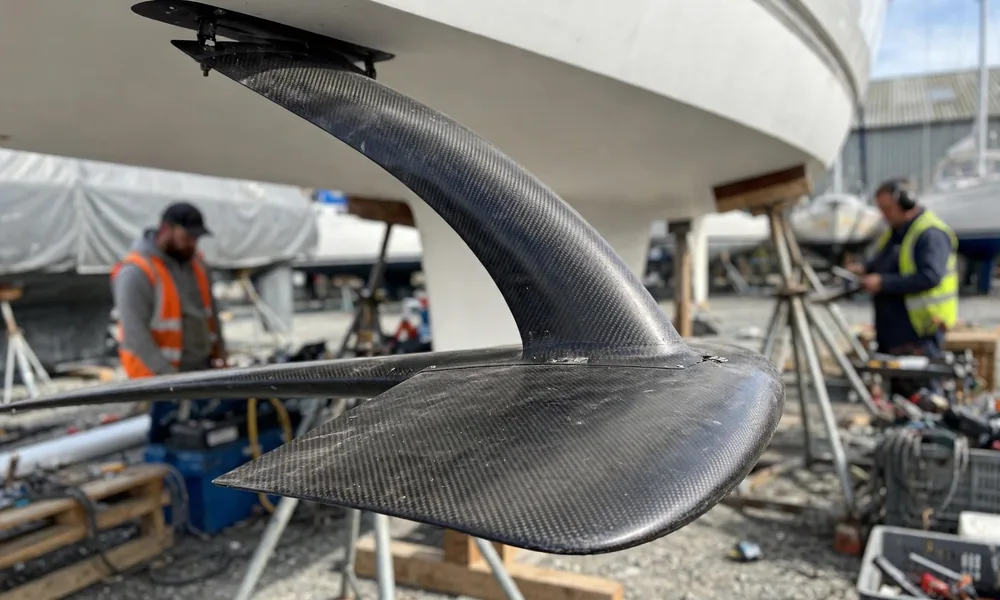
As the wind fills the sails and the boat accelerates, the water flowing over the foils starts to do its work. A foil is shaped like an aeroplane wing, flat on top and curved underneath, and as water rushes over it, the pressure above the foil drops and the pressure below it rises, pushing the foil upwards. The faster the boat goes, the stronger the lift, and at a certain speed, usually around 12 to 15 knots, the lift from the foils equals the weight of the boat. At that moment, the hull starts to rise.
Step 3: Take-off, the hull leaves the water
Take-off is the moment the whole boat changes. As the speed climbs past the tipping point, the hull rises clear of the water in a few seconds, and suddenly the drag that was holding the boat back almost disappears. With only the thin foils and the rudder still in the water, the boat accelerates hard, often to twice the speed it had a moment before. The numbers behind that speed are a subject of their own, and the guide to luxury racing yacht specs, explained sets out what the figures mean for a boat built to fly.
Step 4: The ride is balanced by sensors and flaps
Staying in the air is harder than getting there. The height of the boat above the water is controlled by small flaps on the foils, like the flaps on an aeroplane wing, and on luxury yachts those flaps are adjusted constantly, either by the crew or by a computer reading sensors. A sensor on the rudder measures the height of the hull above the water many times a second, and if the boat rises too high, the flap changes angle to reduce the lift; if it sinks too low, the flap adds lift.
Step 5: Steering and turning in the air
Steering a foiling yacht is a different skill from steering an ordinary one. The rudder still turns the boat, but the foils respond to heel, the lean of the boat, as much as to the rudder: lean the boat one way and the foils pull it in that direction, so the crew steers partly by shifting their weight and partly by trimming the sails. Good crews tack in a wide, smooth arc, keeping the speed up and the foils flying, and they practise the turn hundreds of times before it becomes reliable.
Step 6: Landing and slowing down
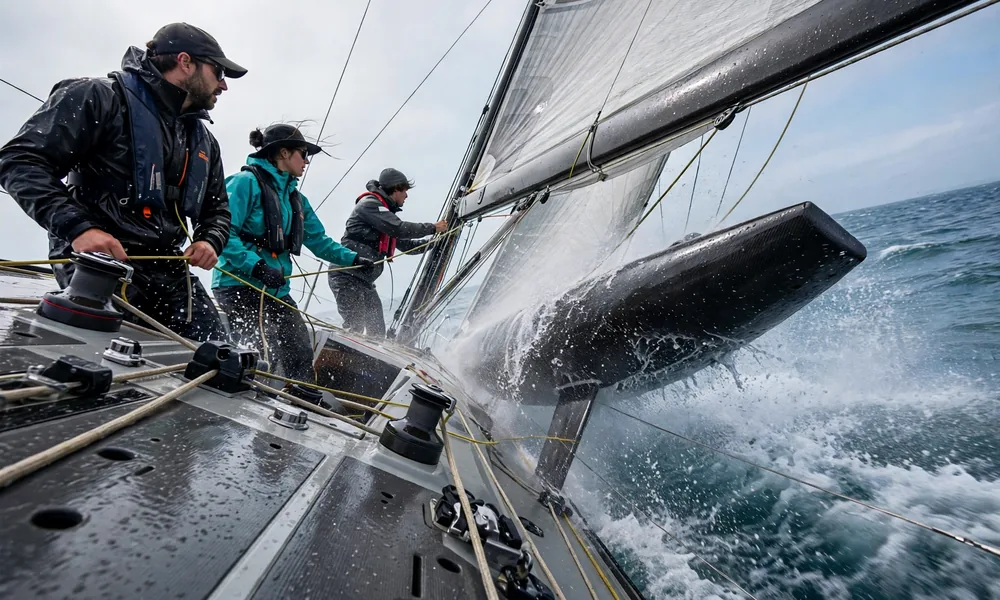
Every flight ends with a landing. When the wind drops or the crew wants to slow down, they ease the sails, the speed falls, and the lift from the foils fades. The hull settles back onto the water gently if the crew does it well, or with a slap if the speed drops too fast. The price of this flying machine is a story of its own, and the guide to why a luxury hydrofoil yacht is so expensive sets out where the money goes, from the carbon foils to the computers that balance the ride.
The spec sheet at a glance
| Specification | Typical luxury figure | What it tells you |
|---|---|---|
| Take-off speed | 12–15 knots | How fast it must go before it flies |
| Top speed | 35–50 knots | How fast it flies once airborne |
| Foils | Carbon fibre, two plus rudder foil | What lifts the hull out of the water |
| Flight height | 0.5–1.5 metres | How high the hull rides above the sea |
| Hull | Carbon fibre monohull or catamaran | How light and stiff the boat is |
| Control | Flaps plus ride-height sensors | How the flight is kept level |
| Crew | 4–8 sailors | How many hands it takes to fly it |
| Sail area | 150–300 square metres | How much wind power it carries |
| Weight | 6–12 tonnes | How much the foils must lift |
Keeping it in good shape
A foiling yacht is looked after like an aircraft, not a boat. The foils are inspected after every sail for chips and cracks, since a damaged foil can fail under load, and they are polished smooth, because a rough foil creates drag and loses lift. The flap mechanisms are checked for play, the sensors are cleaned and tested, and the rig is inspected for wear, since the loads on a foiling yacht are far higher than on an ordinary boat. A foiling yacht that is not maintained does not just go slower: it stops flying safely.
What it costs
A luxury foiling yacht typically costs an estimated $2 million to $15 million, depending on its size, its foils and whether the flight controls are manual or computer-assisted. The estimate covers the yacht alone, not the crew, the berth or the maintenance. The price is mostly in the foils and the control system: the carbon wings must be built to aircraft tolerances, and the sensors and flaps that keep the boat in the air cost as much as a small house.
A rare fact
One detail few sailors ever learn is that the hydrofoil is more than a century old. In 1906, an Italian inventor named Enrico Forlanini built a small boat with underwater wings and drove it across Lake Maggiore at about 68 kilometres per hour, faster than any boat of its day. The idea then waited almost a hundred years for carbon fibre, computers and light enough hulls to catch up with it. The foiling yachts flying across the sea today are using an idea from 1906, finally built with materials its inventor could only have dreamed of.
From the first push through the water to the moment the hull leaves the sea, a luxury foiling yacht works by turning speed into lift, and lift into flight. It is sailing, but with the water left behind.


