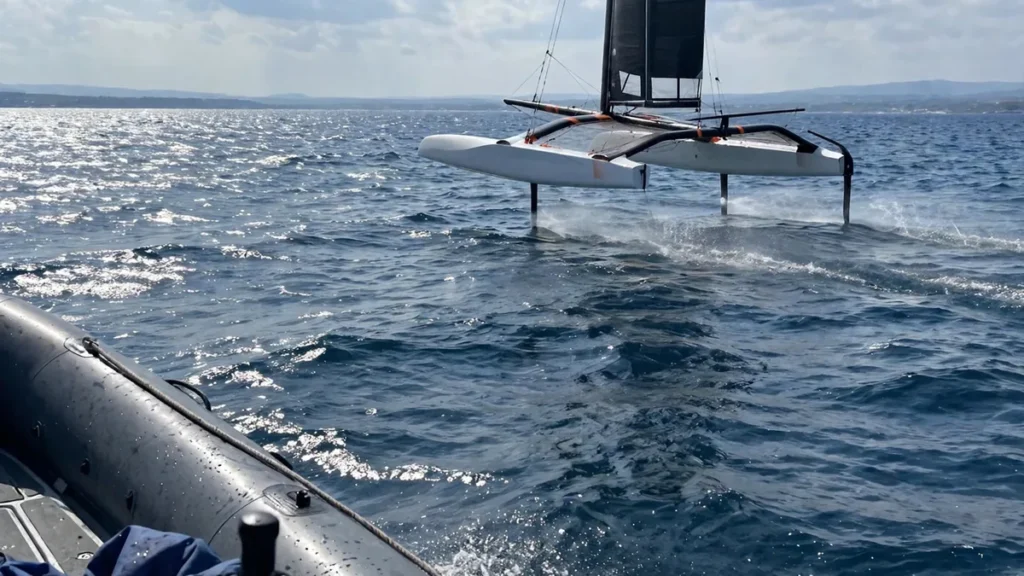
A foiling yacht does not sail through the water the way an ordinary yacht does. Once it reaches a certain speed, underwater wings called hydrofoils lift the hull clear of the surface, and the boat flies a metre or so above the waves, held up by two thin blades and a rudder foil. Only a small part of the boat still touches the water, so drag falls away: the fastest racing foilers now sail at more than 50 knots, roughly 93 kilometres per hour.

What a Foiling Yacht Actually Is
A foiling yacht is a sailing yacht fitted with hydrofoils, shaped underwater wings that generate lift as water flows over them. At low speed the boat behaves like a normal yacht, floating on its hull. As speed builds, the foils start to work, and at a speed known as take-off the lift they produce equals the weight of the boat. From that point the hull rises out of the water.
The idea is old: hydrofoils were tested on boats more than a century ago. What changed was materials and control: carbon fibre made foils strong and light enough to carry a whole yacht, and fast sensors and hydraulics made it possible to balance a boat on them. Foiling reached the top of the sport in 2013, when the America’s Cup was raced in foiling catamarans, and in 2021, when the Cup moved to foiling monohulls.
How a Hydrofoil Makes Lift
A hydrofoil works like an aeroplane wing, but in water instead of air. Its upper surface is curved and its lower surface flatter, so water flowing over it creates lower pressure above and higher pressure below, pushing the foil upward. Lift rises with the square of speed, so doubling the speed makes roughly four times the lift.
Water is about 800 times denser than air, which is both the advantage and the problem. A small wing can lift a heavy boat, which is why a foil the size of a dining table can hold up a yacht weighing several tonnes. The same density means drag is fierce when the foil is not shaped well, so foils are carefully designed and polished. Designers also fit flaps, small hinged surfaces on the trailing edge that add lift for take-off and trim drag at top speed.
The Parts of a Foiling System
A modern foiling monohull, such as an America’s Cup yacht, carries two foil arms, one on each side of the hull. Each arm ends in a T-shaped wing: a horizontal foil with a flap, mounted on a vertical strut. The arms pivot, or cant, so the windward foil can be lifted clear while the leeward foil does the work. The raised foil is not dead weight: its mass, more than a tonne on a Cup yacht, hangs out to windward as ballast.
The rudder carries its own small foil, an inverted T at the bottom of the rudder blade. Together the main foil and the rudder foil form a stable pair: the main foil carries most of the weight and the rudder foil trims the pitch, the nose-up or nose-down angle of the boat. Foils are built from high-strength carbon fibre, stiff in bending but able to twist slightly under load, which helps shed gusts.

Flight Control: Staying in the Air
Flying a yacht is a balancing act. Height above the water is the first thing to control. Fly too high and the foil breaks the surface, loses lift, and the boat drops back down in a crash known as a touchdown. Fly too low and the hull touches the waves, drag spikes, and speed falls away. The sweet spot is a ride height of roughly a metre.
On a racing foiler a dedicated flight controller watches ride height, pitch, and speed on displays fed by sensors, and adjusts the flap on the active foil to add or remove lift. Power comes from the crew, since Cup rules forbid engines during racing, so grinders turning hand cranks generate the hydraulic pressure that moves the foils. Turning is the hardest part: in a tack or a gybe the boat must swap which foil is in the water, and good teams keep flying through the turn while weaker ones splash down.
The America’s Cup and the AC75
The clearest example of a foiling yacht is the AC75, the class used for the America’s Cup since 2021. It is a 75-foot, or 22.9-metre, monohull weighing about 6.5 tonnes, with two canting T-foils and a twin-skin mainsail. In the 2024 Cup in Barcelona, the second-generation AC75s regularly sailed above 50 knots, with crews of eight.
The AC75 is a development class within tight rules: the foil arms are one-design parts supplied identically to every team, while the foil wings are open to design. The boats carry no keel: the foils provide both lift and righting moment, the force that keeps the boat upright. Foiling is not confined to the Cup: the IMOCA 60 ocean racers of the Vendée Globe carry foils, and Olympic sailing has foiling classes including the Nacra 17.
How Fast, and Why Not Faster
A conventional racing monohull might sail at 12 to 15 knots. A foiling catamaran of the previous Cup generation reached about 45 knots, and an AC75 has passed 50 knots. On a fast reach it can sail at three to four times the true wind speed, because the apparent wind swings forward as the boat accelerates.
The gains come from removing the hull from the water. A displacement hull pushing through water makes waves, and wave-making drag rises steeply with speed; it is the wall that limits ordinary boats. A foiling hull makes almost no waves, because only the thin foils and the rudder are in the water. Still, the rig can only take so much load, and in big waves a foiler must fly high enough to clear the crests.
Foiling Beyond Racing
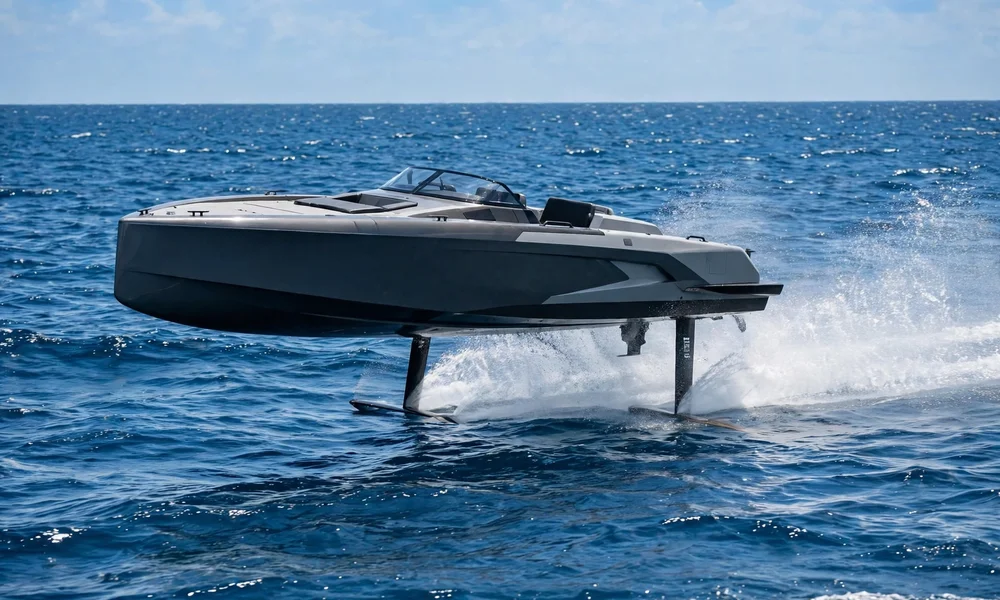
Foiling is moving beyond grand-prix racing, and the most important step is electric foiling. Builders such as Candela in Sweden fit computer-controlled foils to electric dayboats, lifting the hull clear at about 16 knots and cutting energy use by roughly 80 percent compared with a planing hull. Foiling electric ferries now carry passengers in regular service. How the power behind these boats works is covered in our explainer on how electric yacht propulsion works, and the ferry version is shown in how an electric hydrofoil ferry is made.
The same physics helps yachts that will never race: foil-assisted cruisers use smaller foils to lift part of the weight, reduce pitching, and add speed without full flight. But foiling has limits: a foiling yacht needs depth for its foils, speed to take off, and maintenance, since foils are precision parts that do not tolerate grounding or neglect.
What to Remember
A foiling yacht is a sailing yacht that flies. Underwater wings lift the hull out of the water once the boat is fast enough, drag falls away, and speed climbs to levels no ordinary hull can reach. The AC75 shows the idea at its most extreme, at more than 50 knots, while electric foiling boats show it at its most useful, turning the same lift into range and silence. For a sense of where foiling sits among the boats it is replacing, our ranking of the best sailing yacht brands shows how much of the traditional fleet still sails the old way.