A Formula 1 car is the fastest racing machine on earth, and it is also one of the most exclusive objects ever made. Only twenty are on the grid, each one the product of hundreds of people and thousands of hours of work. It can accelerate faster than a falling stone, brake harder than a fighter jet landing, and corner with forces that would make most people faint. Yet it is built in a workshop, by hand, one carbon fibre layer at a time.
The cost of a single car runs into many millions of dollars, and the rules change every few years, forcing teams to start again from a blank sheet. Here is how a Formula 1 car is made, from the carbon tub that protects the driver to the hybrid power unit that drives it, and why no other vehicle on earth is built quite like it.
How It’s Made
Step 1: The survival cell
At the centre of every Formula 1 car is the survival cell, a carbon fibre tub that holds the driver and must survive impacts that would destroy any road car. It is made by laying hundreds of sheets of carbon fibre into a mould, each one placed by hand in a precise direction, then curing the whole thing in an autoclave under heat and pressure. The finished cell is tested by crashing it into a wall at high speed, and it must stay intact. Around it, crash structures at the front, sides and rear absorb energy in an accident. The driver sits inside this cell, wrapped in padding and held by a six-point harness, in one of the safest seats in motorsport.
Step 2: The hybrid power unit
The engine is a 1.6-litre turbocharged V6, small in size but enormous in power, joined to hybrid systems that recover energy from braking and from the exhaust. Together they produce around 1,000 horsepower, more than most supercars, from an engine smaller than the one in a family hatchback. The power unit is built in a clean room by specialists, with parts machined to tolerances measured in microns. It is tested for hundreds of hours on a dynamometer before it is fitted, because a failure during a race costs the team points, money and pride. The sound it makes is a high, sharp scream, very different from the roar of older Formula 1 engines.
Step 3: Aerodynamics, the invisible bodywork
A Formula 1 car’s shape is decided by the air. The front wing, the floor, the rear wing and even the mirrors are designed to push the car into the road with downforce, so it can corner at speeds that seem impossible. At full speed, a Formula 1 car produces more downforce than its own weight, which means it could, in theory, drive upside down on a ceiling. The bodywork is carbon fibre, made in moulds and finished to a mirror shine, and it is changed constantly: teams bring new wings, floors and ducts to almost every race. The rules limit how much teams can test in wind tunnels, so much of the work is done in computer simulations before a single part is made. The science of airflow on fast cars is explored further in how hypercar active aerodynamics works, which covers the same ideas in road cars.

Step 4: Suspension, brakes and tyres
The suspension is pushrod-operated, with the springs and dampers hidden inside the bodywork to keep the airflow clean. It must cope with huge loads: under braking, the car can slow with forces of more than five times gravity. The brakes are carbon discs that glow orange at the end of a straight and can stop the car from 300 km/h in about four seconds. The tyres are wide slicks, made to grip the track and wear out quickly, with different compounds for different conditions. The whole car weighs around 800 kilograms including the driver, which is lighter than most small hatchbacks.
Step 5: Electronics and the steering wheel
The steering wheel is a small computer, covered in buttons, dials and screens, and it costs more than most family cars. From it, the driver controls the brake balance, the engine modes, the radio and the energy recovery system, all while cornering at speeds that blur the world outside. Hundreds of sensors send data back to the pit wall every second, where engineers watch tyre temperatures, fuel use and engine health. The car’s software is as important as its hardware, and teams employ armies of engineers just to write and test it. A single race generates more data than many companies produce in a year.
Step 6: Assembly, testing and the first run
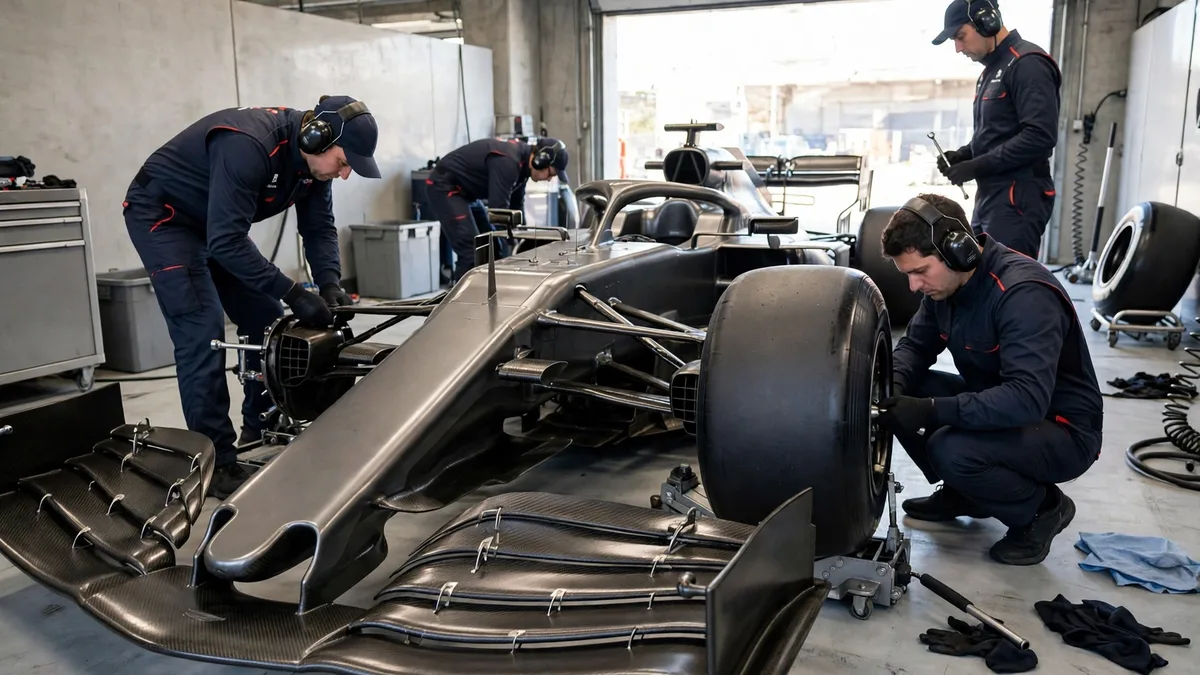
Assembly takes place in a clean, quiet workshop, where the car is built up from thousands of parts, each one checked and recorded. The car is then tested on track, with the driver and engineers working through a long list of checks: aero balance, tyre wear, brake cooling, fuel consumption and reliability. A new car may cover thousands of kilometres in testing before its first race. Even then, it is never finished. Parts are redesigned and replaced through the season, so the car that ends the year is often very different from the one that started it. The figures behind the fastest road cars that borrow this technology are covered in the luxury supercar specs explained guide.
Specifications
| Feature | Typical Formula 1 Car |
|---|---|
| Power unit | 1.6-litre turbo V6 hybrid |
| Power | Around 1,000 horsepower |
| Weight | Around 800 kg including driver |
| 0 to 100 km/h | Around 2.5 seconds |
| Top speed | Around 350 km/h |
| Brakes | Carbon discs, brake-by-wire rear |
| Downforce | More than the car’s own weight at speed |
The Price
A Formula 1 car costs an estimated $12 million to $15 million to build, and a team’s yearly budget runs into hundreds of millions of dollars. The survival cell alone costs hundreds of thousands, the power unit over a million, and a single front wing tens of thousands. Crashes are part of the sport, and a heavy accident can destroy a million dollars of carbon fibre in a second. The cars are never sold to the public, so the price is a matter of team spending rather than a showroom figure, but it makes a Formula 1 car one of the most expensive machines ever built for sport. The stopping power behind these numbers is ranked in the best hypercar brakes ranked guide, which shows how carbon brakes work at the limit.
A Rare Fact
A Formula 1 steering wheel costs an estimated $50,000, more than many new cars, and it takes months to build. It is made from carbon fibre, holds over twenty buttons and dials, and contains a screen that shows the driver everything from lap times to engine temperatures. The driver removes it to climb in and out of the car, and if it is dropped, the cost of the damage can run into thousands. It is probably the most expensive steering wheel in the world, and it is used for only a few hours before being rebuilt.

A Formula 1 car is the purest expression of what engineering can do when money and rules are pushed to the edge. It is built by hand, tested to destruction, and rebuilt constantly, all for a few hours of racing each weekend. No other vehicle combines this much speed, this much science and this much craft in a single machine. It is, quite simply, a jet on four wheels, and it remains the benchmark every other fast car is measured against.