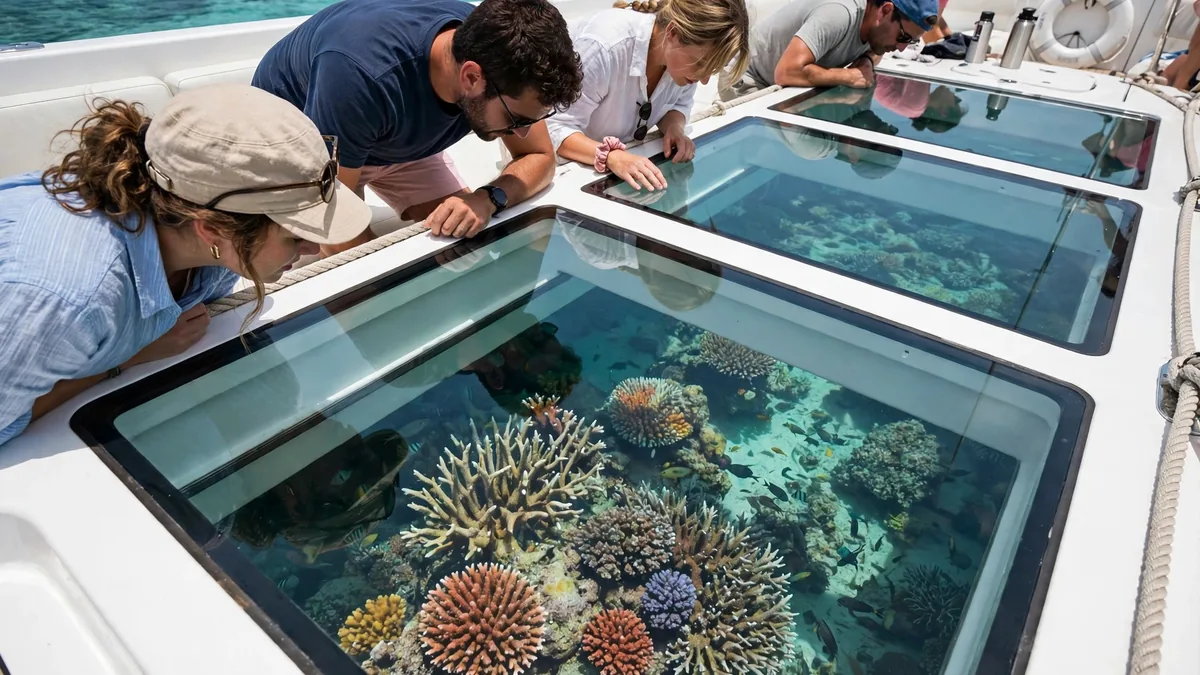
In a clear bay in the tropics, a boat drifts slowly over a coral reef, and the people on board are not looking at the horizon. Nobody on deck is wet, nobody is wearing a mask, and the reef is as close as the floorboards. That quiet trick is the whole point of a glass-bottom boat, and the luxury version turns it into a floating viewing room.
This is how a luxury glass-bottom boat is made, in six steps, from a strong hull to a finished boat that lets a dozen passengers watch the sea without ever getting in it: the hull, the glass panels, the frame that holds them, the seating and shade, the engine and steering, and the testing that proves a boat with a glass floor is still a safe boat. It is a different build from a plain yacht, and the guide to why a luxury glass-bottom boat is so expensive explains why a boat like this costs so much, where the glass alone is the largest single item on the whole vessel.
Step 1: Building a hull with a hole in it
A glass-bottom boat begins with a hull that is designed, from the first drawing, to have a hole in its floor. Watertight compartments are built into the bow and the sides, so that even if the glass were ever damaged, the boat would stay afloat long enough to reach the shore.
Step 2: Making the glass that becomes the floor
The glass is the heart of the boat, and it is not ordinary window glass. The panels are often treated with a coating that resists scratches from sand and shoes, because a viewing window that clouds over in a season is no use to anyone, and the edges are polished smooth so they sit perfectly in their frames.
Step 3: Fitting the glass into its frame
Fitting the glass is the most careful job on the whole build. The panels are lowered into steel or aluminium frames that are bolted through the hull, and the gap between glass and frame is sealed with a flexible marine sealant that stays watertight as the hull bends and flexes in the waves. The frames are shaped so that no sharp edge sticks up into the viewing area, and the panels are set slightly below the deck so that feet and luggage slide over them without catching. Each panel is pressure-tested with water before the boat ever leaves the yard, because a leak around a viewing panel is a leak through the floor, and the builders would rather find it on land than in the middle of a bay. The guide to how a luxury yacht is made follows a larger yacht through a similar yard, where the same care goes into a hull that must carry far more weight and far more people.

Step 4: Seating, shade and a clear view for everyone
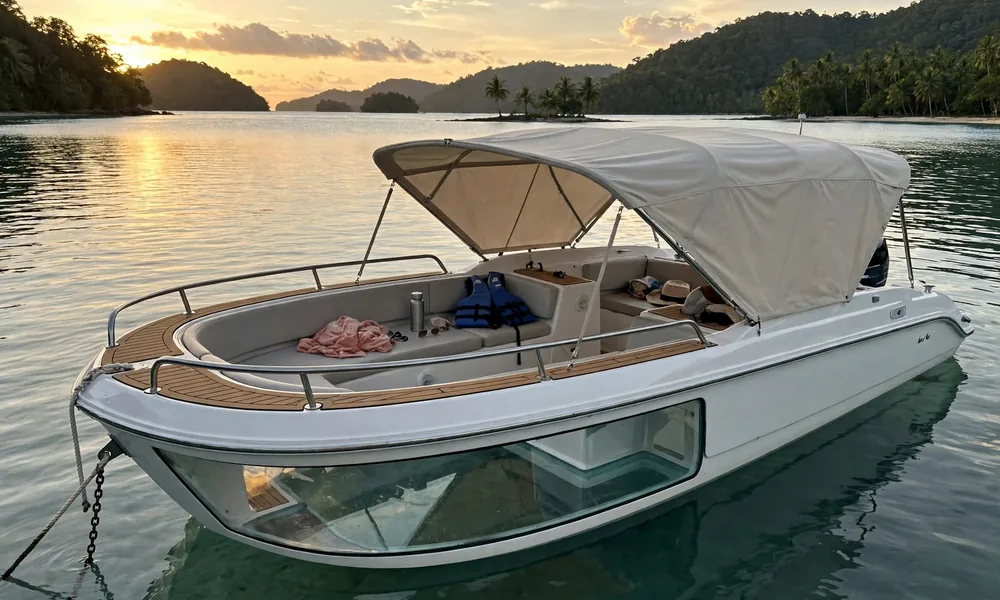
Once the glass is in, the boat is fitted out so that every passenger gets a good view. Handrails are fitted along the sides, non-slip decking is laid around the panels, and a small bar or storage locker is tucked under the seats, because a tour boat that carries families needs somewhere to put bags, cameras and drinks while everyone is looking down.
Step 5: Adding an engine made for drifting
A glass-bottom boat does not need speed, so its engine is chosen for quiet, gentle control rather than power. Most luxury versions carry a single outboard or a small inboard diesel, sized to push the boat at a slow walking pace over the reef and to hold it steady against the wind while passengers watch. The steering is light and precise, because the captain must keep the glass directly over the coral without drifting onto it, and the propeller is often guarded so that it cannot damage the reef if the boat passes over shallow ground. The guide to how a luxury electric boat is made shows how a quiet electric boat is put together, where the same idea of gentle, silent movement is taken even further, with no engine noise at all to scare the fish away.
Step 6: Testing the boat on the reef it was built for
Before it carries its first passengers, the boat is taken out for a long day of testing over the very reef it will work above. Only when the glass stays dry, the boat stays steady and the view stays clear is the boat washed, polished and handed over, ready for its first crowd of watchers.
The glass-bottom boat at a glance
| Part | Typical luxury figure | What it tells you |
|---|---|---|
| Hull | Wide fibreglass or aluminium hull, flat and steady | How stable the boat feels with a full crowd aboard |
| Viewing glass | Laminated toughened panels, several layers thick | How clear the reef looks, and how safe the floor is |
| Frames | Steel or aluminium frames, sealed and bolted through | How watertight the glass stays in rough water |
| Seating | Low benches and swivel seats around the panels | How many passengers get a clear view at once |
| Engine | Single outboard or small diesel, built for slow drifting | How quietly the boat holds its place over the reef |
| Shade | Canopy or hard roof over the viewing deck | How clear the view stays in bright sun |
| Build time | Weeks in the yard, plus a full day of sea trials | How much care goes into each boat |
What it costs
A luxury glass-bottom boat typically costs an estimated $150,000 to $500,000, depending on its length, the size of its viewing panels and the finish of its seating and shade, and the estimate covers the boat alone, not the mooring, the crew or the insurance, which a working tour boat needs before it can carry a single passenger. The glass is the most expensive single part, and replacing a scratched panel costs far more than replacing a broken window at home, which is why the best boats are built with panels that can be lifted out and changed without cutting the hull apart.
A rare fact
One detail few passengers ever learn is that the best glass-bottom boats are deliberately painted white or pale blue below the waterline, because a dark hull throws a shadow onto the reef and scares the fish away before anyone has seen them. The pale paint lets sunlight pass underneath the boat and lights the coral from the sides, so the view through the glass is brighter than the view from the surface, and the reef looks, for a few minutes, like a room with the lights turned on.
Follow the six steps in order, hull first, then glass, frame, seating, engine and testing, and a luxury glass-bottom boat stops looking like a boat with a window in it and starts looking like what it is: a small floating theatre, built around a floor of glass, designed so that people who will never dive can still meet the reef face to face, dry-footed, shaded and safe, while the sea goes about its business just below their shoes.


