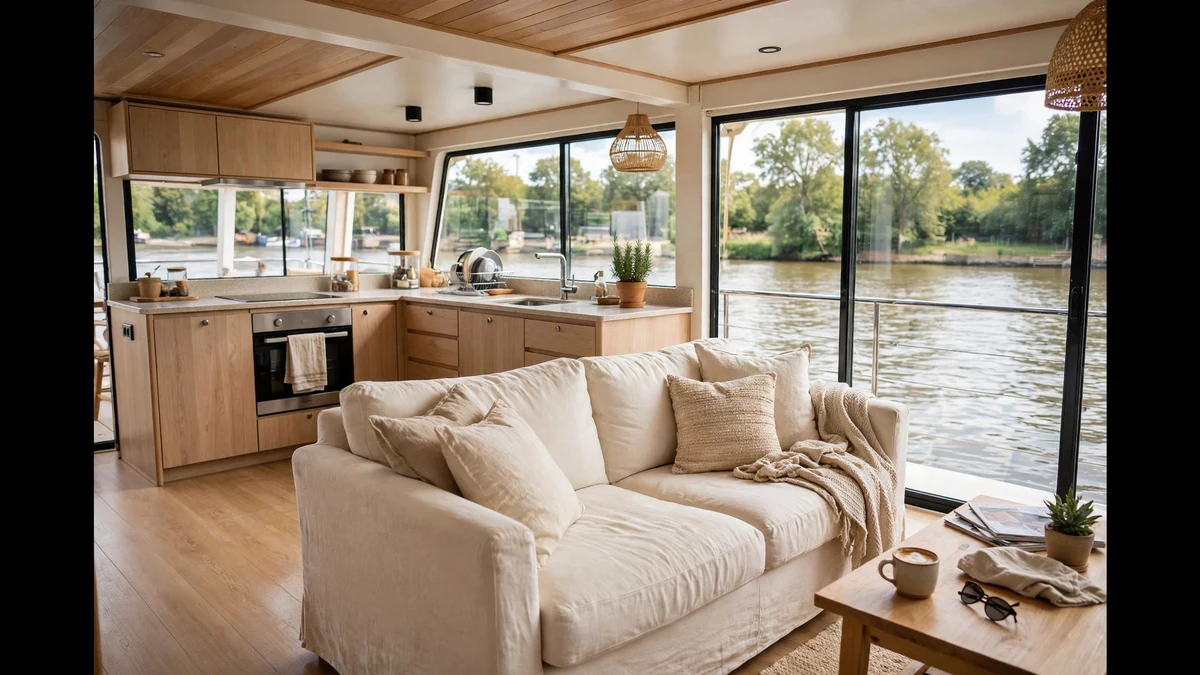
At dawn on a slow river, a luxury houseboat looks less like a boat and more like a house that happens to float. Lights glow behind wide windows, coffee steams on a deck that never moves, and the only hint that this is a vessel at all is the gentle way the whole building rises and falls with the water.
A houseboat is not a yacht with a kitchen. It is a floating home, built to be lived in for months at a time, with full plumbing, heating, and power, yet it must also survive wind, current, and the occasional storm.
This is how a luxury houseboat is made, from the steel hull that keeps it afloat to the finished rooms that make it feel like home.
How a Luxury Houseboat Is Made
A luxury houseboat is built in six main stages: the hull is fabricated, the superstructure is raised, the interior is fitted out, the engines and steering are installed, the water and power systems are connected, and the boat is launched and tested.
Step 1: Fabricating the hull
Most luxury houseboats sit on a steel or aluminium hull, welded from plate in a yard much like a small ship. Steel is heavy and strong, and it takes knocks from debris and mooring walls without complaint; aluminium is lighter, resists rust, and costs more. The plates are cut to shape, rolled to the curve of the hull, and welded seam by seam, then the inside is painted with protective coatings and the outside with antifouling paint. The aluminium used above the waterline on the largest yachts follows the same craft, as described in how a superyacht aluminium superstructure works, where light metal is shaped into living space.
Step 2: Raising the superstructure
On top of the hull, the builders raise the superstructure, the box of rooms that makes the houseboat a home. It is usually a welded steel or aluminium frame clad in panels, with large windows set into the sides so the saloon and bedrooms look out over the water. Insulation goes in before the cladding is closed, because a houseboat must stay warm in winter and cool in summer, and the river offers no shelter from either. The shape is a compromise between a house and a boat: tall enough to stand in comfortably, low enough to pass under bridges, and narrow enough to fit the locks and moorings it will use.
Step 3: Fitting out the interior
Inside, the houseboat is fitted out like a small apartment. Joiners build the galley, the bedrooms, the bathroom, and the saloon, using marine plywood and solid timber that can cope with damp air and the constant small movement of a floating home. The galley gets a full-size cooker, fridge, and worktops; the bathroom gets a proper shower and a flushing toilet connected to a holding tank; the bedrooms get wardrobes, reading lights, and storage under the beds. Nothing is rushed: a luxury fit-out takes months, and the difference from a basic houseboat is visible in every joint, hinge, and handle.
Step 4: Engines and steering
A luxury houseboat does not need speed, but it needs reliable propulsion. Most use a single diesel engine of 50 to 150 horsepower, driving a propeller through a shaft, with a bow thruster at the front that lets the skipper push the bow sideways into a tight mooring. Some newer houseboats use electric propulsion, with a battery bank charged from shore power or solar panels, and the motor that drives them works on the same principles explained in how an electric boat motor works, where a battery, a controller, and a propeller replace the diesel entirely. Steering is usually a wheel in a small wheelhouse or on the aft deck, connected to the rudder by cables or hydraulics.
Step 5: Water, power, and waste
A houseboat that cannot make its own water and power is tied to the shore, so the systems matter as much as the rooms. Fresh water comes from a large tank, filled at a marina tap or made aboard by a watermaker, and a pump pressurises it to every tap and shower. Power comes from shore hook-up, solar panels on the roof, a generator, and a bank of batteries with an inverter that turns battery power into mains electricity. Heating is usually a diesel stove or a central heating boiler, with radiators in every room. Waste goes to a holding tank that is pumped out at a marina, and the plumbing is fitted with filters and vents so the boat never smells of its own drains.
Step 6: Launch, mooring, and testing
When the build is finished, the houseboat is lifted by crane or rolled down a slipway into the water for the first time. The builders watch the waterline carefully: the boat must sit level, with the right amount of hull below the water and the right amount above. Then comes the mooring test, which is where the ground tackle earns its keep, and the same principles that hold a yacht in place are explained in how a yacht anchor system works, where weight, chain, and holding power decide whether a boat stays put. The engine is tested at cruising speed, the bow thruster is tried in a tight turn, and every tap, light, and appliance is switched on at once to prove the power system can cope. Only after a night aboard, with the heating on and the water running, does the yard hand the keys over.
Luxury Houseboat Specifications
| Specification | Typical figure |
|---|---|
| Length overall | 15 to 24 metres |
| Beam | 3.5 to 5 metres |
| Hull material | Steel or aluminium |
| Displacement | 20 to 60 tonnes |
| Engine | 50 to 150 horsepower diesel |
| Fresh water | 600 to 1,500 litres |
| Fuel | 400 to 1,000 litres |
| Berths | 4 to 8 |
| Build time | 8 to 14 months |
What Does a Luxury Houseboat Cost?
A luxury houseboat is priced by length, hull material, and the quality of the fit-out. A 15-metre steel houseboat with a good interior typically costs an estimated $400,000 to $900,000, while a 20 to 24-metre aluminium build with a full luxury fit-out typically costs an estimated $1.2 million to $2.5 million. Mooring fees are the largest running cost, typically an estimated $10,000 to $40,000 a year depending on the river and the city, with insurance, maintenance, and heating adding an estimated $15,000 to $30,000 a year.
A Rare Fact About Luxury Houseboats
Here is the detail most people miss: a luxury houseboat is legally a boat, not a house, even when it never leaves its mooring. That means it is not covered by ordinary house insurance or building regulations, and its owner pays no council tax or property tax on it in most places, but also has none of a homeowner’s legal protections if the mooring is taken away. The houseboat is a home that can be towed away, and that strange legal halfway-house is exactly why people love it: it is a home with an escape route built in.
A luxury houseboat is a contradiction that works: a house that floats, a boat that never hurries, a home that can move to a new view whenever its owner feels like it. It is built slowly, by people who understand both houses and boats, and it rewards that patience every morning, when the owner wakes to a different reflection on the ceiling and the same quiet water outside the window. The river does the decorating. The builders just had to make sure the house would stay afloat long enough to enjoy it.


