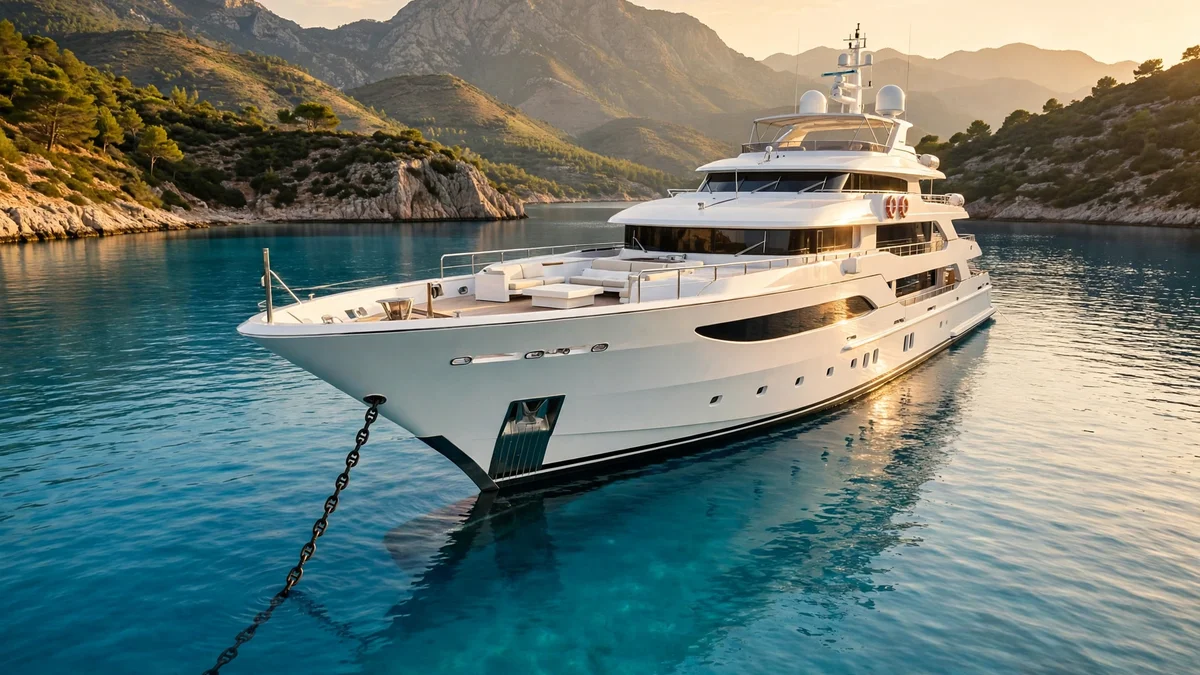
The sun is going down over the bay, and the yacht is not moving. That is the whole point. Around it, the water is turning gold and other boats are swinging gently on their moorings. This one is not swinging at all. Below the surface, a piece of shaped steel is holding several tonnes of yacht still with nothing but its shape and the weight of a chain. No engine, no rope tied to a dock, no hands on a wheel. Just an anchor, a chain, and the seabed. It looks simple from the deck. Under the water, it is one of the cleverest pieces of engineering on the boat.
Most people imagine an anchor works by being heavy. Weight helps, but it is not the main trick. A modern yacht anchor works by digging in. Its flukes, the broad pointed blades, bite into sand or mud and bury themselves deeper the harder the boat pulls. The chain lying along the seabed does the rest, keeping the pull low and steady so the anchor stays buried. Together, anchor and chain form a system, and every part of it has a job to do.
How It Works
Anchoring looks like dropping a heavy object over the side. In practice it is a careful sequence. Here is how the system works, step by step.
1. The windlass lowers the anchor
Everything starts on the bow, at the windlass, the powerful electric winch that raises and lowers the anchor. The crew releases the brake, and the windlass pays out chain in a controlled fall. The anchor drops from its bow roller and sinks to the seabed. A superyacht anchor and chain can weigh hundreds of kilograms. The windlass is built to haul that weight back up again later, which is the harder half of the job.
2. The chain is paid out to the right scope
The crew does not stop when the anchor touches the bottom. They keep paying out chain until the scope, the length of chain out, is several times the depth of the water. In calm conditions, five times the depth is a common rule; in strong wind, seven times or more. The extra chain lies along the seabed, pulling the anchor from a low, horizontal angle. A short, steep chain would pull the anchor upwards and drag it free. A long, flat chain keeps the anchor buried. The chain itself is the system’s shock absorber, smoothing out every gust and wave.
3. The anchor digs in
As the boat drifts back, the chain tightens and the anchor’s flukes meet the seabed. The tip catches, the blade slices in, and the anchor begins to bury itself. This is called setting, and a good crew tests it by gently reversing the engine to see whether the boat holds. On sand or firm mud, a modern anchor can bury itself completely. On rock or thick weed it may not set at all, which is why sailors choose their anchorage carefully. The hull it all hangs from is itself a feat of engineering, as our guide to superyacht hull construction shows.
4. The chain holds the angle
Once the anchor is set, the chain does most of the work. In a breeze, part of the chain lifts off the seabed in a curve called a catenary, and its weight pulls the boat back toward the anchor with every gust. In a strong blow, a heavy weight on the chain or a stretchy nylon snubber line takes over the shock-absorbing job. Either way, the pull on the anchor stays low and horizontal, which keeps the flukes buried. It is the chain, not the anchor alone, that makes the system work.
5. The boat swings, but stays put
An anchored yacht is never perfectly still. It swings in a slow arc around the anchor as the wind and current change. A well-set anchor holds through this, because its flukes stay buried and its shape lets it pivot without breaking out. The crew keeps watch all the same, checking their position against landmarks. Staying still at sea also means staying steady, and the systems that keep a yacht level are covered in our guide to yacht gyroscopic stabilizers.
6. The windlass brings it all home
When it is time to leave, the crew motors slowly forward over the anchor while the windlass hauls in the chain. Directly above the anchor, the pull turns vertical, and the flukes break out of the seabed. The windlass lifts the muddy anchor to the bow roller, where it locks into place. The crew washes the chain as it comes in, so mud does not end up in the chain locker below. The same modular thinking that makes the anchor system serviceable shapes the whole vessel, as our look at modular ship construction explains.

Specs: What the Numbers Mean
| Specification | Typical yacht anchor system | What it means for you |
|---|---|---|
| Anchor weight | 15–50 kg (yachts); 100 kg+ (superyachts) | Sized to the boat’s weight |
| Chain size | 8–13 mm link diameter | Thicker chain is stronger |
| Scope ratio | 5:1 calm, 7:1 or more in wind | Chain length vs water depth |
| Holding power | Many times the anchor’s weight | A buried anchor grips beyond its mass |
| Anchor types | Plough, claw, scoop, fluke | Different shapes, different seabeds |
| Windlass pull | 500–2,000 kg or more | Force needed to raise anchor and chain |
| Chain material | Galvanised or stainless steel | Resists salt-water corrosion |
| Rode | Chain, or chain plus rope | All-chain is strongest |
The number that surprises most people is holding power. A well-set modern anchor can hold many times its own weight, sometimes twenty times or more. A 20-kilogram anchor can hold a boat that weighs tonnes, not because it is heavy, but because it is buried. The seabed does the holding; the anchor is just the tool that engages it. That is why scope matters so much: no anchor can hold if the chain pulls it upward instead of along the bottom.

What Does It Cost?
Anchor systems span a wide range. For a mid-size cruising yacht, a quality modern anchor is generally estimated at $500 to $2,000, galvanised anchor chain at roughly $10 to $20 per metre, and a good electric windlass at $1,500 to $5,000. For a superyacht, the numbers rise sharply: anchors of 100 kilograms or more, high-tensile chain, and hydraulic windlasses can bring the whole system to an estimated $20,000 to $100,000. These are estimates, not fixed prices, and they vary with size, materials, and brand. The anchor system is the cheapest insurance on the boat, the one piece of equipment that stands between a peaceful night and a yacht on the rocks.
A Rare Fact
The largest anchor ever made was not for a yacht at all. It was built for the oil tanker Seawise Giant, the longest ship ever constructed, and it weighed 36 tonnes, more than six elephants. Yet the principle was the same as on a small sailing yacht: flukes that dig in, and a chain that keeps the pull low. The oldest anchors, found in ancient shipwrecks, were simply stones with a hole for a rope, and they worked by weight alone. It took thousands of years to learn that shape matters more than weight.
Next time you see a yacht sitting motionless in a bay at sunset, remember what you cannot see. Somewhere below, a piece of steel is buried in the sand, a chain is lying in a long curve along the bottom, and the whole weight of the wind is being answered by nothing more than geometry and patience.