The ferry leaves the quay like any other boat, hull sitting low in the harbour water, passengers settling into leather chairs with coffee in hand. Then the captain opens the throttle, the bow lifts, and something strange happens: the whole vessel rises out of the water, the spray falls away, and the lounge goes quiet except for the soft hum of the motors. Below the deck, slender wings are doing the flying.
This is how a luxury hydrofoil ferry is made, from the first steel plate and the shaped foil to the battery banks, the fitted lounge and the first foil-borne sea trial, and why a boat that spends half its life in the air takes so much hand work to build.
Step 1: The hull is built light, stiff and fair
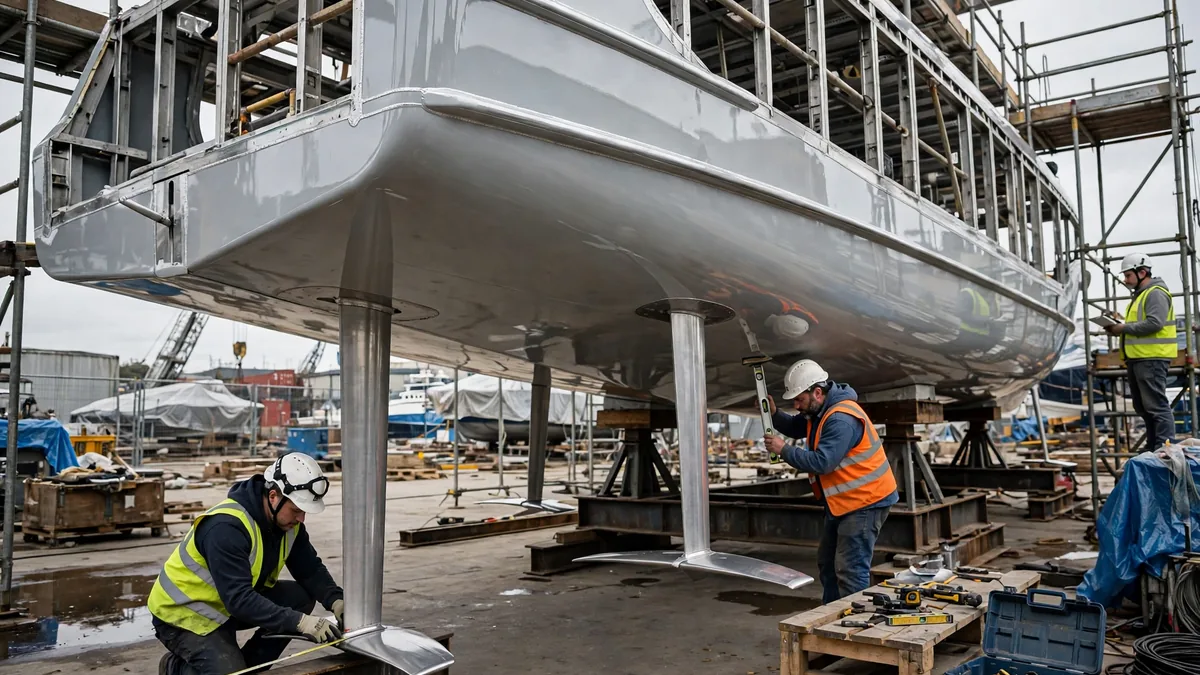
Every hydrofoil ferry starts as a hull, but it is a hull built to leave the water. The yard cuts aluminium plate and extrusions, welds them into frames and plating, and checks the shape against the drawings again and again, because a hull that will fly must be both light and stiff. Weight is the enemy of lift, so every panel is weighed against its strength, and every weld is inspected, ground smooth and tested. The guide to how a luxury hydrofoil ferry works follows the finished vessel from the quay to foil-borne flight, and the shape built in this first step is what makes that flight possible.
Step 2: The foils are shaped like aircraft wings
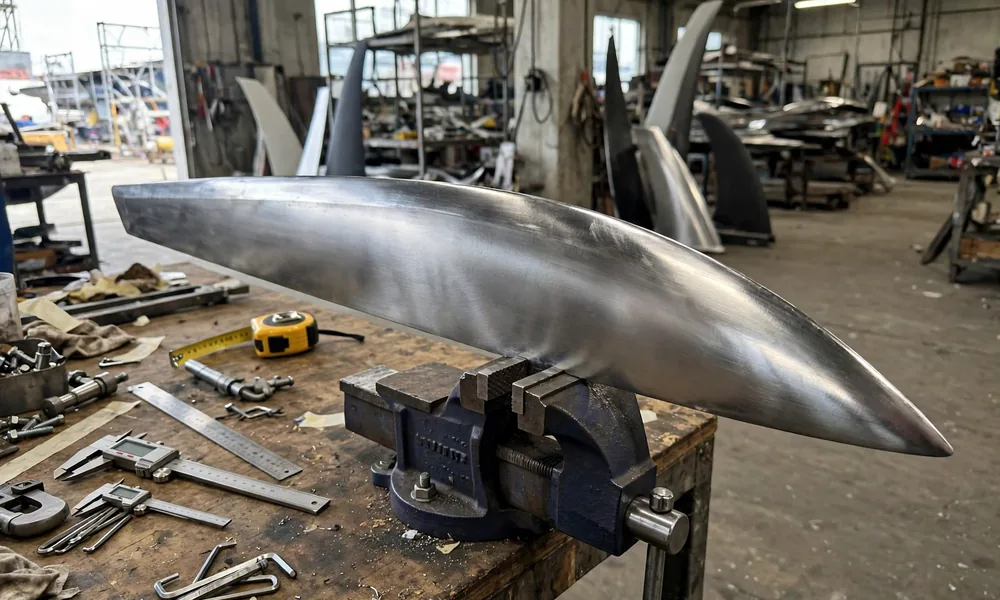
With the hull taking shape, the yard turns to the foils themselves, and this is the most exacting work in the whole build. Each foil is a shaped blade, milled or cast from stainless steel or carbon fibre, then ground and polished until its surface is fair to a fraction of a millimetre. The front foil carries most of the weight, the rear foil steers and steadies, and both are mounted on struts that must be strong enough to carry the whole vessel yet slim enough to slip through the water cleanly.
Step 3: The struts, steering and control system go in
The foils are no use without the struts that hold them and the system that controls them. The yard bolts the struts through reinforced sockets in the hull, seals every joint against the sea, and runs hydraulic lines and sensors down to the flaps. In the wheelhouse, the control system is wired in: sensors that read height, pitch and roll, a computer that adjusts the flaps many times a second, and a helm that lets the captain take over by hand. The whole assembly is tested dry, moving the flaps through their full range while engineers watch for stiffness, lag or leaks, because a flap that sticks at speed is a problem no captain wants to meet on the water.
Step 4: Batteries, motors and the quiet drivetrain
Under the cabin floor, the yard installs the electric drivetrain that makes a luxury hydrofoil ferry so quiet. Battery modules are lowered into sealed, cooled compartments low in the hull, wired through power electronics to electric motors that drive the propellers directly. The ferry charges at the terminal between crossings, so the yard also fits the charging sockets and the shore connection, and tests the whole system at full power while the vessel is still in the shed.
Step 5: The lounge is fitted like a first-class cabin
Once the engineering is in, the ferry becomes a luxury room. Joiners fit the lounge with wide leather chairs in rows that face the windows, low tables, soft lighting and a small galley, and every fitting is fixed against the motion of the sea. The guide to how a luxury ferry works follows a conventional ferry through the same kind of crossing, and the difference here is what the passengers never feel: no spray, no slam, no vibration, because the hull is flying above the waves rather than pushing through them.
Step 6: Painting, sealing and the first launch
With the cabin finished, the hull is painted with marine coatings, the foils are given a smooth anti-fouling finish, and every through-hull fitting is sealed and tested. The vessel is lifted, carried to the water and launched, and the first hours afloat are spent checking the obvious things: that it floats level, that nothing leaks, that the motors turn and the steering answers.
Step 7: Sea trials, tuning and handover
The last step is the longest. Over days of sea trials, the crew runs the ferry at every speed, in calm water and in chop, while the engineers tune the control system, trim the foils and balance the load. The ride is judged the way passengers will judge it: by the coffee in the cup and the conversation in the lounge. The same electric foil system on a smaller scale is covered in the guide to how an electric hydrofoil ferry works, where the ride is built for commuters and the luxury version adds a larger, quieter cabin on top of the same flying hull.
The spec sheet at a glance
| Specification | Typical luxury figure | What it tells you |
|---|---|---|
| Hull material | Marine aluminium, welded and faired | How light and stiff the vessel is, and how easily it lifts |
| Foil material | Stainless steel or carbon fibre | How precisely the wings hold their shape under load |
| Foils | Front and rear, with moving flaps | How the vessel lifts, steers and stays level |
| Drivetrain | Battery electric, direct-drive motors | How quiet the lounge stays at full speed |
| Cruising speed | Roughly 25 to 40 knots foil-borne | How fast the crossing feels, and how smooth it is |
| Passengers | Often 50 to 150, in lounge seating | How many guests the cabin carries in comfort |
| Control | Sensors, computer and flaps, many times a second | How steadily the vessel holds its height |
| Charging | High-power shore connection at the terminal | How quickly the ferry is ready for its next crossing |
| Build time | Many months, much of it hand finishing | How much of the vessel is fitted and tuned by hand |
What it costs
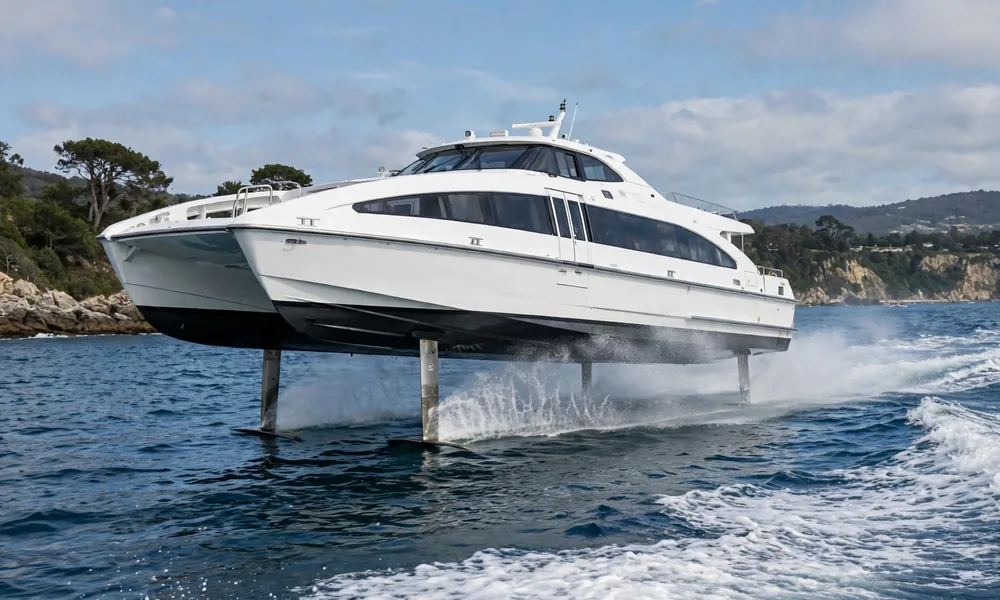
A luxury hydrofoil ferry typically costs an estimated $5 million to $25 million, depending on its size, its passenger count, its battery capacity and how lavish the lounge is fitted. The estimate covers the vessel alone, not the terminal charging, the crew or the running costs. Most of the price is in the precision foils, the battery banks and the hand-fitted cabin, and in the sea trials that tune the control system until the ride feels like flying rather than sailing.
A rare fact
One detail few passengers ever learn is that a hydrofoil ferry uses less energy at high speed than a conventional ferry of the same size, and the reason is simple: once the hull is out of the water, the only drag left is the slim struts and foils cutting through the sea. A hull pushing through waves wastes most of its power on spray and resistance, while a foil-borne hull slips above it all, which is why a vessel that looks like it is working harder is, in the water at least, working less.