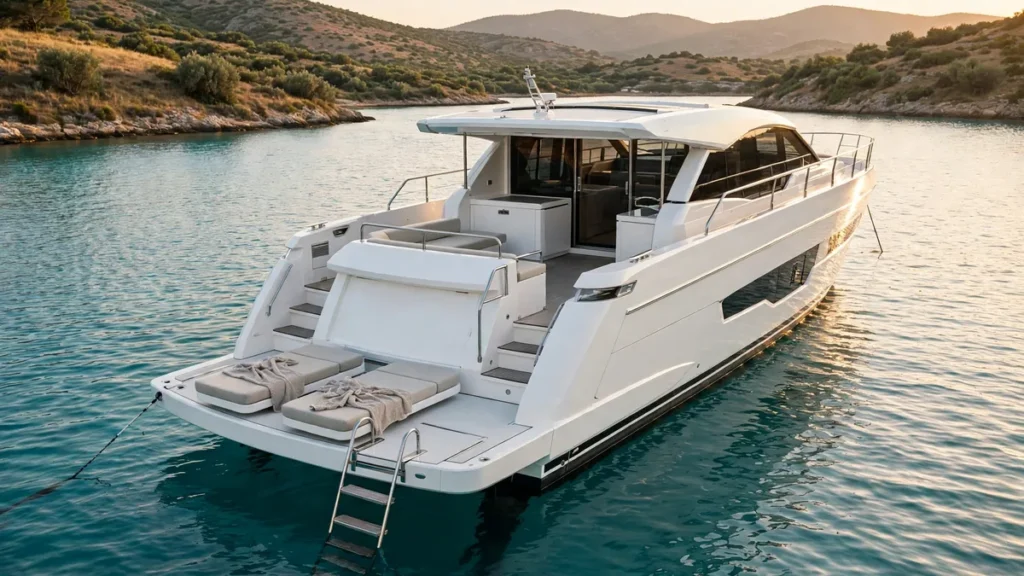
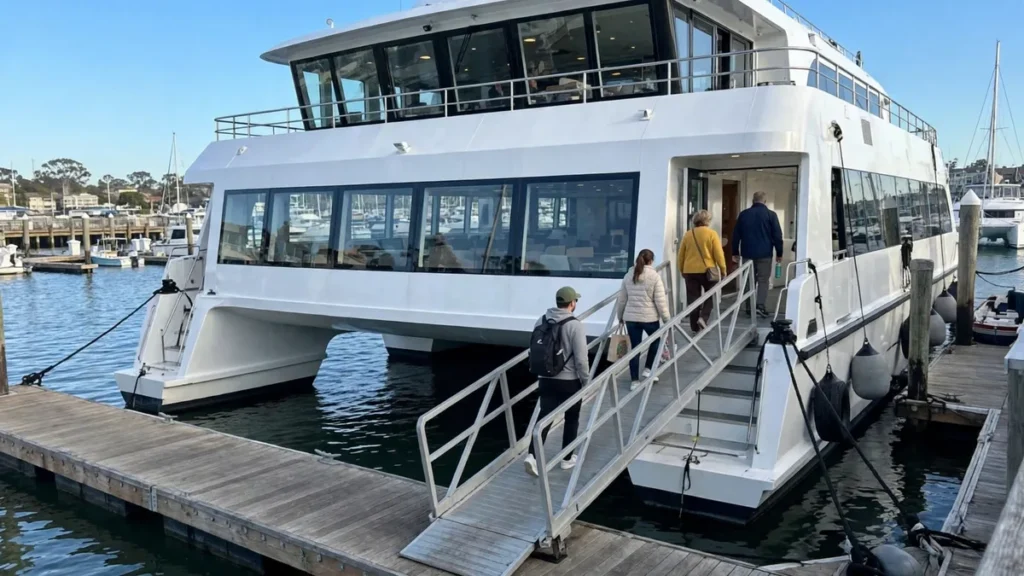
The first time you see one, your brain refuses the picture. A small white boat is moving fast across the bay, but it is not sitting in the water at all. It is floating above it, held up by thin dark legs that disappear into the spray, like a bird that has forgotten to land. There is no bow wave, no pounding, no white wake tearing behind it. The boat simply glides, quiet and level, while the water rushes past underneath.
That is a hydrofoil doing its job, and it is one of the strangest machines on the water. The hull is almost an afterthought. The real boat is underneath, in the wings. Building a luxury hydrofoil means building those wings to aeroplane standards, fitting them to a hull light enough to lift, and adding a drive system that can push the whole thing up out of the water and keep it there. It is a boat built by people who think in lift and drag, not just in length and beam, and every gram counts.

How It’s Made
Step 1: The foils are designed like aircraft wings
Everything starts with the foils, the underwater wings that lift the boat. Engineers design them the way aircraft designers design wings, shaping the cross-section so that water flowing over the top moves faster than water flowing underneath, creating lift. The front foil carries most of the weight and the rear foil steers, and both must work together or the boat will pitch forward and dive. Designers test the shapes in computer simulations first, then in towing tanks, watching tiny models rise and settle.
Step 2: Carbon fibre is laid up in moulds
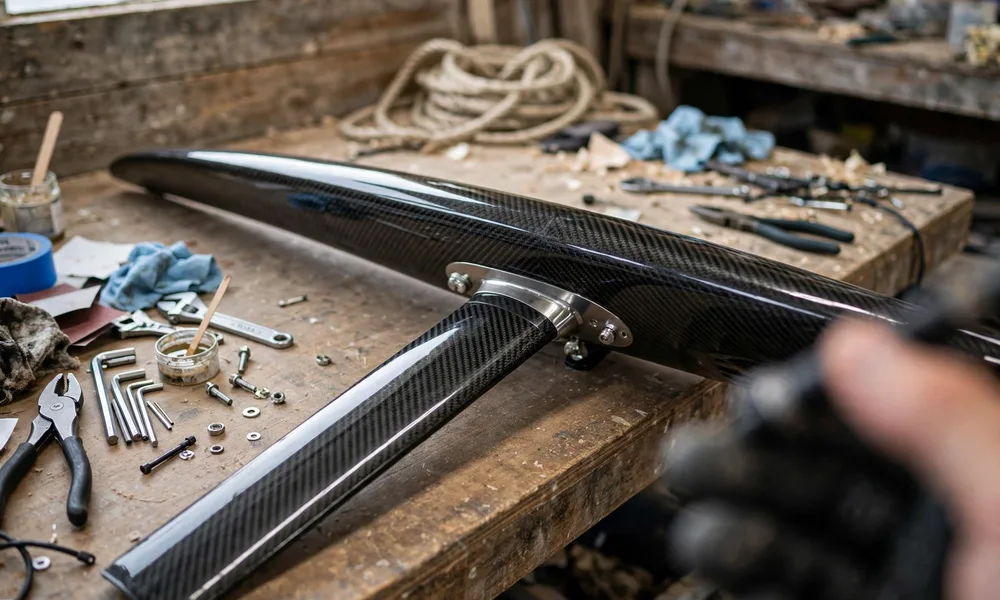
The foils are made from carbon fibre, layer upon layer of black woven cloth laid into moulds by hand. Each layer is brushed with resin and pressed down to drive out air, because a single bubble inside a foil can become a crack under load. The struts that connect the foils to the hull get the same treatment, built thick at the root where the bending forces are worst and tapering toward the wing tips. Once cured in an oven, the parts are so stiff and light that a foil the length of a person can be lifted with one hand, yet it will carry the weight of the whole boat at forty knots. The same material thinking shows up in a carbon fibre yacht hull, where lightness is bought gram by gram.
Step 3: The hull is built light and strong
While the foils cure, the hull takes shape in its own mould. A hydrofoil hull has an unusual job: it must be strong enough to survive a hard landing when the boat drops off its foils, yet light enough to lift in the first place. Builders use carbon fibre and foam cores to keep the weight down, shaping a fine bow that cuts through waves at low speed and a flat run aft that lets the hull break free of the water cleanly. The deck is kept simple, with low windage and seats set low so the centre of gravity stays down. Every fitting is weighed, because a heavy anchor locker or a chunky cleat can be the difference between flying and ploughing.
Step 4: The foils are fitted and aligned
Fitting the foils is the most precise job in the build. The front and rear foil assemblies are bolted to the hull through reinforced mounts, and their angles are set with shims thinner than a sheet of paper. If the front foil points even slightly up relative to the rear, the boat will porpoise, rising and falling in a sickening rhythm. If it points down, the bow will never lift. Technicians measure the alignment with lasers, then lock it in place and seal the mounts so salt water cannot creep into the structure. This is the moment the boat stops being a hull with parts attached and becomes a flying machine.
Step 5: The drive and controls go in
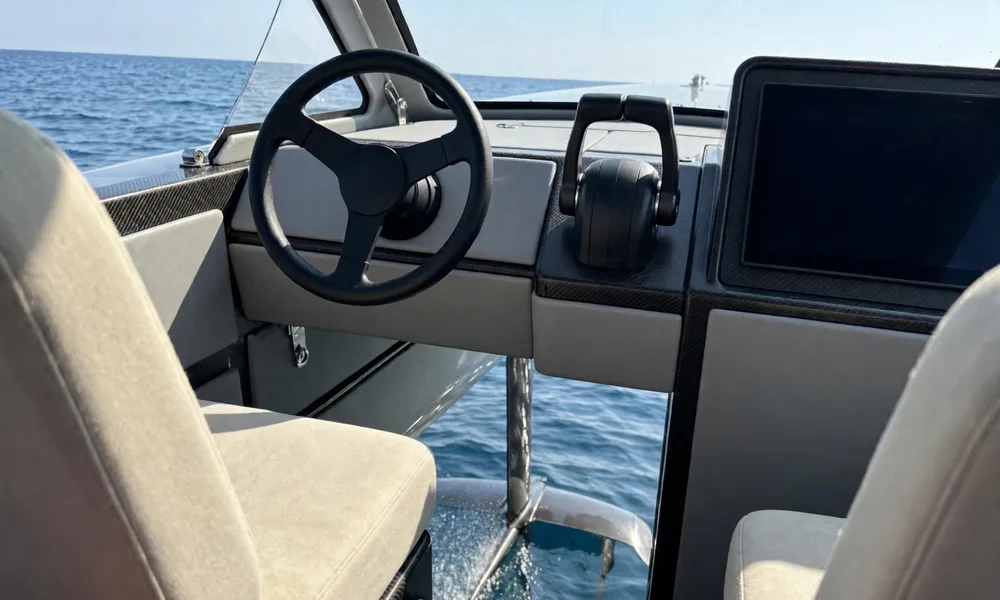
Most luxury hydrofoils use a quiet electric motor, mounted low and driving a propeller on the rear foil strut, so the propeller stays in the water even when the hull is flying. Batteries sit low in the hull, doubling as ballast, and a control system reads the boat’s height above the water many times a second, adjusting small flaps on the foils to keep the ride level. The helm is deliberately simple: a wheel, a throttle and a screen showing speed, height and battery charge. The propeller itself is a specialist part, and the craft of making one is close to the work in a titanium propeller build, where a tiny flaw costs speed and silence.
Step 6: Testing moves from tank to open water
Testing begins gently. The boat is towed, then driven slowly, then pushed faster in small steps while the crew watches the height sensors and the foil loads. The moment of take-off is unmistakable: the bow wave vanishes, the noise drops, and the boat rises until only the struts touch the water. Testers then try turns, stops and sudden throttle changes, checking that the boat settles back down safely instead of dropping hard. Only after hours of this, in different sea states, is the hydrofoil handed over. The numbers that come out of these trials feed the spec sheets, in the same way that the hydrofoil ferry specs turn trial data into figures a buyer can compare.
Hydrofoil Specifications
The figures below describe a typical small luxury hydrofoil craft, the kind built for day trips and short coastal runs rather than carrying passengers on a timetable. Larger foiling yachts scale these numbers up, but the balance of weight, lift and power stays the same.
| Specification | Typical value |
|---|---|
| Length overall | 7 to 10 metres |
| Weight | 1,500 to 2,500 kilograms |
| Take-off speed | 14 to 18 knots |
| Cruising speed on foils | 25 to 35 knots |
| Propulsion | Electric motor, propeller on rear strut |
| Foil material | Carbon fibre composite |
What It Costs
A small luxury hydrofoil costs an estimated $250,000 to $600,000, depending on size, battery capacity and the standard of the finish, and larger foiling yachts run into the millions. Those are estimates, not quotes, and the price is dominated by the foils themselves, which are hand-built, hand-finished and tested to aircraft tolerances. Running costs are modest by boating standards, because an electric drive has few moving parts and the foils slash the energy needed at cruising speed. The real cost is care: a foil that strikes floating debris can need a specialist repair, and the boat must be lifted out of the water for inspection more often than a plain hull. Owners pay it gladly, because nothing else on the water feels quite like flying.
A Rare Fact
Here is a detail that surprises even experienced boaters. A hydrofoil uses less energy at thirty knots than it does at fifteen, because once the hull lifts clear, the drag of the water on the hull disappears and only the thin struts and foils remain in the flow. The boat is literally more efficient going fast than going slowly, which is the opposite of almost every other boat afloat. The trick is getting through the awkward middle speed, where the hull is half out of the water and the drag is at its worst. Builders spend more time tuning that take-off moment than any other part of the performance envelope, because a hydrofoil that cannot take off cleanly is just an expensive boat that goes nowhere fast.