A superyacht’s propeller lives a hard life. It spins underwater for thousands of hours, pushing tonnes of steel and glass through salt water, and it must do it quietly, smoothly and without ever rusting. Bronze has done the job for a century, but the finest yachts now ask for something better. Titanium is lighter than steel, stronger than bronze, and almost immune to corrosion, so a titanium propeller can be thinner, sharper and faster than anything that came before it.
The catch is that titanium is one of the hardest metals on earth to shape. It eats cutting tools, it catches fire if it gets too hot, and it demands a workshop that treats every gram like a jewel. Here is how a luxury titanium propeller is made, from a solid ingot to the silent blades under a superyacht’s stern.

How It Is Made
Step 1: Choosing the titanium alloy
The build begins with the alloy. Naval engineers choose a titanium grade blended with aluminium and vanadium, the same family of alloys used in jet engines, because it holds its strength in cold salt water and resists the pitting that eats lesser metals. The ingot arrives as a solid cylinder, and every batch is tested before a single cut is made. A sample is pulled apart in a testing machine to prove it can take the load, and its chemistry is checked against the specification sheet.
Step 2: Forging the blank
The ingot is heated in a furnace until it glows, then pressed in a forge under thousands of tonnes of force. Forging squeezes the metal’s grain structure into line, which makes the finished blade far tougher than a cast one. The rough shape that comes out of the forge is called a blank, and it already hints at the propeller to come: a thick hub with five stubby arms reaching outwards, like a starfish made of silver metal. The forging press works in stages, reheating the metal between blows so it never cools enough to crack under the strain.
Step 3: Rough machining
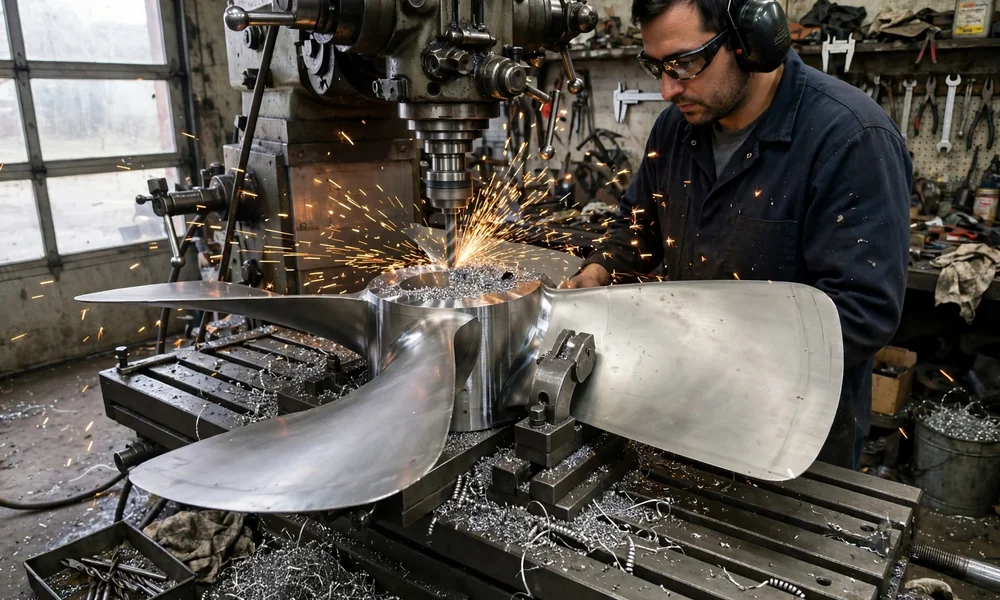
The blank is bolted to a five-axis milling machine, a computer-controlled cutter that moves in every direction at once. Slowly, the machine carves away metal to reveal the shape of each blade. Titanium is so tough that the cutters wear out quickly, and the whole job is flooded with coolant to keep the metal from overheating. A single blade can take a full day of cutting, and the machine runs through the night while the workshop sleeps.
Step 4: Shaping the blade curves
A propeller blade is not flat. Each one is twisted along its length, steep near the hub and shallow at the tip, so every part of the blade bites the water at the same angle as it spins. This twist is called the pitch, and getting it right is the difference between a propeller that sings and one that shakes the whole yacht. The machinist works from a digital model of the blade, checking the curve with a laser scanner after every pass. The pitch changes smoothly from root to tip, so the blade loads the water evenly instead of cavitating at the edges.
Step 5: Balancing the propeller
Once all five blades are shaped, the propeller is mounted on a balancing machine and spun. Even a tiny difference in weight between blades will cause a vibration that the owner feels through the deck, so the technicians grind away small amounts of metal from the heavier blades until the spin is perfectly smooth. A luxury propeller is balanced to a tolerance finer than a coin’s weight, and the test is repeated until the needle barely moves.
Step 6: Polishing to a mirror finish
The propeller is then polished by hand, first with coarse abrasives and then with finer and finer compounds until the surface shines like a mirror. A smooth blade slips through the water with less drag, and it also resists the tiny sea creatures that try to grow on it. The polishers work blade by blade, feeling for the smallest ripple with their fingertips, because a ripple the eye cannot see is enough to slow the yacht down. Each blade is checked against the design with a template before the final polish begins, so no curve is left to guesswork.
Step 7: Fitting and sea trials
The finished propeller is lifted under the yacht’s stern and bolted to the shaft, with its hub sealed against the sea. Divers check the fit, and the yacht is launched for trials. At first the captain runs the engines gently, listening for vibration and watching the wake. Then the throttle opens, and the engineers measure speed, fuel use and noise. Only when the propeller pushes the yacht to its designed speed, silently and smoothly, is the build signed off.
Key Specifications
The figures below describe a typical luxury titanium propeller for a large superyacht; individual builds vary.
| Specification | Typical figure |
|---|---|
| Diameter | 1.5 to 2.5 metres |
| Number of blades | Five |
| Material | Titanium alloy with aluminium and vanadium |
| Weight | Around 30 to 40 percent lighter than bronze |
| Shaft speed | 800 to 1,200 revolutions per minute |
| Blade finish | Hand-polished mirror smooth |
| Corrosion resistance | Very high in salt water |
| Service life | 20 years or more with care |
How Much Does It Cost?
A luxury titanium propeller typically costs from around $150,000 to $500,000, depending on its size, the number of blades and the finish. That is an estimate based on current custom marine builds, and the price can rise further for very large superyacht propellers or for a matched pair. Most of the cost sits in the raw titanium, the slow machining and the hand polishing, because the metal fights every tool that touches it. To understand the metal itself, read yacht propeller materials engineering for the science behind the blades. For the numbers in plain language, yacht propeller specs explained breaks down diameter, pitch and blade count. And yacht stabilizer fins materials engineering shows how the fins that steady the yacht are built from similar thinking.

A Rare Fact
Here is something few yacht owners ever learn: titanium can catch fire while it is being machined. The metal burns so hot and so bright that a pile of fine titanium shavings can ignite from the friction of a dull cutter, and the fire cannot be put out with water. Workshops that machine titanium keep special extinguishers on hand and flood the cutting zone with coolant, not just to protect the blade, but to stop the swarf from bursting into flame. It is one of the reasons a titanium propeller costs so much: the people who make it are working with a metal that can burn.
A luxury titanium propeller is a quiet marvel. It weighs less than the bronze propeller it replaces, it never rusts, and it pushes a superyacht through the sea with barely a tremor. From the glowing ingot in the forge to the mirror polish on the blade, every step is slow, expensive and exact. When the yacht slips away from the dock and the water behind her stays calm, the propeller has done its job, and nobody on board will ever think about it again.