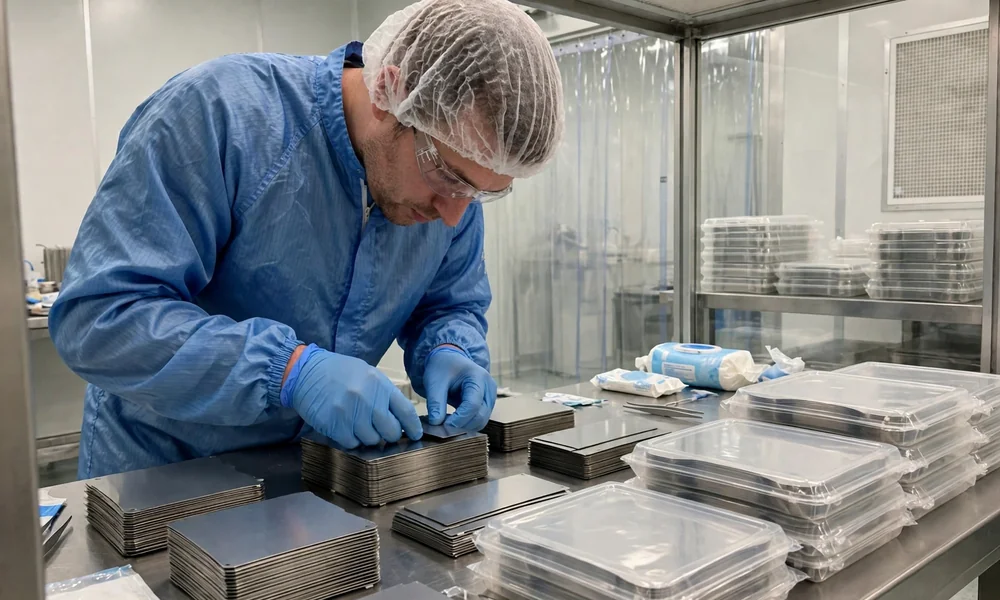
A silver car body rolls into a clean, bright hall where nobody wears a welding mask and nobody smells petrol. Instead of an engine line, there is a row of sealed cabinets, and inside each one a technician in white gloves is fitting a stack of thin metal plates no thicker than a sheet of paper. This is not a battery car and not a petrol car. It is a car that will run on hydrogen, and the only thing it will ever breathe out is water.
A luxury hydrogen car is an electric car that makes its own electricity on board, from hydrogen gas and oxygen drawn from the air. A device called a fuel cell combines the two and produces power, and the electric motor that drives the wheels is the same kind of motor found in a battery car. Building one means building two machines at once: a silent electric limousine, and a small chemical power station that must be sealed, tested and finished to the standard of a jewel.

How a Luxury Hydrogen Car Is Made, Step by Step
Step 1: The body shell is built around the hydrogen tanks
Building begins with the body shell, pressed from steel and aluminium and welded together by robots, but the floor is shaped differently from an ordinary car. Instead of a flat battery tray, the floor holds two or three cylindrical hydrogen tanks, made by winding carbon fibre around a plastic liner until the wall is strong enough to hold gas at 700 times normal air pressure. The tanks are lowered into a reinforced cradle in the floor and bolted in place, surrounded by crash protection, because hydrogen is stored under enormous pressure and the tanks must survive any impact.
Step 2: The fuel cell stack is assembled by hand
The heart of the car is the fuel cell stack, and it is assembled by hand in a dust-free room. Hundreds of thin plates are stacked together, each one coated with a tiny amount of platinum, separated by membranes thinner than a human hair. Hydrogen flows across one side of each membrane and oxygen from the air across the other, and the chemical reaction between them makes electricity and pure water. The stack is pressed together in a steel case and sealed, then tested for leaks with helium before it ever meets a car.
Step 3: The electric motor and power electronics go in
With the tanks and the fuel cell in place, the electric drive is fitted. A powerful electric motor is mounted on the rear axle, and in some cars a second motor is fitted at the front for four-wheel drive. Between the fuel cell and the motor sit the power electronics, a set of inverters and converters that turn the fuel cell’s steady current into the changing power the motor needs. The same motor-and-battery thinking shapes the build of a luxury electric car, and the finished car drives with the same silent surge, the only difference being where the electricity comes from.
Step 4: The hydrogen plumbing is fitted and pressure tested
Next comes the plumbing, and it is the most carefully checked part of the whole build. Stainless steel pipes and special valves carry hydrogen from the tanks to the fuel cell, and every joint is tightened to an exact torque and then tested. The car is filled with helium or nitrogen and left overnight while sensors watch for the smallest drop in pressure, because a leak that would be harmless in a petrol car could be dangerous with hydrogen. Sensors are fitted throughout the car to sniff for escaping gas, and if one ever detects a leak it shuts the tank valves in a fraction of a second.
Step 5: The cabin is finished in luxury
With the machine built, the cabin is fitted out like a private lounge. The seats are wide, leather, heated and cooled, and they can recline for a passenger who wants to sleep on a long journey. A large screen controls the heating, the music and the navigation, and the trim is wood, metal and stitched leather. The cabin of a hydrogen car has one party trick no other car can match: the water made by the fuel cell is so pure that some makers pipe it to a small tap or use it to humidify the air, and the idea of a car that produces drinking water as it drives is described in the guide to the luxury hydrogen car specifications.
Step 6: Testing, filling and the first drive
Before delivery, the car is filled with hydrogen for the first time and driven on a test track and on public roads. Engineers watch the fuel cell’s output, the tank pressure and the temperature of the stack, checking that the car refuels in about five minutes and drives as far on a tank as a petrol car does on a full tank of fuel. The paint is checked under bright lights, the interior is inspected, and the car is washed and filled. Only then is it handed to its owner, with a handover that explains where to find hydrogen stations and how the car makes its own power. The finished machine is as much a laboratory as a limousine, and its build shares the careful, computer-checked discipline of the car described in the guide to how a luxury autonomous car is made.
Specifications at a Glance
| Feature | Typical Luxury Hydrogen Car |
|---|---|
| Powertrain | Fuel cell plus electric motor |
| Power | 180 to 250 horsepower |
| Hydrogen storage | Two or three tanks, 700 bar pressure |
| Range | 600 to 700 kilometres per fill |
| Refuelling time | About 3 to 5 minutes |
| Acceleration | 0 to 100 km/h in about 7 seconds |
| Emissions | Water vapour only |
| Seats | Four or five, leather, heated and cooled |
What a Luxury Hydrogen Car Costs
As an estimate, a luxury hydrogen car might cost roughly $70,000 to $120,000, with the fuel cell stack and the carbon-fibre tanks accounting for a large share of the price. The most richly finished cars, with hand-stitched interiors and the longest range, could cost an estimated $150,000 or more. Those are estimates, and the running costs are unusual: hydrogen fuel is still expensive and stations are rare, so owners usually live near a filling station or have one on their regular route.
A Rare Fact
The fuel cell is far older than the car. It was invented in 1839 by a Welsh judge and scientist named William Grove, who built a device he called a gas voltaic battery and showed that hydrogen and oxygen could make electricity. The idea slept for more than a century until NASA used fuel cells to power the Apollo spacecraft in the 1960s, because they made electricity and drinking water at the same time, which was perfect for astronauts. The luxury hydrogen car of today is the great-grandchild of a judge’s experiment from nearly two hundred years ago, and its power station is small enough to fit under the bonnet.
A luxury hydrogen car is built like a contradiction that works: a chemical plant and a limousine, a car that fills up in minutes like a petrol car and drives in silence like an electric one. Its only exhaust is a few drops of water, left behind on the road as it glides away.