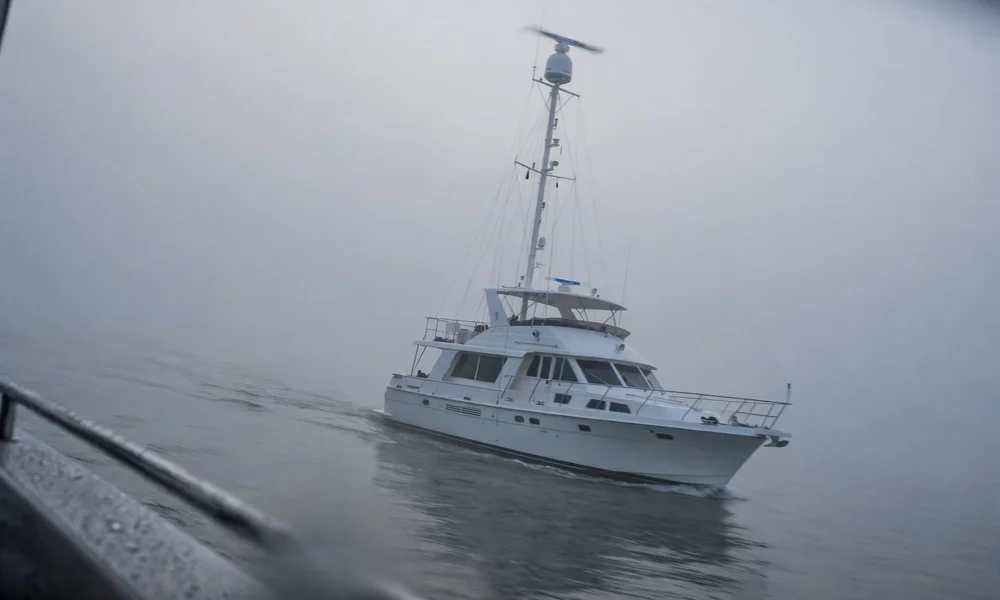
On a clear day, a yacht’s radar is a luxury. On a foggy night, it is the difference between seeing and guessing. Radar lets the crew see other boats, the coastline, buoys, and rain squalls, even when the eye sees nothing but grey. It works in the dark, in the rain, and in thick fog, and it has been doing so on yachts for decades.
The principle is simple: the yacht sends out a pulse of radio waves, the waves bounce off anything solid, and the echo comes back. By measuring how long the echo takes, the radar works out how far away the object is. By knowing which way the antenna was pointing, it works out the direction. The result is a picture on a screen, and that picture is the radar image. This guide explains how yacht radar works, from the antenna on the mast to the screen at the helm.

The scanner: the antenna that spins
The part of the radar you can see is the scanner, mounted high on the mast or on a radar arch. On most yachts it is a horizontal bar, a metre or so long, inside a white radome, and it spins. As it spins, it sends out a pulse of radio waves in a narrow beam, listens for the echo, and then sends the next pulse a fraction of a degree further around. A full rotation takes about two seconds, and the picture on the screen is rebuilt with every turn.
The width of the beam matters too. A longer antenna makes a narrower beam, and a narrower beam gives a sharper picture, because it can tell two close objects apart. A short antenna gives a wider beam and a fuzzier picture. This is why larger yachts have longer scanners: they need the resolution to pick out a small boat close to a large ship.
The pulse and the echo
Inside the scanner, a transmitter generates the pulse. On older radars this was a magnetron, a vacuum tube that produced a powerful burst of microwaves. On modern yachts it is usually a solid-state transmitter, which is smaller, lighter, uses less power, and lasts longer. Either way, the pulse lasts only a fraction of a microsecond, and the transmitter then switches off and listens.
The pulse travels at the speed of light, hits an object, and a tiny fraction of its energy bounces back. The receiver, which is extremely sensitive, picks up the echo and measures the time it took. Because radio waves travel at a known speed, the time gives the distance directly: a pulse that returns after 12 microseconds has travelled about 1.8 kilometres each way, so the object is about 900 metres away. The radar does this thousands of times a second.
Frequency: X-band and S-band
Yacht radars work on one of two frequency bands, and the choice is a trade-off. X-band, around 9 gigahertz, is the standard on yachts. It gives a sharp picture and works well at short range, which is what a yacht needs in coastal waters and in a busy harbour. It is also affected by rain, which can hide small targets behind a curtain of clutter.
Power is modest. A typical yacht radar transmits a few kilowatts in each pulse, but because the pulse is so short, the average power is only a few watts, less than a light bulb. The scanner is safe to be near, though it is wise not to stand directly in front of a spinning scanner at close range, and most crews switch the radar to standby when someone is working aloft.
The display: turning echoes into a picture
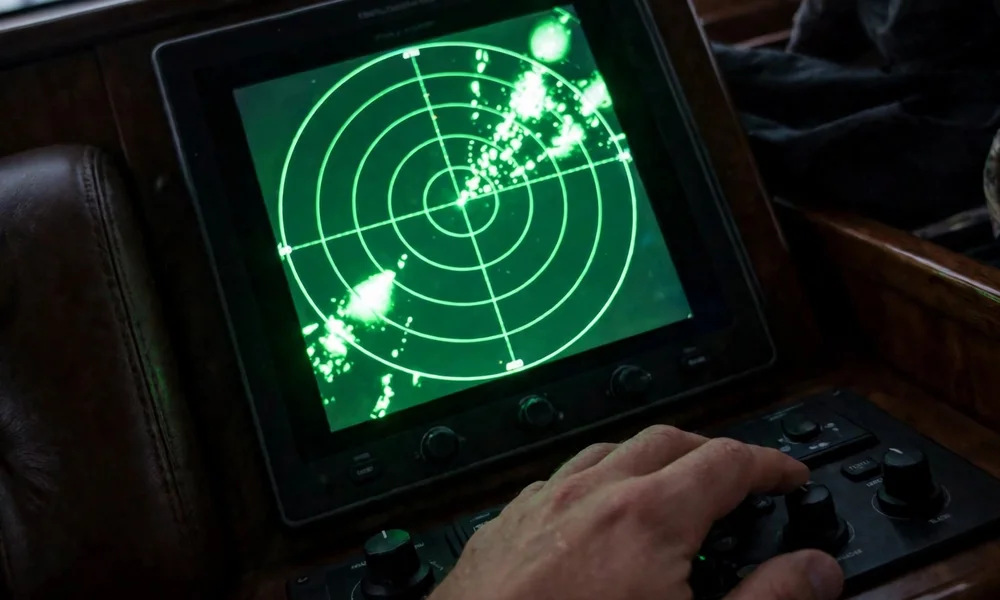
The display is where the radar becomes useful. The screen shows a circular picture, with the yacht at the centre and the echoes as bright blobs around it. The distance rings mark the range, and the heading line shows which way the yacht is pointing. A blob that stays in the same place is land or a buoy. A blob that moves is another vessel.
The display also filters. Sea clutter, the echoes from waves, can be reduced with a control that suppresses weak, nearby returns. Rain clutter can be reduced in the same way. And the gain control sets the sensitivity, so the crew can turn it up to find a small boat in calm water, or turn it down to clear the screen in a storm. The best yacht helm stations, ranked shows the screens and consoles where this display sits, and the radar is usually the largest picture on them.
Range, resolution, and blind spots
Yacht radar is good at some things and limited at others, and the crew needs to know both. The maximum range is set by the horizon, and in practice a yacht radar sees ships to around 20 kilometres and the coast to the horizon. Small boats are visible to a few kilometres, and a wooden dinghy may not show at all unless it carries a reflector.
Radar and collision avoidance
The most important job of yacht radar is collision avoidance, and it is here that the modern display earns its keep. When the radar tracks another vessel, it calculates the closest point of approach and the time to that point. If another vessel will pass within a set distance, the alarm sounds, and the crew can alter course early, while there is still time and sea room.
Radar also helps with navigation in poor visibility. By matching the radar picture to the chart, the crew can fix the yacht’s position, identify a headland, or find the entrance to a harbour. In the age of GPS this sounds old-fashioned, but GPS can fail, and a radar fix is independent of any satellite. How a luxury chase boat works describes a boat that relies on its crew and its instruments in the same way, and the radar is part of that picture.
Modern radar: solid state, Doppler, and broadband
Modern yacht radar is quieter, smaller, and smarter than the magnetron radars it replaces. Solid-state transmitters use less power and switch on instantly, with no warm-up time. Broadband radar, sometimes called frequency-modulated radar, transmits continuously at very low power rather than in bursts, and it gives an exceptionally clear picture at short range, which is where a yacht needs it most.
These radars are also safer to be around, because their average power is so low, and they are lighter, because the scanner contains no heavy magnetron. How a submarine sonar array works is the underwater cousin of the same idea: send out a signal, listen for the echo, and build a picture from what comes back.
Using radar well: the human part
The best habit is the simplest: keep the radar on. In clear weather it confirms what the eye sees. In poor weather it sees what the eye cannot. And in the dark, when the coast is a line of lights and the sea is black, it is the picture that tells the crew where they are, what is around them, and whether the way ahead is clear.