A luxury laptop looks simple. It is a thin slab of metal that opens to reveal a screen and a keyboard, and it weighs less than a hardback book. Yet inside that slab is a complete computer, more powerful than the machines that once filled whole rooms: a processor with billions of transistors, a graphics chip, memory, storage, a battery, speakers, cameras and a cooling system, all fitted into a space thinner than a finger.
The luxury is not just in the power. It is in the feel of the aluminium under your fingers, the silence of the fans, the sharpness of the screen and the way the whole machine feels carved from a single piece of metal. Here is how a luxury laptop works, from the chip that thinks to the screen that shows, and what makes it different from an ordinary laptop that looks similar at first glance.

How It Works
Step 1: A processor that thinks in billions
At the heart of the laptop is the processor, a chip smaller than a postage stamp that contains billions of transistors. It runs every program, from the operating system to the video editor, by switching those transistors on and off billions of times a second. A luxury laptop uses the fastest mobile processors available, with many cores that share the work, so it can edit video, run a dozen browser tabs and compile code at the same time without slowing down. The chip is made in a factory cleaner than an operating theatre, where a single speck of dust can ruin a whole wafer of chips.
Step 2: Memory and storage at the speed of thought
Next to the processor sits the memory, fast short-term storage that holds whatever the laptop is working on right now. A luxury laptop typically has 16 or 32 gigabytes of it, soldered directly to the board to save space and speed things up. Long-term storage is a solid-state drive, a chip with no moving parts that can read data far faster than an old hard disk. The two work together: the drive holds everything, the memory holds what is needed now, and the processor moves between them at extraordinary speed. The craft that goes into building machines like this is described in how a luxury laptop is made.
Step 3: Graphics that paint the screen
The graphics chip paints everything on the screen, from text to 3D games to video effects. In a luxury laptop it may be built into the processor or it may be a separate, more powerful chip with its own memory. It works by calculating the colour of millions of pixels many times a second, a task that demands huge amounts of arithmetic. It is also the part that gets hottest, which is why the cooling system is designed around it as much as around the processor.

Step 4: Cooling without noise
Keeping a powerful laptop cool in a thin body is one of the hardest problems in engineering. Heat pipes, thin copper tubes filled with liquid, carry heat away from the chips to the fans, which blow it out through vents hidden in the hinge. The fans in a luxury laptop are designed to be quiet, with blades shaped to move air without a whine, and they spin up only when needed. Under light work the laptop may be completely silent, with no fan at all, because the chips use so little power. Under heavy work the fans spin up, but the noise is a soft rush rather than a roar. The metal body itself helps, spreading heat across its surface like a heatsink.
Step 5: A screen that shows every detail
The screen is what the owner looks at all day, so luxury laptops spend heavily on it. It is usually a high-resolution panel with accurate colours, a bright backlight for working outdoors, and a smooth refresh rate that makes scrolling feel fluid. Some use OLED technology, where each pixel makes its own light, giving perfect blacks and vivid colours. The glass is thin and laminated to the panel, which removes the air gap and makes the image look painted onto the surface. Above it sits a camera, microphones and sensors, all fitted into a bezel only a few millimetres wide.
Step 6: A battery, keyboard and the whole experience
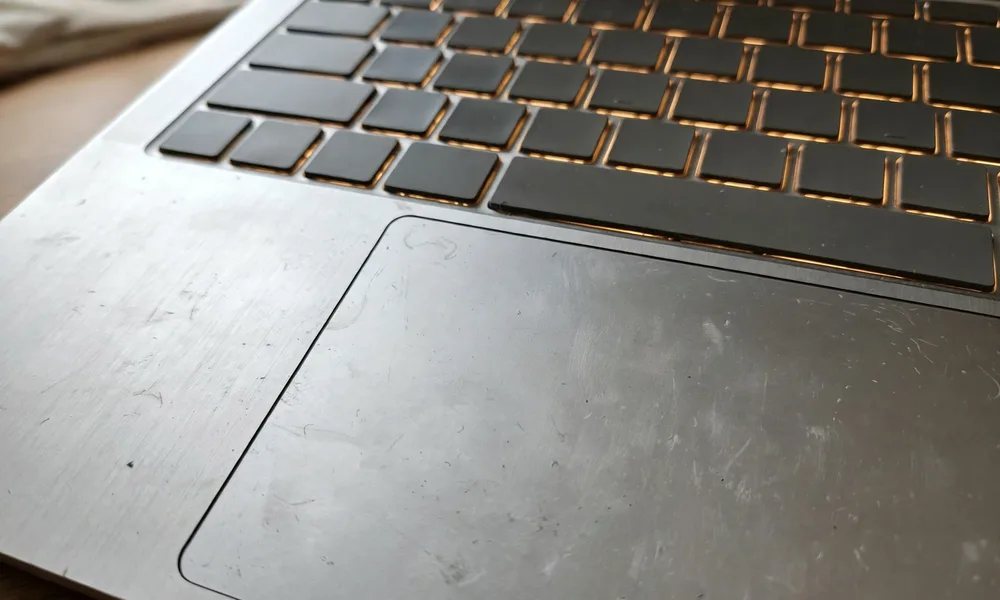
The battery is a flat pack of lithium cells that fills much of the laptop’s base, and it is the reason the machine can work all day away from a socket. Power management software watches every part of the laptop, dimming the screen, slowing the chips and switching off the radios to stretch the charge. The keyboard is backlit, with keys that travel a precise distance and give a satisfying click, and the trackpad is a large sheet of glass that reads gestures with precision. The speakers are tuned to fill a room, the fingerprint sensor unlocks the machine in a second, and the whole laptop wakes the moment the lid is lifted. It is a collection of small details, each one refined, that add up to a machine that feels effortless to use. The price of all this refinement is explained in why a luxury laptop is so expensive.
Specifications
| Feature | Typical Luxury Laptop |
|---|---|
| Processor | Latest multi-core mobile chip, 10 to 16 cores |
| Memory | 16 to 32 GB, soldered to the board |
| Storage | 512 GB to 2 TB solid-state drive |
| Display | 14 to 16 inch, high resolution, up to 120 Hz |
| Battery life | Around 12 to 18 hours of mixed use |
| Weight | Around 1.2 to 1.6 kg |
| Body | CNC-milled aluminium unibody |
The Price
A luxury laptop typically costs an estimated $1,800 to $3,500, with the most powerful configurations passing $4,000. That is roughly three times the price of a basic laptop, and the gap is explained by the faster chips, the better screen, the milled aluminium body and the engineering that fits it all into a thin, silent machine. The screen alone can cost several times more than a budget laptop’s panel, and the battery, speakers and keyboard are all upgraded too. Owners accept the price because the machine is used for hours every day, and because a well-built laptop lasts longer, holds its value better, and makes every task feel a little easier.
A Rare Fact
The aluminium body of a luxury laptop is often carved from a single block of metal by a computer-controlled mill, a process that takes hours and throws away most of the block as waste. The result is a unibody with no seams or joints, which is why the laptop feels so solid and has no creaks or flex. Some makers recycle the aluminium shavings back into new blocks, but the process remains one of the most wasteful, and most expensive, ways to make a laptop case. It is done anyway, because no other method gives the same feel in the hand.
A luxury laptop works by hiding enormous complexity inside a simple object. The processor thinks, the memory remembers, the graphics chip paints, the cooling system breathes and the battery keeps it all alive, and the owner sees none of it, only a screen, a keyboard and a machine that responds instantly. That invisibility is the point. The best technology is the kind you never have to think about, and a luxury laptop is built to be forgotten while you work. For a look at a close cousin in the same premium tech family, the luxury tablet specs explained guide covers the numbers behind the tablet that shares much of this DNA.