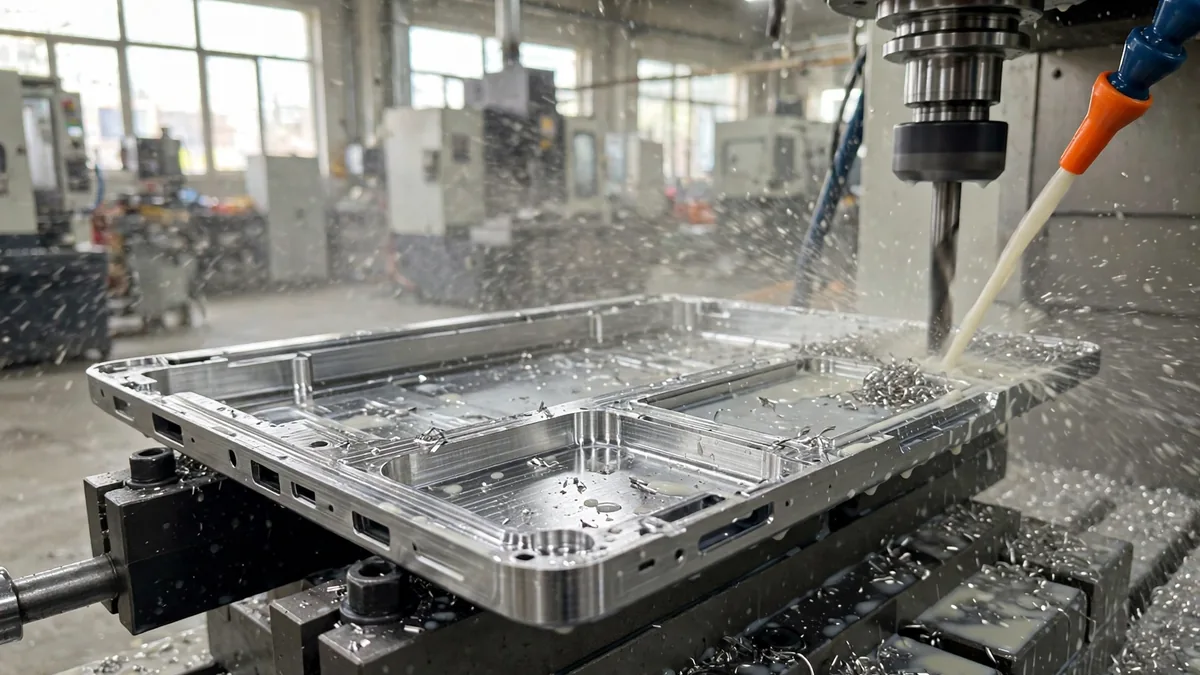
On a bench in a quiet factory, a block of aluminium the size of a hardback book is clamped into a machine, and a cutter no wider than a pencil begins to carve it away. Over the next hour the solid block slowly becomes the body of a laptop, thin as a magazine.
This is how a luxury laptop is made, from the milled aluminium body and the bonded glass display to the fitted chip, the slim battery, the quiet cooling and the final hands-on test, where the finished machine is opened, closed and typed on a hundred times before it is allowed to leave.
Step 1: The body is milled from a solid block
Every luxury laptop starts as a billet, a solid block of aluminium alloy chosen for strength and lightness. The block is clamped into a computer-controlled milling machine, and cutters of different sizes carve away most of it, leaving a shell with walls only a millimetre or two thick. Afterwards the sharp edges are softened, the surface is blasted with fine glass beads for a matte finish, and the body is anodised, a process that grows a hard coloured layer on the metal so it resists scratches and fingerprints. The guide to how a luxury gaming laptop works shows what this body must survive at full speed.
Step 2: The keyboard and trackpad are fitted
With the body finished, the keyboard goes in. Each key sits on its own scissor mechanism, a tiny folding frame that lets the key travel a short, precise distance and spring back, and the keys are backlit from below by a thin sheet of light guides. The whole keyboard is fitted into the body from underneath and screwed down, so it sits perfectly flush with the surface around it. Beside it goes the trackpad, a sheet of glass on a hinge, tuned so a light tap registers and a firm press clicks.
Step 3: The display is bonded to the glass
The screen is made separately, and it is the most delicate part of the whole laptop. A thin panel of liquid crystal or organic light-emitting diodes is laid onto a sheet of cover glass, and the two are bonded together with a clear adhesive in a dust-free room, so no speck of dust is ever trapped between them. The bonded display is then hinged to the body, and a flat cable is threaded through the hinge to carry the picture from the main board to the screen. The story of how an OLED display panel is made follows the same bonding work at the scale of the panel factory.
Step 4: The main board and cooling go in
Inside the body, the main board is the heart of the machine, a dense plate carrying the processor, the memory, the storage and dozens of smaller chips. It is lowered into place and screwed to brass inserts in the aluminium, so the body itself becomes part of the cooling, drawing heat away from the chips. Over the processor sit heat pipes, thin copper tubes filled with liquid that boils at one end and condenses at the other, carrying heat to a pair of small fans at the back. The guide to how a laptop vapour chamber is made shows a flatter, more powerful version of the same cooling idea.
Step 5: The battery and speakers are fitted
With the board in place, the battery goes in, and it is shaped to fill every spare corner of the body. Luxury laptops use layered pouch cells, thin flat batteries glued into the case in a stepped pattern that follows the shape of the keyboard well and the trackpad. The cells are wired to a small board that watches their temperature and charge, and the whole pack is tested for swelling and heat before the bottom cover goes on.
Step 6: Assembly, software and the final test
Before a luxury laptop leaves the factory, it has to prove itself as a whole machine. The bottom cover is screwed on, the operating system is loaded, and the laptop is run through a test that exercises every part: the screen is checked for dead pixels, the keyboard is typed on by a machine that presses every key, the trackpad is swiped, the speakers are played, and the battery is charged and drained. Only a laptop that passes both the machine test and the human one is cleaned, wiped down and packed with its charger.

The spec sheet at a glance
| Specification | Typical luxury figure | What it tells you |
|---|---|---|
| Body | Milled aluminium, anodised | How rigid the laptop feels, and how it resists scratches |
| Thickness | Roughly 12 to 16 millimetres | How slim the machine is when closed |
| Weight | Roughly 1.2 to 1.6 kilograms | How easily it carries in a bag all day |
| Display | 13 to 16 inches, bonded glass | How sharp the picture looks, and how solid the lid feels |
| Processor | Latest high-end mobile chip | How fast it runs demanding work |
| Memory | 16 to 32 gigabytes | How many apps it can keep open at once |
| Storage | 512 gigabytes to 2 terabytes | How much it can hold, and how fast it opens files |
| Battery | Roughly 60 to 100 watt-hours | How long it lasts away from a charger |
| Cooling | Heat pipes and twin fans | How quiet it stays under heavy work |
What good build looks like
A well-made luxury laptop gives itself away in small details. The lid should open with one finger and stop exactly where you leave it, the seam between the body and the bottom cover should be even all the way round, and the keyboard should feel the same on every key, with no loose or rattling ones.

What it costs
A luxury laptop typically costs an estimated $2,000 to $4,500, depending on the processor, the memory, the storage and the size of the display. The estimate covers the laptop alone, not the charger, a case or software. The price is mostly in the milled body, the display and the cooling.
A rare fact
One detail few owners ever learn is that the aluminium body of a luxury laptop is mostly air by the time it is finished. The milling machine cuts away as much as ninety per cent of the original block, and the shavings are collected, melted down and milled again, so the body in your bag may contain metal that has already been a laptop once before. The shavings are swept up after every shift, weighed, and sent back to the smelter in sealed drums.
From a solid block of aluminium on a milling machine to a finished laptop tested key by key, a luxury laptop is made in slow, precise stages, each one checked before the next begins. The result is a machine that feels like a single piece of metal, even though it holds a screen, a battery, a board and two fans inside.