On a still morning on a lake, a boat drifts slowly past the reeds, and on its deck a family sits in the sun, fishing rods out, a cooler between them, and no hurry at all. The boat is wide, flat and open, with a roof over the seats and a motor at the back that purrs rather than roars, and it looks like a floating patio. The boat is a pontoon boat, and it is built for the opposite of speed: for sitting, for drifting, for an afternoon that does not need to go anywhere, and the luxury version of it is built to do that in comfort that would shame many yachts.
This is how a luxury pontoon boat is made, in seven steps, from the first aluminium to the day the boat is handed over to its owner: the pontoons, the deck, the fence, the furniture, the motor, the electronics and the water trials that prove it all works.
Step 1: Building pontoons that float a patio
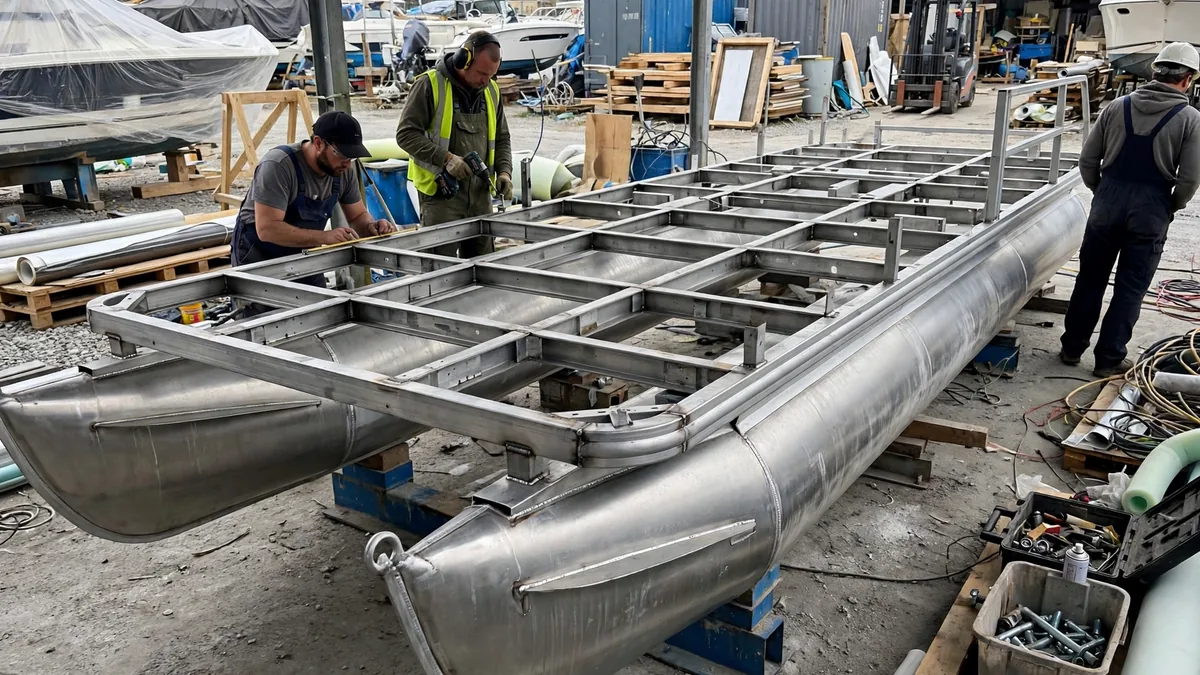
Everything starts with the pontoons, the two or three long aluminium tubes that hold the whole boat up. The tubes are made from marine-grade aluminium, rolled and welded into cylinders, and sealed into separate chambers, so a puncture in one chamber cannot sink the boat. The pontoons are pressure-tested, and then fitted with anodes, small blocks of zinc that corrode instead of the aluminium, because a boat that lives in the water is always fighting corrosion, and the guide to how a luxury ferry works follows a larger vessel through the same fight, where the hull is steel, the water is salt, and the anodes are the size of bricks.
Step 2: Laying a deck like a floor
On top of the pontoons sits the deck, and a luxury pontoon deck is built like the floor of a house. The deck is marine plywood, sealed against water, and covered in carpet or vinyl that can be hosed down, because a boat deck gets wet, and it is bolted to the pontoons through cross members, steel beams that spread the load across the tubes.
Step 3: Raising the fence that keeps everyone aboard
Around the deck runs the fence, the low aluminium railing that keeps passengers aboard and gives the boat its shape. The fence is made from aluminium panels, powder-coated in the boat’s colour, and fitted with a gate at the front and a gate at the side, and it is the first thing a buyer sees, so it is finished to a standard the rest of the boat must match. The fence is tested by leaning on it, hard, because a fence that gives way is a passenger in the water, and the guide to luxury dive boat specs, explained sets out the numbers for a different kind of railing, where the fence must hold divers, tanks and cameras as well as people.
Step 4: Furnishing a floating living room
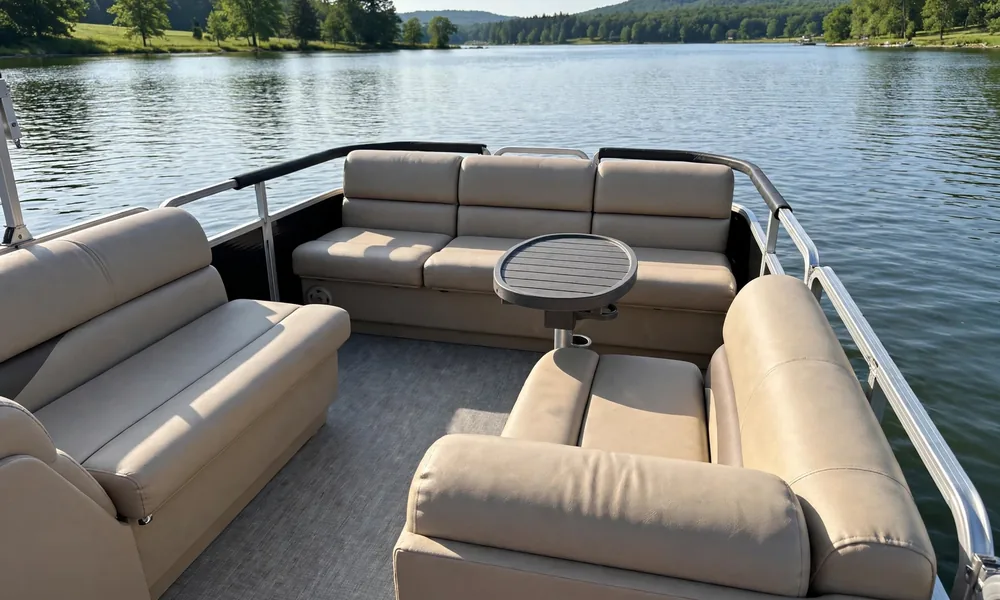
The furniture of a luxury pontoon boat is where the price lives, because the boat is a living room that floats. The seats are deep, wide and upholstered in marine vinyl that resists sun and water, and they are arranged in an L-shape around the deck, so everyone can talk, and under every seat is a storage locker, dry and ventilated, for life jackets, towels and fishing gear. The furniture is bolted to the deck, not screwed, because screws pull out when the boat flexes, and the guide to how a luxury yacht tender is made shows the same thinking in a smaller boat, where the seats must survive being lifted aboard a yacht in a swell.
Step 5: Fitting a motor that purrs, not roars
A luxury pontoon boat does not need a racing motor, it needs a motor that is quiet, reliable and strong enough to push a heavy deck through the water. Most use a single outboard, between a hundred and three hundred horsepower, mounted on the transom at the back, and the motor is chosen for its quietness, because a pontoon boat is for talking, not for shouting over an engine. The motor is tested on the water, at full throttle and at idle, because a motor that stalls when it is needed is a boat adrift, and a boat adrift on a lake is a long walk home.
Step 6: Wiring the electronics that make it easy
Behind the helm, a luxury pontoon boat carries electronics that make the boat easy to use, because the owner is often not a sailor. The boat has a depth sounder, so the driver knows when the water is shallow, a GPS that shows the lake, and a stereo that plays through speakers built into the fence, and they are all wired through a panel that is sealed against water. The electronics are tested with the boat in the water, because a wire that works in the factory and fails in the rain is a wire that was not tested properly, and the boat must work on the lake, not on the bench.
Step 7: Water trials, and the first afternoon aboard
Before it is handed over, the boat goes to the water for trials that test everything at once. The builders run it at full speed, measure how it handles in a turn, test the brakes, which on a boat means the reverse gear, and load it with people, to check how it sits in the water when it is full.
What it costs
A luxury pontoon boat typically costs an estimated $60,000 to $150,000, depending on its length, its motor and the standard of its furniture. The estimate covers the boat alone, not the trailer, the mooring or the insurance, which are a real part of owning a boat that lives on a lake, and which the owner pays every year whether the boat is used or not.

A rare fact
One detail few lake visitors ever learn is that a pontoon boat can carry far more weight than a boat of the same length with a normal hull, and the reason is the pontoons themselves. The tubes displace a great volume of water for their weight, so a pontoon boat can hold a dozen people, their chairs and their cooler, and still float high, and that is why the boats are used as ferries, as work platforms and as floating classrooms, as well as for fishing: a deck that floats is a deck that can be anything. A pontoon boat loaded to its limit still floats higher than a conventional boat of the same length carrying half as much.
Follow the seven steps in order, pontoons first, then deck, fence, furniture, motor, electronics and trials, and a luxury pontoon boat stops looking like a floating patio and starts looking like what it is: a boat built to do nothing quickly, and everything comfortably, on a lake, on a still morning, with no hurry at all.