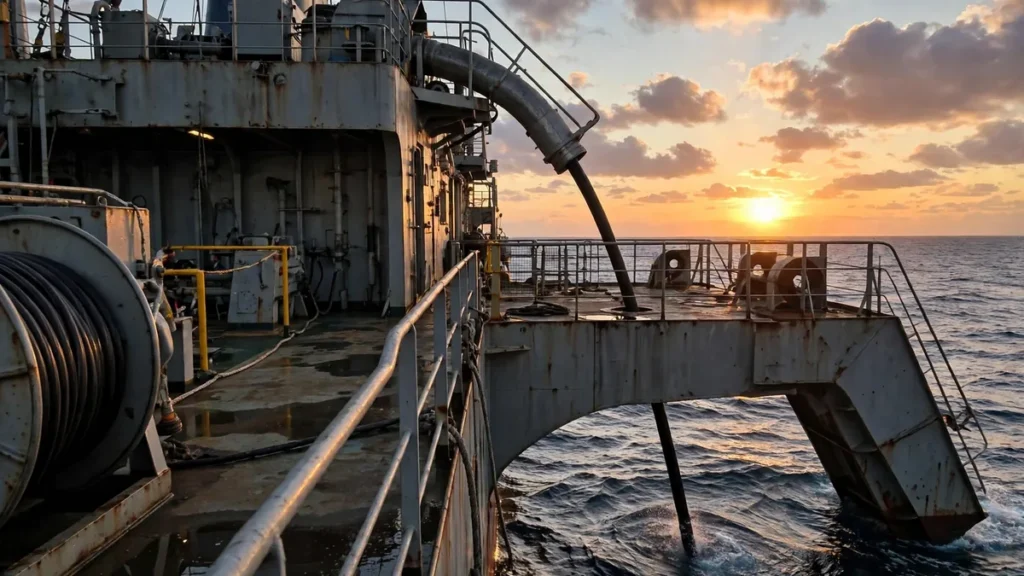
The broker slides the spec sheet across the table, and it looks like a maths exam. Length overall, beam, draught, displacement, cruising speed, range, tank capacity, diver capacity, compressor output, generator load, fuel burn, waterline, air draft, stabilisers. The numbers are all there, but the sheet never says which ones decide whether a week of diving feels easy or feels like a queue for the shower.
This guide reads a luxury dive boat spec sheet the way a divemaster would, number by number, so you can tell which figures change the diving and which are only there to fill the page. The boat in question is a typical modern luxury dive vessel of around 30 to 40 metres, and as an estimate, one like it sells for around $2 million to $8 million, depending on size and fit-out.

The spec sheet at a glance
| Specification | Typical luxury figure | What it tells you |
|---|---|---|
| Length overall | 30 to 40 metres | How much deck and cabin space there is |
| Beam | 8 to 10 metres | How steady the deck feels at anchor |
| Draught | 2 to 3 metres | How close to the reef it can anchor |
| Cruising speed | 10 to 12 knots | How fast it moves between dive sites |
| Range | 2,000 to 4,000 nautical miles | How far it can roam without refuelling |
| Tank capacity | 24 to 40 cylinders | How many divers can dive at once |
| Compressor output | 200 to 400 litres per minute | How fast empty tanks are refilled |
| Diver capacity | 16 to 24 guests | How crowded the dive deck gets |
Length and beam: how big the diving platform is
The first numbers to read are length and beam, and on a dive boat they mean something different from on a yacht. Length buys deck space and cabins, and a boat of 35 metres has room for a proper dive deck, a camera room, a compressor room and cabins that are quiet enough to sleep in between dives. Beam is the number that decides comfort, because a wide boat rolls less at anchor, and a beam of 9 metres gives a stern deck wide enough for a whole group to kit up at once without tripping over each other. The guide to how a luxury dive boat is made follows the hull from the mould to the water, and it shows how the shape is chosen for steadiness rather than speed.
Cruising speed and range: how the boat earns its living
Cruising speed on a dive boat is a modest number, usually 10 to 12 knots, and that is by design rather than by failure. A dive boat spends most of its life at anchor or moving slowly between sites a few miles apart, so a hull built for 25 knots would burn fuel for speed nobody uses, and the money is better spent on the dive systems. Range matters more, because a boat that can cover 3,000 nautical miles without refuelling can work a whole season of remote reefs and islands, while a short-range boat is tied to the fuel dock.
Tank capacity and compressor output: the diving day in numbers
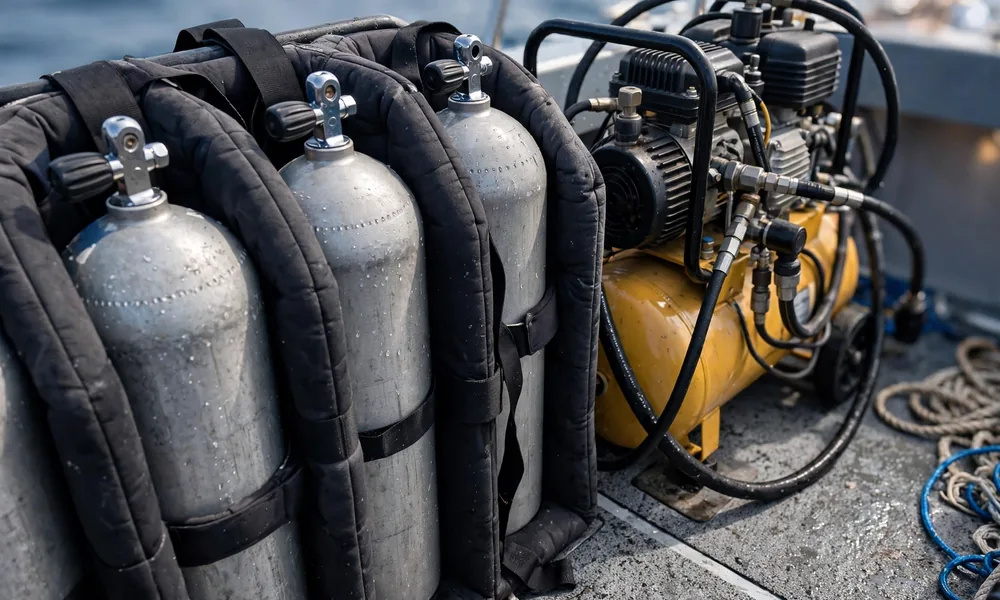
Tank capacity and compressor output are the two numbers that decide how many dives a day the boat can actually run, and they are the ones most buyers overlook. A boat that carries 36 cylinders can put 18 divers in the water twice before anything needs refilling, and a compressor that delivers 300 litres a minute can refill a tank in about ten minutes, so the whole set is ready again by the time the divers have had lunch. A slow compressor is the hidden bottleneck of a dive trip, because a boat that fills tanks all afternoon cannot run a third dive, and a boat with too few cylinders has to ration dives.
Diver capacity and cabins: how crowded it feels
Diver capacity is the number the broker quotes first, and it is the one to read most carefully. A boat listed for 24 guests may have bunks for 24, but the diving only feels relaxed if the deck, the rinse tanks, the camera room and the showers were sized for 24 as well, and on many boats they were sized for fewer. Cabins matter too, because a luxury dive boat is a place to sleep between dives, and the spec sheet should tell you whether the cabins are twins or doubles, whether they have their own bathrooms, and whether they sit above or below the waterline, where engine noise is louder.
Air systems: nitrox, rebreathers and the numbers that keep divers safe
The air systems are where a luxury dive boat separates itself from an ordinary charter boat, and the spec sheet gives them away in a handful of lines. Nitrox blending lets divers stay down longer, and the sheet should say whether the boat blends its own nitrox on board or carries it in banks, because on-board blending means the mix can be adjusted for each dive. The guide to how a luxury dive boat works follows the air from the compressor to the diver, and it shows why the compressor room is the heart of the boat.

Draught and stabilisation: getting close to the reef
Draught is a quiet number with a loud effect on the diving, because a boat that draws 2 metres can anchor close in over a reef, while a boat that draws 4 metres must anchor far out and ferry divers in by tender. Stabilisation is the companion figure, and a dive boat at anchor rolls with the swell, so fins and gyroscopic stabilisers are worth more than they are on a yacht that spends its time in a marina. A boat with proper stabilisation keeps the deck still enough to kit up in comfort, and it keeps the tender alongside instead of banging against the hull.
What the spec sheet leaves out
Every spec sheet leaves out the numbers that matter most, and on a dive boat the missing numbers are the ones about the crew. A rare fact worth knowing is that some luxury dive boats carry a small recompression chamber on board, a steel tube that can treat a diver with decompression sickness far from the nearest hospital, and it is the single most expensive safety item on the boat, costing more than the tender. The price of a dive boat is built from all of this, and the guide to why a luxury dive boat is so expensive follows the seven costs behind the figure, from the dive systems to the small market that cannot share its costs widely.
Read the sheet in this order, and it stops being a maths exam. Start with beam and tank capacity, because they decide how the diving feels. Then read compressor output and range, because they decide how many dives a day the boat can run and how far it can roam. The rest of the numbers are decoration, and a boat that scores well on the working figures is a boat worth diving from.