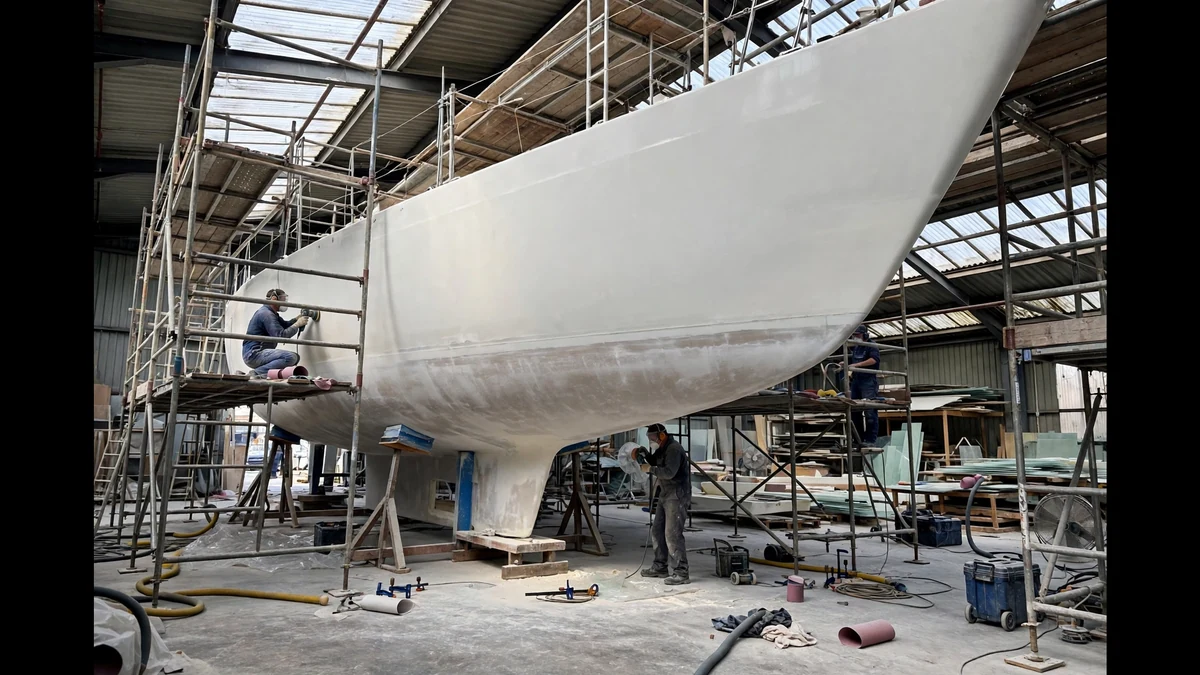
On a still morning in a boatyard, a luxury sailboat begins as nothing more than a set of drawings and a hull mould the size of a house. There is no rigging yet, no gleaming deck, just a team of builders whose next twelve months of work will eventually carry a family across an ocean, quietly and under sail alone.
A luxury sailboat is not assembled the way a car is. It is built by hand, in stages, by specialists who rarely meet: laminators who shape the hull, joiners who fit the interior, riggers who tune the mast, and electricians who wire a floating home. Each trade has to be right, because a mistake buried under a deck can be impossible to reach once the boat is at sea.
This is how that transformation happens, from an empty mould to a finished yacht ready for its first sea trial, and what makes a luxury sailboat different from an ordinary production boat.
How a Luxury Sailboat Is Made
A luxury sailboat is built in six main stages: the hull is moulded, the deck is fitted, the interior is joined, the rig is stepped, the systems are installed, and the boat is tested at sea.
Step 1: Moulding the hull
Everything starts with the mould, a polished female form that defines the exact shape of the hull. Builders lay gelcoat into the mould first, the smooth coloured skin of the finished hull, then layer after layer of fibreglass cloth and resin. On a luxury build, the hull is often a sandwich: fibreglass skins bonded to a foam or balsa core, which makes it stiff and light at the same time. When the hull is finally lifted out, the shell is already recognisable as a boat, though it is hollow and a long way from finished. The steel hulls of the largest yachts are built very differently, as described in how a superyacht steel hull is made, where plates are cut, welded, and faired into a very different kind of strength.
Step 2: Fitting the deck and bulkheads
With the hull out of the mould, the builders fit the structural bulkheads, the vertical walls that divide the interior and give the hull its rigidity. These are bonded in with thickened resin and glass tape, measured to the millimetre, because every cabin and tank depends on them. The deck is moulded separately, then lowered onto the hull and bonded and bolted around the sheer line. Teak decking, if the owner has chosen it, is laid plank by plank, each strip glued and caulked by hand. It is slow, expensive work, and one of the clearest signs of a luxury build. The craft behind that finish is the same patient work described in how a yacht teak deck is made, where every plank is fitted and sealed by hand.
Step 3: Building the interior
While the hull and deck cure, the joinery shop builds the interior as modules: cabins, galley, saloon, and heads, crafted from veneered marine plywood, solid timber trim, and stone worktops. Luxury interiors use book-matched veneers, where slices of the same log mirror each other across a door or panel. The modules are craned into the hull before the deck is sealed, because a finished saloon table would never fit through a hatch. Every surface is finished to furniture standard, and every drawer runs on soft-close runners. Wiring and plumbing runs are fitted behind the panels as the joinery goes in, so nothing is visible except switches, lights, and taps.
Step 4: Stepping the mast and rigging
The mast of a luxury sailboat is usually aluminium or carbon fibre, built in sections and finished with anodising or paint. It is stepped, lowered vertically into the boat by crane, and secured at the keel step and the deck partners. Then the riggers arrive with the standing rigging that holds the mast upright and the running rigging, the ropes that control the sails. Each wire is cut to length and tensioned with a gauge until the mast is straight and the rig is balanced. The numbers that decide all of this, from wire diameters to safe working loads, are the same kind of figures explained in yacht sail rigging specs explained, where every stay and shroud is sized for the loads it will actually carry. The rig is then tuned again under sail, because a mast that looks straight at the dock can bend very differently in the wind.
Step 5: Installing the systems
A luxury sailboat is also a small power station. Builders install a diesel engine, a generator, battery banks, a watermaker that turns seawater into drinking water, air conditioning, navigation electronics, radar, and safety gear. The wiring alone can run to several kilometres, loomed and labelled for later fault-finding. Tanks for fuel and water sit low in the hull, and the plumbing is pressure-tested before the joinery hides it. Every system is commissioned one by one: the engine is run, the watermaker is tested, and the electronics are calibrated.
Step 6: Sea trials and handover
Before handover, the boat goes to sea for trials. The builders check the engine at full throttle, test the sails on every point of wind, and listen for anything that rattles, leaks, or vibrates. The rig is re-tuned, the sails are checked for shape, and any snag is written on a list and fixed. The owner then takes the boat for an acceptance sail with the yard’s skipper aboard, and the handover includes a full briefing on every system. Only when the list is empty does the boat truly belong to its owner.
Luxury Sailboat Specifications
| Specification | Typical figure |
|---|---|
| Length overall | 15 to 25 metres |
| Hull construction | Fibreglass sandwich, foam or balsa core |
| Displacement | 15 to 40 tonnes |
| Mast | Aluminium or carbon fibre, 20 to 30 metres |
| Engine | 50 to 150 horsepower diesel |
| Fresh water | 400 to 1,000 litres |
| Fuel | 300 to 800 litres |
| Berths | 6 to 10 |
| Build time | 9 to 18 months |
What Does a Luxury Sailboat Cost?
A luxury sailboat is priced by length, materials, and the level of custom work. A 15-metre semi-custom yacht typically costs an estimated $1 million to $2.5 million, while a 20 to 25-metre fully custom build typically costs an estimated $4 million to $12 million, with the joinery, rig, and electronics accounting for much of the difference. Annual running costs are typically an estimated 8 to 10 percent of the purchase price, covering berthing, insurance, maintenance, and crew. A carbon mast alone can add an estimated $150,000 to $400,000 over aluminium.
A Rare Fact About Luxury Sailboats
Here is the detail most people miss: the hull of a luxury sailboat is often built upside down, or rather, the deck is. Many yards mould the deck with its underside facing up, so the builders can fit the headlining, wiring, and deck hardware from above, working with gravity instead of against it, before the deck is flipped and lowered onto the hull. It is a quiet piece of workshop logic: every cable and fitting was placed while the builders could actually see what they were doing.
A luxury sailboat is the sum of a thousand small decisions made by hand: a veneer matched across a door, a wire tensioned to the kilogram, a plank caulked so it will not leak in ten years. No machine can make those choices, which is why the best yards still build one hull at a time. The sea does not care how much a boat cost. It cares whether it was built properly, and a luxury sailboat is built to answer that question with a quiet yes.


