The smell hits you before the sight does. Step into a boatyard shed on a warm morning and the air is thick with it: warm, honeyed, faintly oily, the smell of freshly cut teak. Somewhere in the shed, a shipwright is on his knees on the deck of a yacht, a plank in his hands, sighting along its edge the way a carpenter sights a rifle barrel. The deck beneath him is half-finished — golden strips of wood laid in perfect parallel lines, dark seams waiting for their caulking, the white hull curving away on either side. It is slow work. A single deck can take a team of four a month or more. And when it is done, the owner will walk across it in bare feet and never once think about the month it took, which is exactly the point. A good teak deck is meant to be felt, not noticed.
Teak has been the deck of choice for working boats and grand yachts alike for more than a century, and the reasons have not changed. The wood is dense with natural oils, so it shrugs off salt water that would rot most timber in a season. It stays cool under a tropical sun and keeps its grip when wet, where fibreglass turns treacherous. But none of that matters unless the deck is laid well. Teak moves with heat and moisture and blunts tools with the silica in its grain. Laying a deck is less like flooring a room than building a ship’s skin, one plank at a time.

There are two ways to build a teak deck, and the choice shapes everything that follows. The traditional way screws each plank down through the deck beneath, plugging every screw hole with a small teak bung. The modern way — now standard on most new yachts — glues the planks down with a flexible adhesive and uses no screws at all, which means no holes through the deck and nothing to leak. Both end in the same place: narrow planks separated by a thin black seam. That seam is the signature of a teak deck, and its engineering: the wood swells when wet, pressing tight against the caulking and sealing the deck.
How It’s Made
Step 1: Choosing and milling the timber
It starts in the timber yard, not the boatyard. Deck teak is quarter-sawn, which means each plank is cut so the grain runs straight down its face — straighter grain, less movement, fewer knots. Each plank is milled to a precise width, usually 40 to 45 millimetres, and a thickness of 6 to 12 millimetres depending on whether it will be glued or screwed. The edges are machined with a slight bevel, so the gap between two planks is wider at the top — a V-shape that holds the caulking like a dovetail.
Step 2: Preparing the deck beneath
A teak deck is only as good as what lies under it. The structural deck — fibreglass, steel or aluminium — is faired smooth, checked for flatness, and sealed with an epoxy primer. This stage is part of the hull’s own story — see how a superyacht hull is built — and any hollow or high spot will telegraph through the thin planks above it. The deck is then marked out: a centreline is drawn, and the plank layout is planned around hatches, winches and curves, so the seams fall in fair, unbroken lines.
Step 3: Laying the planks
Laying begins at the centreline and works outward, one plank at a time. Each plank is dry-fitted first, then lifted, buttered with adhesive or bedded on a compound, and pressed home. Spacers hold the seams at a steady width — usually 4 to 6 millimetres — while the glue cures. The shipwright sights along each new plank before it sets, because a plank laid a degree out of true will be visible from fifty metres away once the deck is finished.

Step 4: Caulking the seams
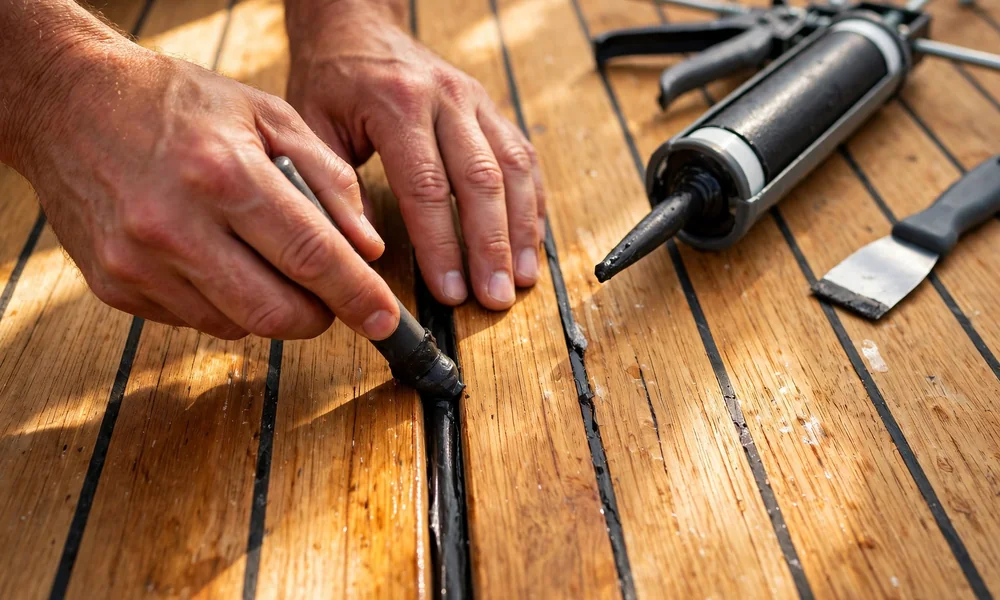
Once the glue has cured, the seams are caulked. A two-part polysulphide or polyurethane compound — black, and almost tar-like — is gunned into each V-shaped gap, slightly proud of the surface. This is the step that gives a teak deck its look, and it is also the step that keeps the sea out. The caulking stays flexible for the life of the deck, moving as the planks swell and shrink with the seasons.
Step 5: Sanding and finishing
With the caulking cured, the whole deck is sanded flat. The team starts coarse and works finer, taking the caulking down flush with the planks and revealing the grain. Sanding a teak deck is a skill in itself: press too hard and the soft grain hollows out, leaving the hard grain standing in ridges; sand across the grain and the scratches will show in sunlight forever. On many yachts the deck is left bare after sanding — no oil, no varnish — because bare teak grips best underfoot and weathers honestly.
Step 6: Fitting out and sea trials
Last come the details that make the deck a working part of the yacht. Hatches are re-bedded, cleats and winches are bolted through to the structure below with their holes carefully sealed, and the margin planks are trimmed at the bulwark. The deck is washed down with salt water — fresh water is the enemy of teak, oddly enough, because it feeds the mildew that salt suppresses — and inspected in hard sunlight for missed seams or proud caulking. Then the yacht goes to sea. A deck that survives its first season of sun, spray and bare feet without a seam opening has passed the only test that matters. The same care that goes into how gyroscopic stabilizers work applies here: a deck that never moves underfoot. And when a yacht is built in sections far from the water, the deck may be laid in a hall and shipped with the vessel, as in modular ship construction.
Specs
| Specification | Typical value |
|---|---|
| Plank width | 40–45 mm |
| Plank thickness | 6–12 mm (glued); 9–12 mm (screwed) |
| Seam width | 4–6 mm, caulked |
| Caulking | Two-part polysulphide or polyurethane, black |
| Fixing (modern) | Flexible adhesive, no screws |
| Fixing (traditional) | Screwed and bunged |
| Deck lifespan | 20–30 years with care; re-sandable several times |
| Maintenance | Salt-water wash; sanding every few years |
Price
A teak deck is one of the most expensive surfaces on a yacht, and the price is mostly labour. The timber itself is costly — genuine marine-grade teak sells for an estimated $25–$35 per board foot — but the laying, caulking and sanding take weeks of skilled handwork, and that is where the bill grows. As an estimate, a full teak deck on a 40–50 ft yacht typically costs $30,000–$100,000 or more installed, depending on the yard, the complexity of the deck, and whether the old deck must be stripped first; on a large superyacht the figure runs into the hundreds of thousands.
A Rare Fact
Teak is one of the few woods that gets better at keeping water out the wetter it gets. Its fibres swell as they absorb moisture, pressing each plank tight against the caulking in its seams — so a teak deck is at its most watertight in a rainstorm, and at its leakiest after months baking dry in a shed. The deck does not just resist the sea. It uses it.


