Forty feet of yacht, heeled hard to leeward, the rail buried and the sea hissing past the hull. The wind is gusting to thirty knots, the mainsail is full and thrumming, and every tonne of that force is held by wires no thicker than your little finger. If a single shroud, turnbuckle or pin lets go, the whole rig comes down in seconds, taking the mast, the sails and the crew’s season with it.
That is what yacht sail rigging is: a web of wire and rope that turns wind into speed and keeps a tall, heavy spar standing over a moving deck. It looks simple from the dock — a mast, a few wires, some ropes — but every piece is sized to a number, a compromise between strength, weight and stretch. Get the numbers right and the boat sails fast and safe. Get them wrong and the rig sags, stretches and slows the boat, or breaks at the worst possible moment.
The rigging on a yacht falls into two families. Standing rigging is the fixed wire that holds the mast up, while running rigging is the rope that raises, trims and controls the sails. The two families work together on every point of sail, and the way they are built and tuned is the subject of how yacht sail rigging works. The wire itself, and the rope that replaced it in some places, is made to exact standards — the story of how yacht sail rigging is made explains what goes into each strand. Here is what the specifications mean, in plain English.

The Specs, Explained
1. Standing rigging: wire size and breaking load
Standing rigging is almost always 1×19 stainless steel wire — nineteen strands twisted into a single stiff rope — and its size is the first number on any rigging specification. A typical 40-foot cruising yacht uses 8 mm wire for its cap shrouds, the wires that hold the mast sideways, and 7 or 8 mm for the forestay and backstay. The number that matters most is the breaking load: 8 mm wire breaks at roughly 5,600 kilograms, while 10 mm wire breaks at about 8,600 kilograms. Rigging is never loaded anywhere near its breaking point in normal sailing, but the margin is there for gusts, waves and the shock of a sudden gybe.
2. Running rigging: rope diameter and stretch
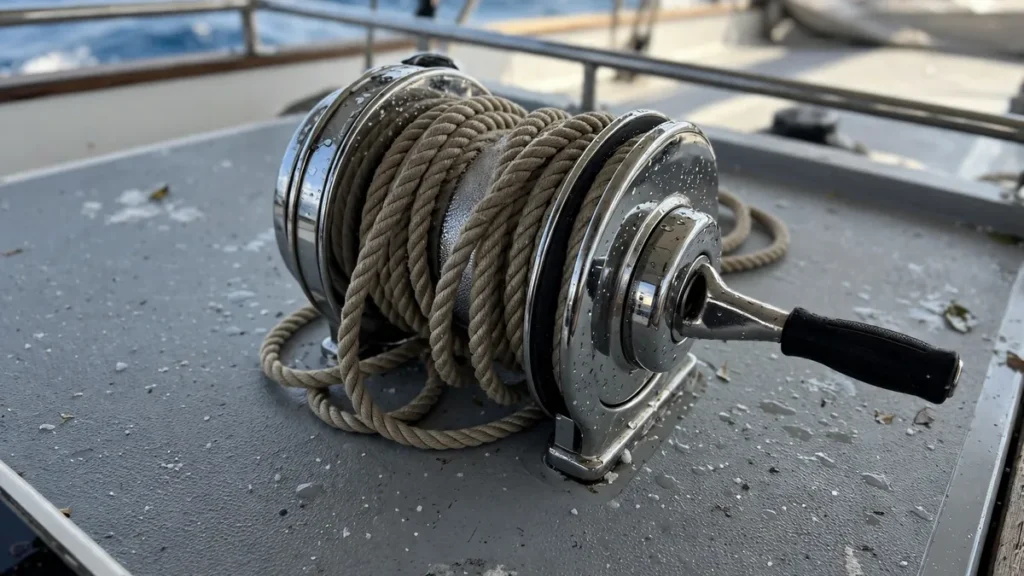
Running rigging is rope, and its specification balances diameter, strength and stretch. Halyards, which hoist the sails, must stretch as little as possible, so modern yachts use low-stretch Dyneema or polyester-cored rope, usually 10 to 12 mm on a 40-footer. Sheets, which trim the sails, are thicker for grip — 12 to 14 mm is common. A 12 mm Dyneema halyard can break above 4,000 kilograms yet weigh a fraction of the wire it replaced. The trade-off is cost: high-tech rope can cost five times as much as ordinary polyester, and it needs careful handling to avoid chafe.
3. Mast height and sail area
The mast is specified by its height above the waterline and by the sail plan it carries. A 40-foot cruising yacht typically carries a mast around 18 to 20 metres tall, with a mainsail of roughly 40 square metres and a headsail of 35 to 45 square metres. Sailmakers describe the rig with four letters — I, J, P and E — measuring the height and base of the foretriangle and the mainsail. The taller the mast and the bigger the sails, the heavier the loads on every wire and fitting.
4. Rigging tension: tuning the rig
A rig is tuned to a precise tension, measured with a gauge on each wire. Cap shrouds are tensioned to about 15 to 20 per cent of their breaking load, the forestay slightly tighter, because a sagging forestay ruins the headsail’s shape. Too loose and the mast pumps and sways in a seaway, fatiguing the wire at its terminals. Too tight and the hull can be squeezed, distorting the deck and overloading the chainplates. A well-tuned rig stands straight, its leeward shrouds going just slack in a strong gust.
5. Materials: stainless wire versus synthetic fibre
Stainless steel has been the default rigging material for decades because it is strong, cheap and familiar. But synthetic fibre — Dyneema and its cousins — is now found on racing yachts and increasingly on cruisers. A Dyneema stay of the same strength as steel wire weighs about a seventh as much, does not corrode, and can be inspected by eye for chafe. Its weaknesses are creep, a slow permanent stretch under load, and vulnerability to heat and ultraviolet light. Steel is forgiving and long-lived; fibre is light and fast but demands more attention. The engineering behind that choice is covered in rigging a yacht sail and the materials that hold the wind.
6. Fittings: turnbuckles, chainplates and terminals
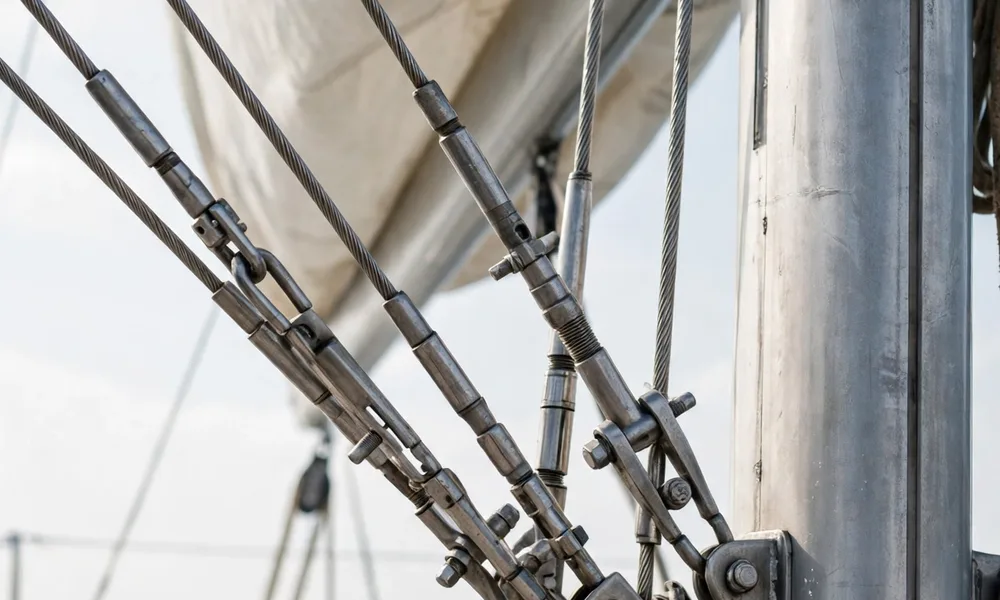
The wires are only as strong as their fittings. At the bottom of each wire sits a turnbuckle, a threaded barrel that adjusts the tension, and at the top a terminal that connects the wire to the mast. At the deck, the wires meet chainplates, stainless straps bolted through the hull or to a bulkhead. A chainplate on a 40-footer is typically 6 to 8 mm thick and 50 mm wide, and it must be inspected for crevice corrosion, the hidden enemy of stainless steel in damp, oxygen-starved places. Most rigging failures are a fitting failing at an end, not the wire breaking in the middle, which is why riggers inspect terminals and chainplates first.
Yacht Sail Rigging Specs
| Specification | Typical range |
|---|---|
| Mast height (40 ft yacht) | About 18 to 20 metres above the waterline |
| Mainsail area | About 35 to 45 square metres |
| Cap shroud wire diameter | About 8 mm (1×19 stainless steel) |
| 8 mm wire breaking load | About 5,600 kilograms |
| Forestay diameter | About 7 to 8 mm |
| Halyard diameter | About 10 to 12 mm, low-stretch rope |
| Sheet diameter | About 12 to 14 mm |
| Cap shroud tension | About 15 to 20 per cent of breaking load |
| Standing rigging replacement | About every 10 to 15 years |
What Does Yacht Sail Rigging Cost?
A complete re-rig of a 40-foot cruising yacht — new standing rigging, turnbuckles and terminals, fitted by a professional rigger — is estimated to cost roughly $8,000 to $20,000, depending on wire size and the number of stays. Replacing the running rigging is estimated at a further $2,000 to $5,000 for good-quality rope. Prices are estimates only: synthetic fibre rigging can double the cost, and a racing yacht’s rig can cost several times more than a cruiser’s.
A Rare Fact
Experienced riggers still tune a yacht’s rig partly by ear. They pluck a shroud the way a musician plucks a guitar string and judge its tension from the note — a tighter wire sings higher, a looser one hums lower. It works because a wire under tension behaves exactly like a string: its pitch rises with the load. Modern riggers check the result with a gauge, but many still start with a pluck, a listen and a nod.

Next time you watch a yacht lean into a gust, look past the sails to the thin wires doing the work. They are the smallest part of the boat to look at — and the part the whole boat is hanging from.