A luxury sailing catamaran does not begin its life on the water. It begins in a vast, bright shed, where two long hulls lie side by side in their moulds like the twin runners of a sled. Between them, workers move with rollers and resin, laying cloth that will become a boat wide enough to hold a saloon, a galley, and four cabins, yet light enough to be pushed along by wind alone.
That width is the whole idea. A single-hull yacht heels over when the wind fills its sails, leaning hard and spilling speed. A catamaran stands on two hulls, spreading the load across a broad platform that stays level, and that steadiness is what luxury buyers pay for. This is how a luxury sailing catamaran is made.
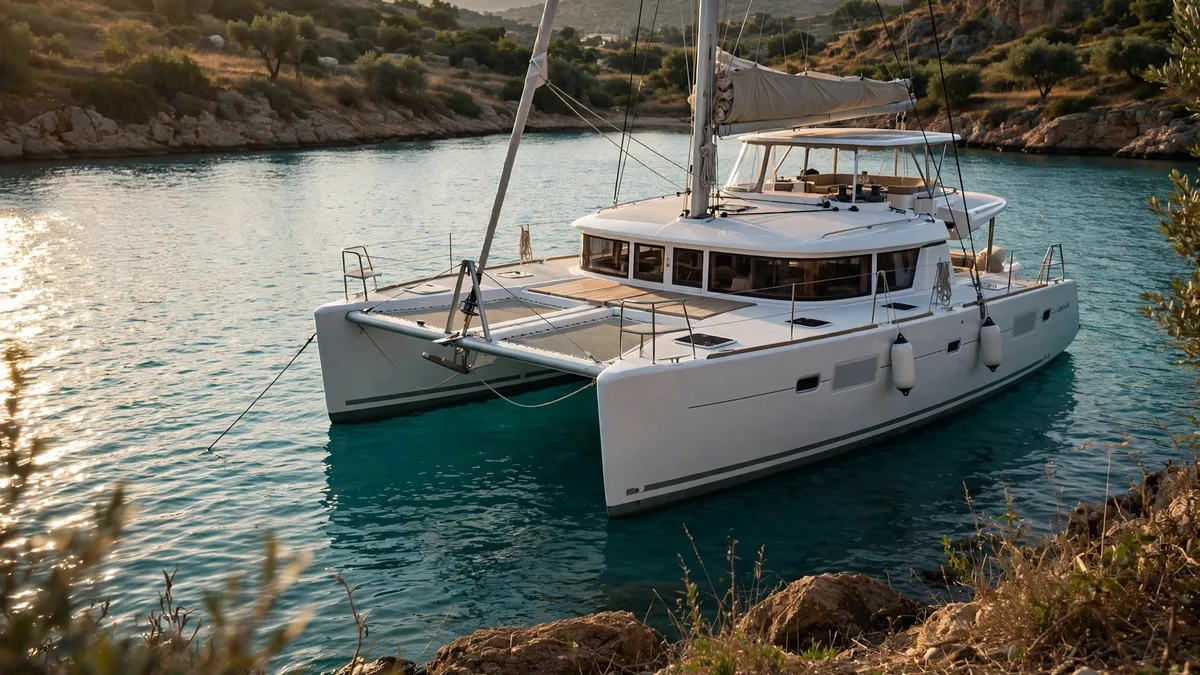
Step 1: The two hulls
Each hull is built in its own female mould, a polished shell shaped exactly like the outside of the finished hull. Builders brush in a gel coat first, the smooth coloured skin that will face the sea, then layer fibreglass cloth and carbon fibre reinforcement, wetting each layer with epoxy resin and rolling it flat to drive out air. Foam core panels go between the skins, giving the hull stiffness without much weight.
The work is slow and physical, and every layer must cure before the next goes on. How a luxury catamaran is made follows the same twin-hull logic on a power catamaran, where the two hulls are shaped for engines rather than sails but the moulding craft is identical.
Step 2: The bridge deck and the beam structure
Once the hulls have cured, they are lifted from their moulds and set on cradles at the exact spacing the design demands. The bridge deck, the wide platform that joins them, is then lowered into place, along with the crossbeams that tie the whole structure together. These beams take enormous loads when a wave lifts one hull and the other stays down, so they are built from carbon fibre and bonded with structural adhesive as well as bolts.
This is the moment the boat stops being two hulls and becomes a catamaran. The deck must be fair and level, because every cabin, window, and fitting that follows will be measured from it.
Step 3: The rig, the mast, and the sails
A sailing catamaran needs a rig built for a wide, stable platform. The mast is usually aluminium or carbon fibre, stepped on the bridge deck rather than on a single hull, and it carries a tall mainsail and a headsail on a roller furler. Standing rigging, the wire and rod stays that hold the mast upright, is tensioned carefully, because a mast that leans even slightly will make the boat sail in circles.
The sails themselves are cut from laminated cloth, shaped with a curve that catches the wind like an aircraft wing. Winches, tracks, and lines are fitted so a small crew can handle a very large sail area from the helm.
Step 4: Engines, steering, and systems
Even a sailing catamaran needs engines, one in each hull, usually small diesels of thirty to sixty horsepower, for manoeuvring in harbour and for motoring when the wind dies. Each engine drives its own propeller, and because they sit far apart, the helm can steer the boat by running one engine ahead and the other astern, spinning the wide boat in its own length.
Below deck, the systems go in: water tanks, a generator, batteries, plumbing, and a watermaker. The wiring runs through conduits that are fitted before the interior panels go on, because reaching them later means taking the boat apart.
Step 5: The interior
The interior of a luxury sailing catamaran is built like a small apartment that happens to float. Cabins fill each hull, usually two per side, with a saloon and galley spanning the bridge deck between them. Joiners fit light wood veneers, soft upholstery, and stone-effect worktops, all chosen to be light, because every kilogram above the waterline makes the boat slower and less stable.
Windows are large, wrapping around the saloon so the crew can see the horizon from the table. How a luxury sailboat is made shows a different interior challenge on a single-hull boat, where the same comfort has to fit into a narrow, heeling space instead of a wide, level one.

Step 6: Launch, tuning, and sea trials
When the build is finished, the catamaran is lifted by travel hoist and lowered into the water for the first time. The first hours afloat are spent checking for leaks, testing both engines, and confirming the boat floats level. Then the sails go up, and the rig is tuned under load, adjusting the stays until the mast stands straight and the sails set cleanly.
Sea trials follow, with the boat sailed through tacks and gybes, tested at speed, and checked for vibration and noise. Only when the boat sails straight, stops cleanly under power, and holds its course does the builder hand it over. What a luxury sail catamaran is explains the design the builders are aiming at, a wide, stable platform that trades the lean of a monohull for space and comfort.
Specifications
| Detail | Specification |
|---|---|
| Hull material | Fibreglass and carbon fibre with foam core |
| Length overall | Around 14 to 18 metres |
| Beam | Around 7 to 9 metres |
| Displacement | Around 15 to 25 tonnes |
| Mast height | Around 20 to 24 metres |
| Sail area | Around 130 to 180 square metres |
| Engines | Twin diesels, around 30 to 60 horsepower each |
| Cabins | Usually four, two in each hull |
| Cruising speed under sail | Around 8 to 12 knots |
| Fuel capacity | Around 800 to 1,200 litres |
Price
The estimated price of a luxury sailing catamaran is around 1,200,000 to 2,500,000 dollars, and that figure is an estimate only, because the cost depends on length, materials, and the level of interior finish. The twin hulls and the carbon rig account for a large share, followed by the engines and the interior joinery. A buyer is paying for a boat that can cross an ocean under sail, sleep eight people in comfort, and sit level at anchor while a single-hull yacht rolls in the swell.
A rare fact
Few people know that a sailing catamaran can outrun the wind that pushes it. Because the boat is light and its hulls are narrow, it can sail faster than the true wind speed on a reach, a feat a heavy single-hull yacht cannot match. The crew feels the apparent wind shift forward as the boat accelerates, and the sails must be trimmed for a wind that seems to come from ahead, not behind.
When the catamaran finally leaves the shed and raises its sails, it looks effortless, just a wide white boat gliding over the water. That ease is the achievement of two hulls, a stiff deck, and a rig tuned to the last millimetre.


