A luxury ship carries a hundred people or more, and every one of them has to eat, three times a day, for weeks at a time, far from any shop. The room that makes that possible is the crew mess, a canteen on a scale no yacht ever needs: long rows of tables, a serving line as long as a kitchen, and a galley behind it that cooks like a small restaurant. It is one of the largest crew spaces on the ship.
A luxury ship crew mess is the dining hall for the ship’s crew, built on the accommodation decks beside the galley. It seats dozens of crew at a sitting, serves food from a long heated line, and is built to maritime rules that fix its size, its ventilation and its finishes. This is how that room is made, from the deck plan to the first meal served at sea.
How It’s Made
Step 1: Two messes are planned, not one
A ship does not have one mess. By long tradition it has two: an officers’ mess for the senior crew and a crew mess for everyone else, each with its own room, its own serving arrangements and its own character. The planners place both on the same deck as the galley, so hot food travels a few steps instead of up a stairwell, and both are sized from the crew list: the room must seat at least half the crew it serves at once. The officers’ mess is smaller and quieter, while the crew mess is the bigger hall, built for speed and volume. Getting the two rooms right on the plan shapes the whole accommodation block. The crew who eat here sleep nearby, and how luxury ship crew quarters are built shows the cabins they return to after dinner.
Step 2: The room arrives as a module
Modern ships are not fitted out room by room inside the hull. Much of the accommodation arrives as prefabricated modules, complete rooms built in a workshop ashore, and the crew mess is often one of the largest of them. The module is built with its floor, walls, ceiling, tables and serving line already fitted, its wiring and pipes already run, and its furniture already bolted down. A crane lifts it over the side and lowers it into the hull, where welders fix it to the deck. The ship gains a whole dining hall in a single lift.
Step 3: The serving line is the heart of the room
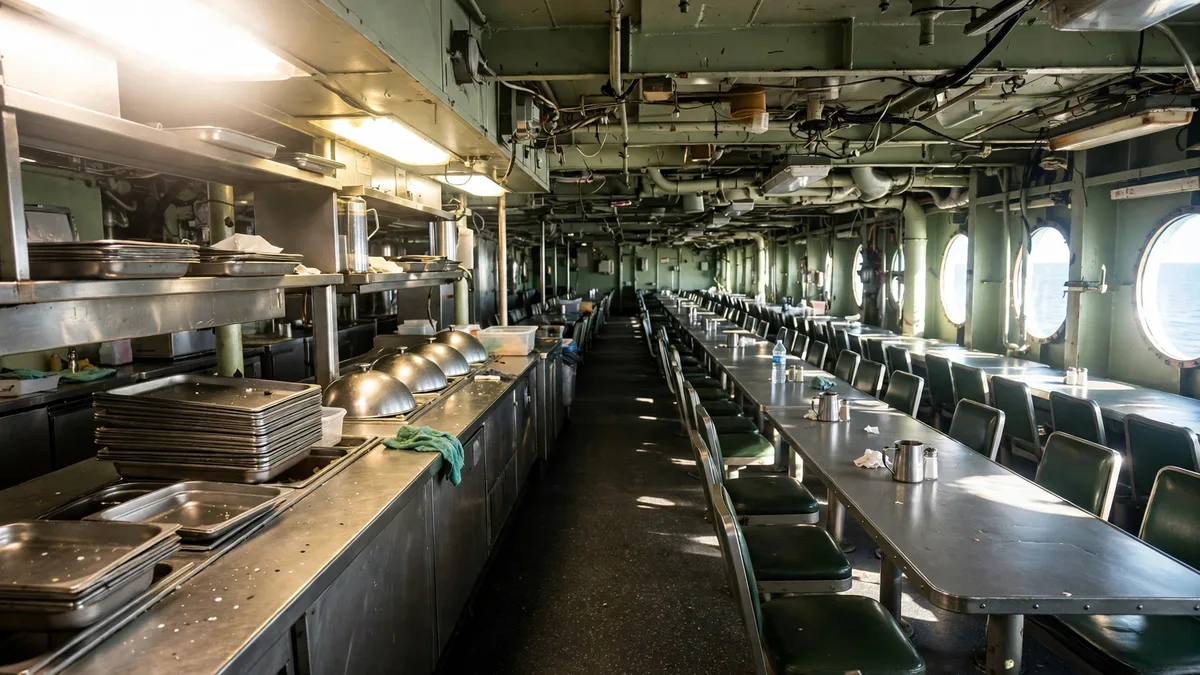
The centrepiece of the mess is its serving line, a run of stainless steel counters six to ten metres long. Hot dishes sit in a bain-marie, a heated water bath that keeps food at serving temperature without drying it out, and beside it run a salad bar, a bread station and a drinks counter with water, juice and coffee. The line is built from marine-grade stainless steel with welded seams, so it can be hosed down and disinfected at the end of every service. The line serves a hundred crew in under half an hour. The kitchen behind the line is the subject of how a luxury ship galley is built, and it cooks for the whole ship.

Step 4: Tables and chairs are fixed for heavy weather
The furniture in a ship’s mess is built to stay put. Tables are pedestal models bolted through the floor, four to six seats to a table, with a raised edge to stop plates sliding in a swell. Chairs are fixed to the deck, with wipe-clean vinyl seats. The floor is a non-slip resin with drains, laid to a gentle fall so wash water runs away instead of pooling under the tables. Everything is arranged so the room can be cleared, washed and reset between sittings in minutes, because the next watch is always coming.
Step 5: Ventilation and power for a hundred diners
A hundred diners generate a remarkable amount of heat and steam, so the ventilation is sized like a small factory’s. Supply fans push in cool fresh air while extract fans over the serving line pull out the heat and steam, delivering twelve to twenty air changes an hour. The air conditioning is a separate zone from the cabins, because the mess is full at midday when the cabins are empty, and the ducts are insulated to stop condensation dripping onto the tables. The room carries its own public address speaker and emergency lighting that stays on if the main power fails.
Step 6: Inspection, certification and the first service
Before the mess can open, it is inspected against the maritime labour rules that govern crew accommodation: the size, the seating, the ventilation, the lighting and the facilities for preparing and eating food are all measured and recorded. Then comes the sea trial, and the first real test is a meal served under way, with the galley working at full pace and the crew eating in a rolling ship. Engineers watch for rattles, check that the serving line stays steady and confirm that the ventilation keeps the room comfortable. Only when the room passes does the mess open for the crew, and from that day it never really closes.
A ship’s crew mess is a canteen, a meeting place and a rest room all at once, and it is built like all three. It is fitted with steel that can be hosed down and ventilated like a factory, yet at dinner it is the warmest room on the ship. The crew eat there, swap news there and plan the next watch there, and the room earns its keep every day of a long voyage. It is the least glamorous space in the accommodation block, and one of the hardest to get right. The rooms work as a pair, and how luxury ship crew quarters work shows the other half of life below deck.
Ship Crew Mess Specifications
| Feature | Typical Detail |
|---|---|
| Seats | 60 to 120 crew per sitting, in two separate messes |
| Floor area | 80 to 150 square metres, beside the galley |
| Serving line | 6 to 10 metres of stainless steel, bain-marie and salad bar |
| Tables | Pedestal tables bolted to the deck, four to six seats each |
| Ventilation | 12 to 20 fresh air changes per hour, dedicated extract |
| Messes | Separate officers’ mess and crew mess, by tradition |
| Floor | Non-slip resin with drains, laid to a gentle fall |
How Much Does a Ship Crew Mess Cost?
Building a luxury ship crew mess typically costs an estimated $250,000 to $800,000, set mostly by the size of the hall, the length of the serving line and the scale of the ventilation. A smaller mess on a modest ship sits near the bottom of the range, while a large hall with two messes, a ten-metre serving line and a dedicated air-handling plant costs far more. Spread across a hundred crew eating three meals a day for years, it is one of the best-value rooms on the ship.
A Rare Fact About Ship Crew Messs

Here is a rule that shapes the whole ship: under maritime labour rules, a ship’s mess must be separate from the sleeping cabins and large enough to seat at least half the crew it serves at once. That single requirement is why the mess is drawn into the ship’s general arrangement before almost any other crew space, and why it sits beside the galley rather than wherever space is left over. The rule exists because a tired crew needs a proper place to eat, not a corner of a cabin.


