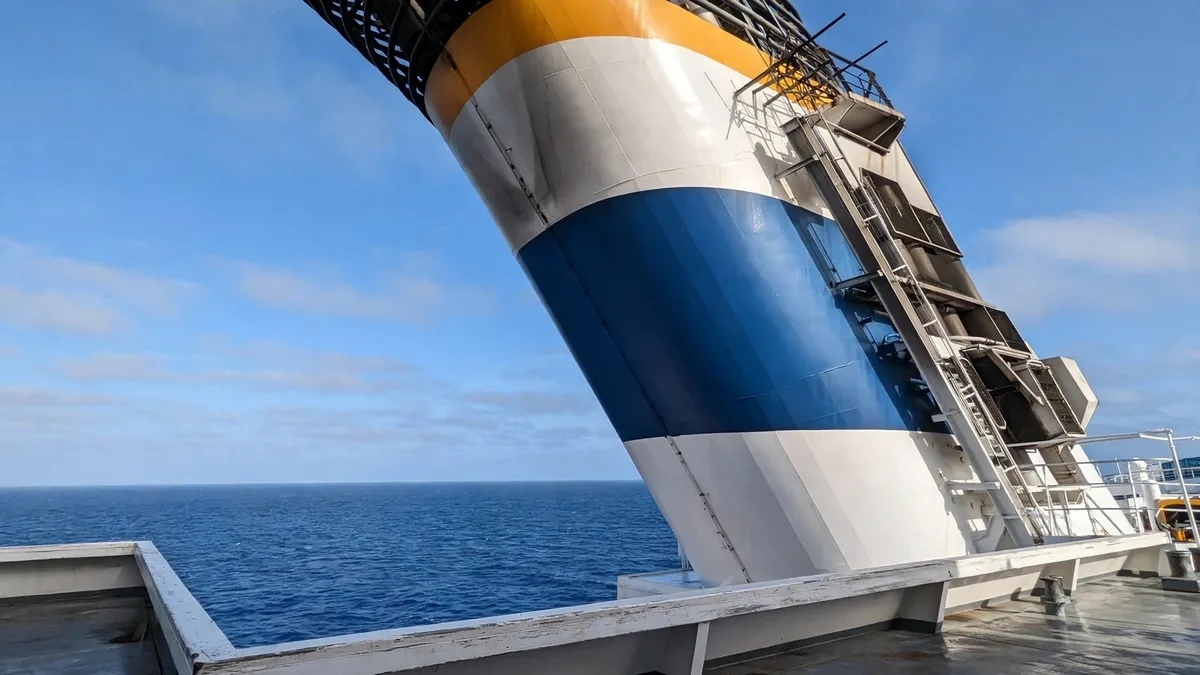
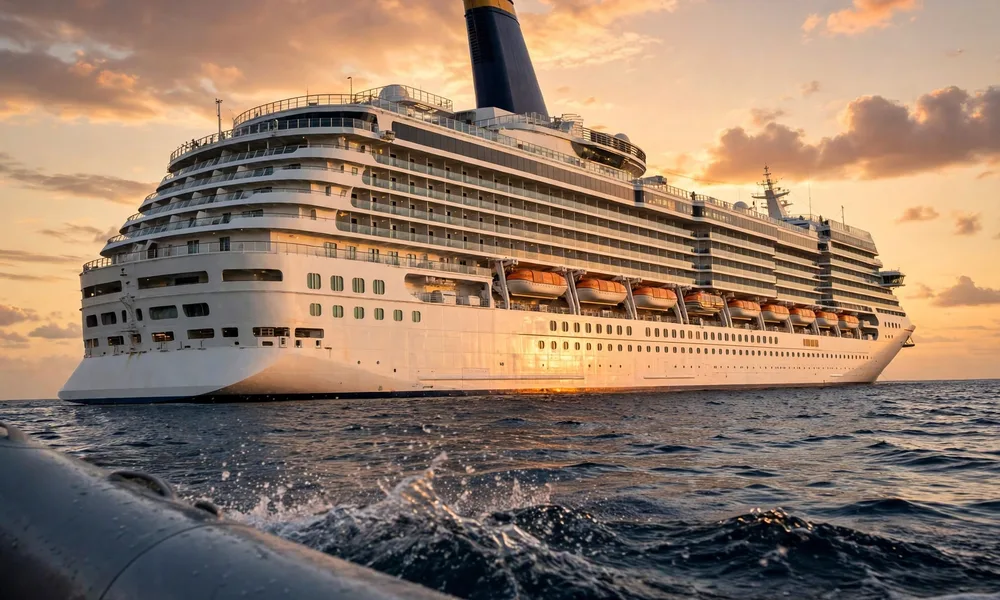
Stand on the deck of a cruise ship at sunset and look up. The funnel rises above you like a tower, painted in the colours of the shipping line, with smoke or steam drifting from its top. It is the tallest thing on the ship, the first thing you see from the shore, and the part of the ship that most people think they understand, until someone asks what it actually does.
A luxury ship funnel is not a chimney. It is a tall, carefully shaped casing that hides the exhaust pipes from the engines, the boilers and the generators, carries their hot gases safely away from the decks, and gives the ship its identity. Inside it is a maze of pipes, fans, filters and ladders, all working together to keep the ship breathing, and to keep the smoke away from the passengers.
How It Works
Step 1: Collecting the exhaust from the engines
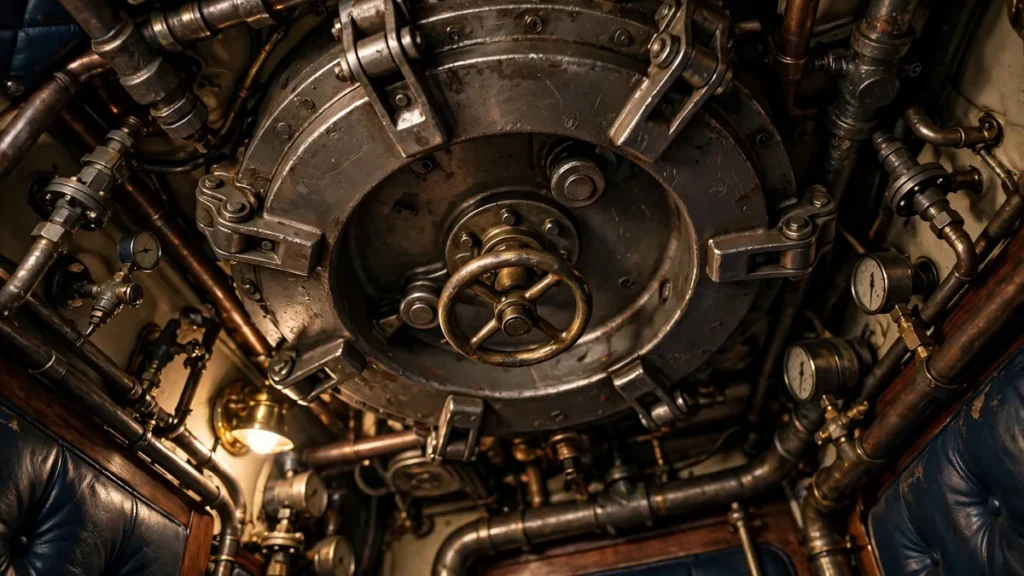
Deep in the engine room, the ship’s main engines burn fuel and produce power, and with that power comes hot exhaust gas. Each engine has its own exhaust pipe, a thick steel tube that carries the gas upwards through the ship. The pipes are insulated, so they do not heat the rooms they pass through, and they are fitted with expansion joints, so they can grow longer when they get hot without cracking.
The exhaust from the boilers and the generators joins the same system, each pipe feeding into the funnel casing at its own level. The way a luxury ship engine room is specified shows how the engines that feed the funnel are planned, with space for every pipe and every valve.
Step 2: Cleaning the gas on the way up
Before the exhaust leaves the funnel, it is cleaned. Modern luxury ships use scrubbers, tall towers inside the funnel where the gas is sprayed with water or a chemical solution that washes out sulphur and soot. The dirty water is collected, treated and stored, never pumped straight into the sea, and the cleaned gas continues upwards, much clearer than it was when it left the engine.
If the readings are wrong, the crew knows at once, and the ship can slow down or switch to a cleaner fuel until the problem is fixed. The funnel is the last place where the ship’s exhaust can be cleaned, so the equipment inside it matters as much as the engines below.
Step 3: Using the funnel shape to lift the smoke
The funnel is tall for a reason. Hot gas rises, and the taller the funnel, the stronger the pull that draws the gas up and away from the decks. The top of the funnel is shaped to throw the gas high into the air and behind the ship, so it does not fall back onto the sun deck or into the open windows of the cabins. The shape is tested in wind tunnels, because a funnel that works in still air can fail badly in a crosswind.
Fans help the flow when the ship is moving slowly or the engines are at low power, and dampers close off pipes that are not in use, so the gas does not flow backwards into a cold engine. The same care with a smooth, strong flow appears in other parts of a ship, and the way a luxury ship hull paint works shows how even a coating is designed to keep a ship moving cleanly through the water.
Step 4: Ventilating the ship through the funnel
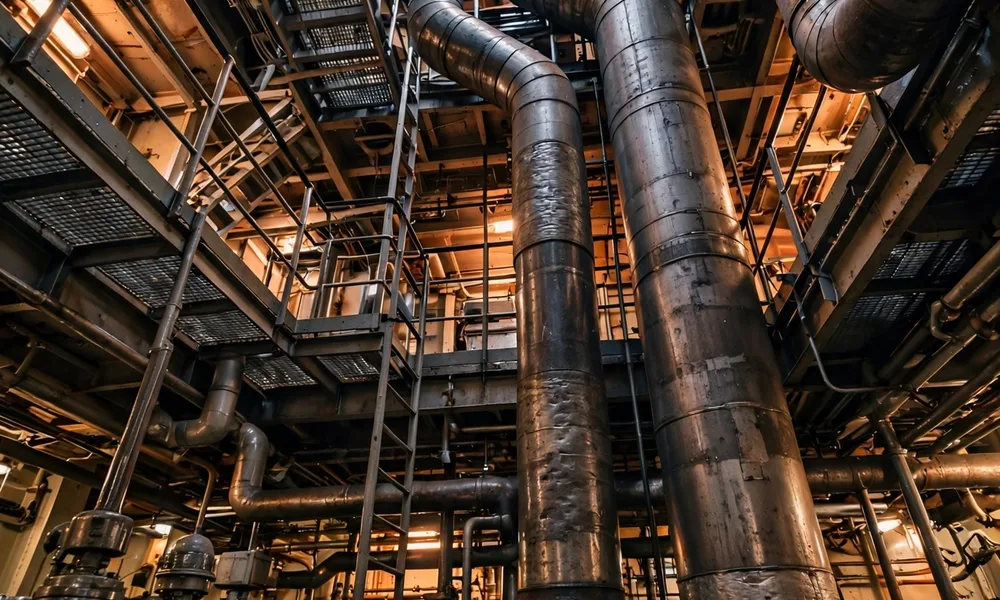
The funnel does more than carry exhaust. It also carries the hot air from the engine room, the galley and the laundry, acting as a giant ventilation shaft for the working heart of the ship. Fans pull the hot, stale air up through the funnel and out to sea, while fresh air is drawn in through vents lower down, keeping the engine room cool enough for the crew to work in.
This ventilation is carefully separated from the exhaust, so the crew never breathes engine gas. The ducts are sealed, the fans are fitted with filters, and the whole system is tested for leaks before the ship enters service. A funnel that cannot breathe properly will overheat the engine room, and an overheated engine room will slow the whole ship down.
Step 5: Keeping the funnel cool and safe
A funnel full of hot gas is a fire risk, so it is built with fireproof insulation, fire dampers that close if a fire starts, and a water spray system that can cool the inside of the casing. The outside is painted with heat-resistant paint in the colours of the shipping line, and the paint is checked regularly, because salt, sun and heat wear it away, and a funnel that looks tired makes the whole ship look tired.
The work is hot, dirty and high up, and it is done while the ship is in port, when the engines are cool and the funnel is safe to enter. The strength of the structure that carries the funnel matters too, and the way a luxury ship keel works shows how the loads of a tall, heavy structure are carried down through the hull.
Step 6: Giving the ship its identity
Finally, the funnel is the ship’s signature. Shipping lines paint their funnels in bold colours and patterns, so a ship can be recognised from miles away, and passengers know at a glance which line they are sailing with. The funnel carries the line’s flag, its colours and sometimes its name, and it is lit at night, so the ship is visible from the shore long after the sun has set.
That identity is why funnels are kept even on modern ships that could, in theory, vent their exhaust in other ways. A cruise ship without a funnel would look unfinished, like a hotel without a sign. The funnel is engineering and branding in one structure, a working exhaust system that also tells the world who owns the ship, and where it is going.
| Specification | Typical luxury ship funnel |
|---|---|
| Height above deck | About 15 to 25 metres, by ship size |
| Exhaust pipes | One per main engine, boiler and generator |
| Cleaning | Scrubbers and filters for sulphur and soot |
| Ventilation | Fans carry hot air from the engine room and galley |
| Fire protection | Insulation, fire dampers and a water spray system |
| Material | Steel casing with heat-resistant paint |
| Monitoring | Sensors measure exhaust at the top of the funnel |
| Identity | Shipping line colours, flag and lighting at night |
A luxury ship funnel is an estimate of $1,000,000 to $5,000,000 to build, depending on the size of the ship, the number of engines it serves and the cleaning equipment fitted inside. The price covers the steel casing, the pipes, the scrubbers, the fans and the paint, and it is a small part of the cost of a cruise ship, yet it is one of the most visible parts of the whole vessel.
Here is a rare fact worth knowing. The funnel of the Queen Mary 2 is so large that it is not a single funnel at all. It is a casing that hides several exhaust pipes, and inside it there is enough space for a small room. Some modern funnels are even designed to tilt or fold down, so the ship can pass under a low bridge, and the funnel is raised again once the bridge is behind them.