Deep under the sea, a submarine is a sealed steel tube, and the only way out in an emergency is up, through the water itself. The escape trunk is the part of the boat built for exactly that moment: a small, strong chamber set into the top of the hull, and the one place on a submarine designed to be deliberately flooded. It is barely bigger than a wardrobe, and it costs more per square metre than any other room on the boat.
Owners regularly ask why. The trunk looks like a simple steel cylinder with two doors, and there is nothing luxurious about it: no leather, no polish, no view. Yet the bill for one runs into the hundreds of thousands, because almost nothing about the trunk is simple. Every part of it must survive the same crushing pressure as the rest of the hull, while having two openings instead of none, and it must work perfectly the one time it is ever needed.
This article explains where the money goes. It is strictly about cost: the steel, the hatches, the fitting, the testing and the certification, and why each one costs far more than its size suggests. It is not about how the trunk is built or how an escape works.
The Steel Is Not Ordinary Steel
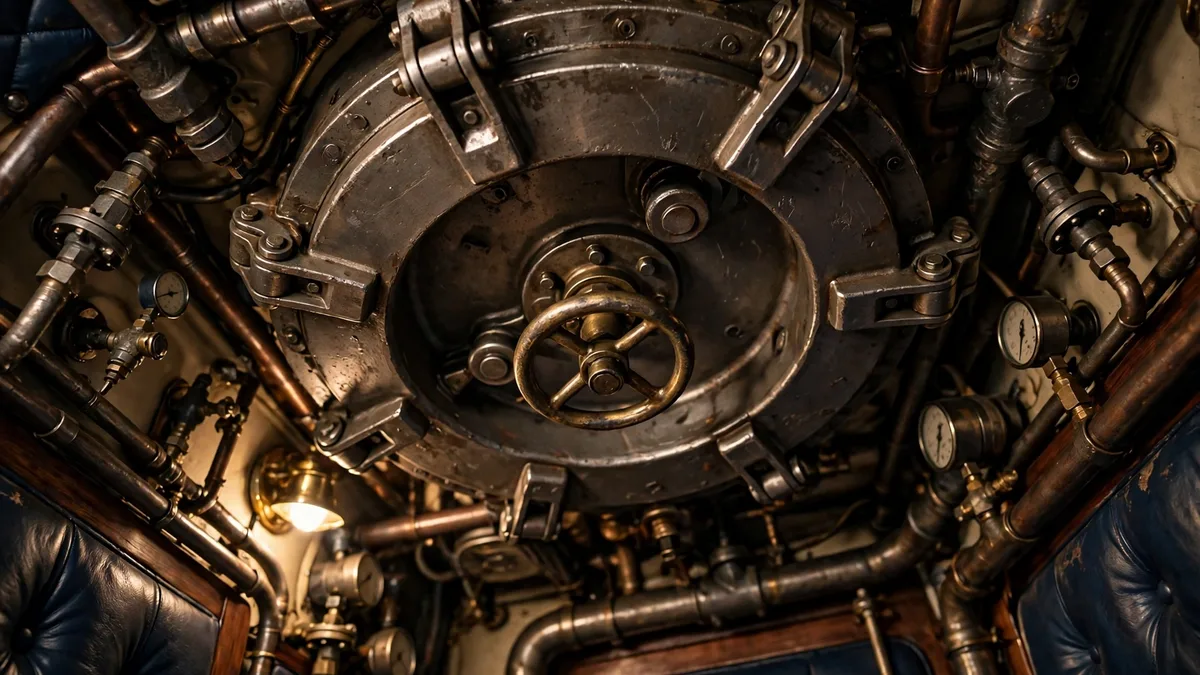
The first cost is the steel, and it is not the steel of an ordinary tank. The trunk is built from the same high-strength steel as the pressure hull, plate that must hold back the sea at depth without bending, cracking or corroding. The cylinder is short and thick-walled, with heavy reinforcing rings around it, because every opening in a pressure hull is a weak point. The plate is bought in small quantities to an exact specification, with mill certificates for every sheet.
The steel must also be formed to a perfect circle. A trunk that is even slightly oval will not seal properly where the hatches sit, and a leak at depth is not a small problem. The plates are rolled a little at a time on a rolling machine until the ends meet, and the seam is welded in several passes. After welding, the cylinder is measured at many points around the circle, and any plate that is out of round is reworked or scrapped. The precision is closer to aerospace than to shipbuilding, and the yard charges for it.
Two Hatches, Two Seals, Zero Room for Error
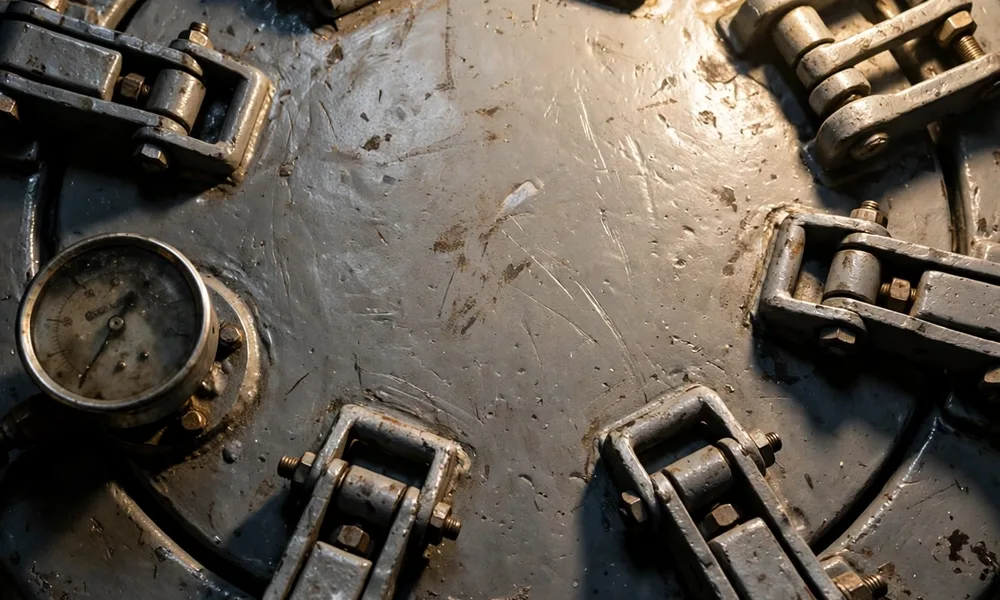
The second cost is the hatches, and there are two of them. The lower hatch opens downwards into the boat, so the pressure of the water above keeps it pressed shut. The upper hatch opens upwards, out of the boat, so it can be pushed open once the pressure inside the trunk matches the sea outside. Each hatch is a thick steel disc, machined flat so it seats perfectly against its frame, and each one gets its own seal, handwheel and dogs.
Each hatch is effectively a pressure vessel door on its own, and it is priced like one. The discs are machined from forgings rather than cut from plate, because a forging has no hidden flaws and a more even grain. The seals are made to order in small batches, and the handwheels, hinges and dogs are machined from the same high-strength steel as the trunk. Nothing in the hatch assembly is bought off the shelf, so there is no volume to spread the cost across.
Fitting It Into the Pressure Hull
The third cost is the fitting, and it is the one the yard charges the most for. The trunk is not bolted on. It is welded into the pressure hull, and that weld is one of the most demanding joints on the whole boat. The hull is curved, the trunk is a cylinder, and the joint between them must be continuous, full-penetration and free of defects. Welders work in cramped positions inside the hull, with inspectors checking every centimetre.
Behind the trunk, inside the hull, the yard fits extra frames and brackets to spread the load, because the trunk acts like a lever. Every dive tries to crush it, and the force at the joint is enormous. That reinforcement is invisible from outside, but it is hours of skilled steelwork, and it is why a trunk cannot simply be added to a finished submarine. The work is done once, during the build, in a sequence that cannot be rushed, and the yard bills the dock time whether the welders are working or waiting for an inspector.
Certification: Tested Like Nothing Else on the Boat
The fourth cost is the testing, and it never really stops. Every trunk design is pressure tested, flooded and approved by a classification society before it is fitted, and every fitted trunk is tested again on the finished boat. The trunk is flooded with water, pressurised to well above its working depth, and held there while inspectors check for a single drop in the wrong place. Any defect means cutting out and re-welding, and the test is run again from the start.
The certification also covers the escape equipment that lives in the trunk: the flooding valve, the pressure gauge, the breathing sets and the buoyancy aids. Each one is tested on its own and then tested again as a system, with a crew member climbing in and running the full escape drill in a training tank. The paperwork alone runs to hundreds of pages, and the surveyors bill by the day. A trunk with no certificate is a trunk that cannot be used.
Where the Money Goes
The shares surprise people who expect steel to dominate. Steel is only a part of the price. Fitting, testing and certification take the rest.
| Cost driver | Share of the price |
|---|---|
| Fitting and welding | About 30 percent |
| Hatches and seals | About 25 percent |
| Steel and forming | About 20 percent |
| Testing and certification | About 15 percent |
| Escape equipment and fitting out | About 10 percent |
The pattern is the same across the boat. The escape hatch, the trunk’s closest cousin, is priced the same way, and why a submarine escape hatch is so expensive shows the same split between steel, machining and testing. The trunk costs more than the hatch because it is a room, not a door, with a chamber between two hatches.

Why Owners Keep Paying
Against the price, the trunk buys something no other fitting can: a way out. A luxury submarine is a sealed tube under crushing pressure, and without the trunk there is no second chance if something goes wrong. It is also the most inspected part of the boat, which means it is the part the owner can be most certain about. Every weld has been checked, every seal has been tested, and every drill has been run, and that certainty is part of what the money buys.
The trunk is also cheap insurance against the alternative. A submarine that cannot prove its escape system will not be certified, will not be insured, and will not be allowed to dive. The cost of the trunk is small beside the cost of a boat that cannot leave the dock. The way a luxury submarine escape trunk is made shows how that certainty is built, plate by plate, and the way a luxury submarine escape trunk works shows why the design has to be exactly as it is. The bill is large because the room is small and the pressure is enormous.