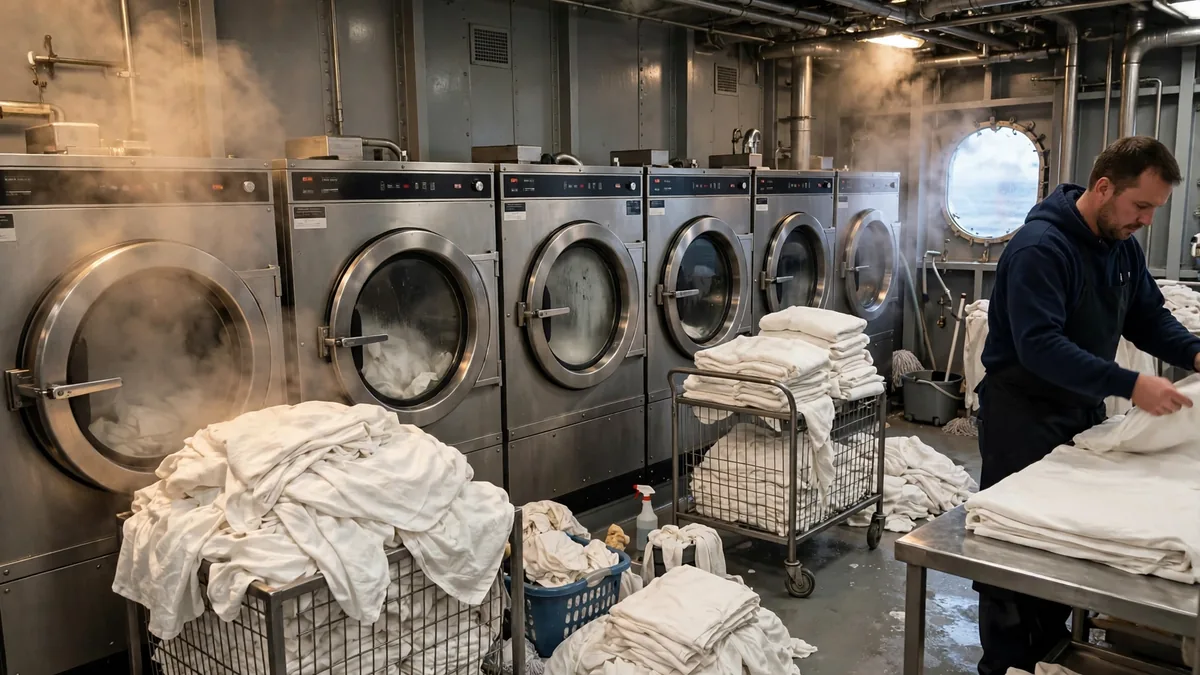
Deep below the guest decks of a luxury ship, down a corridor that smells faintly of steam and clean cotton, there is a room that never really stops. Machines the size of small cars rumble in a row, carts of white linen roll past on rails, and a team in aprons folds sheets so fast their hands blur. Every towel in every cabin, every tablecloth in every dining room and every uniform in the crew mess passes through this room, sometimes twice in a single day.
A luxury ship laundry is the industrial washroom of a large ship, built to clean tonnes of linen a day while the ship rolls at sea, and it is a very different machine from the small laundry on a yacht. Where a yacht laundry is one room with a couple of washers, a ship laundry is a factory: tunnel washers that never stop, giant dryers, flatwork ironers that press a sheet in seconds, and a water system that recycles and heats thousands of litres an hour. This is how it is made, from an empty steel compartment to a laundry that keeps a floating hotel spotless.
How It’s Made
Step 1: Choosing the compartment and sealing it
A ship laundry starts with a choice of room, usually a large, low compartment near the crew quarters and the service lifts, close to the cabins it serves and far from the guest areas. The steel shell is then sealed against steam: walls are lined with smooth, waterproof panels, the floor is laid with a fall toward wide drains, and every joint is sealed so hot, damp air cannot creep into the cabins next door. Ventilation ducts are cut into the ceiling before the machines arrive, because a laundry that washes for hundreds of guests makes more steam in an hour than a bathroom makes in a week.
Step 2: Bolting down the tunnel washers
The heart of the room is the tunnel washer, a long machine divided into chambers that washes linen in a continuous flow rather than in separate loads. Workers crane the sections in through a hatch in the deck above, bolt them to the steel floor on shock mounts, and join them into a single run that can be twenty metres long. Dirty linen goes in at one end and clean, damp linen comes out at the other, pushed along by an internal screw while water, soap and heat do the work. Beside the tunnel, smaller washers are fitted for delicate items: uniforms, soft furnishings and anything that cannot take the heat of the main run. The scale of the room is what sets it apart from a yacht, where a luxury yacht laundry is made around a couple of machines in a space no bigger than a wardrobe.
Step 3: Fitting dryers, ironers and folding lines
Wet linen is heavy, so the dryers stand right beside the washers, and the folding line stands beside the dryers, so nothing travels far. Workers install giant tumble dryers with drums a metre across, heated by steam from the ship’s boilers, and flatwork ironers: long, heated rollers that press a sheet flat and dry in a single pass. The folding tables are set at waist height in a long row, with rails above them for hanging pressed uniforms and shelves below for folded stacks. Each station is lit from above with bright, even light, so a worker can see a stain before a sheet goes back to a cabin. Laundry staff test the line with a full load of sheets, timing each stage to find the slowest point before the room opens for real work.

Step 4: Connecting water, steam and power
A ship laundry drinks water and steam in enormous quantities, so the connections are fitted with the same care as the machines themselves. Plumbers run large-bore pipes from the ship’s fresh-water tanks and from the boilers, with valves and gauges at every machine so a worker can shut one down without stopping the whole room. Electricians wire each machine to its own circuit, with a control panel by the door that shows the state of every washer, dryer and ironer at a glance. The drains are the quiet heroes of the room: wide pipes that carry hot, soapy water away to the treatment plant, with filters that catch lint before it can block anything. That dirty water is handled the way how cruise ship waste systems work describes.
Step 5: Adding sorting, storage and the lifts
Once the machines are running, the room needs a system for the linen itself, and that system is built into the walls and the floor. Dirty linen arrives in canvas bags dropped down chutes from the cabin decks, and workers sort it into wheeled carts: white sheets in one, towels in another, coloured uniforms in a third. Clean linen is stacked on tall shelves in a dry store beside the laundry. The service lifts are fitted last, small goods lifts that carry the clean stacks up to the guest decks and bring the dirty bags back down. It is part of the wider life below deck that how luxury ship crew quarters work describes.
Step 6: Testing a full day and handing over
The last stage is a full trial day, run exactly as if the ship were full of guests. The laundry team works through the morning change of linen, the midday restaurant turn and the evening cabin service, while engineers watch the water pressure, the steam supply and the temperature of every dryer. The room must keep its pace through the busiest hour, with no machine stopping and no cart left waiting, because a ship cannot ask its guests to wait for clean towels. Any fault is fixed on the spot, from a dryer that runs cool to a chute that jams, and the room is then deep cleaned and inspected by the ship’s officers. The finished laundry is a factory that happens to float, and the final sign-off comes when the first real sailing runs without a single linen complaint, which is the quiet proof that the room works.
| Specification | Typical ship |
|---|---|
| Capacity | Several tonnes of linen washed every day |
| Tunnel washer | Continuous multi-chamber run, up to twenty metres long |
| Dryers | Steam-heated tumble dryers with metre-wide drums |
| Ironers | Heated flatwork rollers pressing sheets in one pass |
| Water | Staged heating with reuse from hot to cooler washes |
| Drains | Wide lint-filtered pipes to the treatment plant |
| Sorting | Chutes, wheeled carts and a dry store sorted by deck |
| Lifts | Goods lifts sized exactly to the linen carts |

A luxury ship laundry costs an estimate of $800,000 to $2,500,000 to build, depending on the size of the ship, the number of guests it serves and whether it includes separate dry-cleaning and uniform-pressing sections. The price covers the steel compartment, the tunnel washers and dryers, the ironers, the water and steam systems, and the sorting and lift equipment.
Here is a rare fact worth knowing. On the largest ships, the laundry team can wash and press more than ten tonnes of linen in a single day, and the work is planned around the ship’s port calls, because fresh water is taken on in port and every litre is counted. A single missed water delivery can change the laundry schedule for a whole week at sea, which is why the laundry is planned like a small factory, with a supervisor who knows where every cart and every stack sits.


