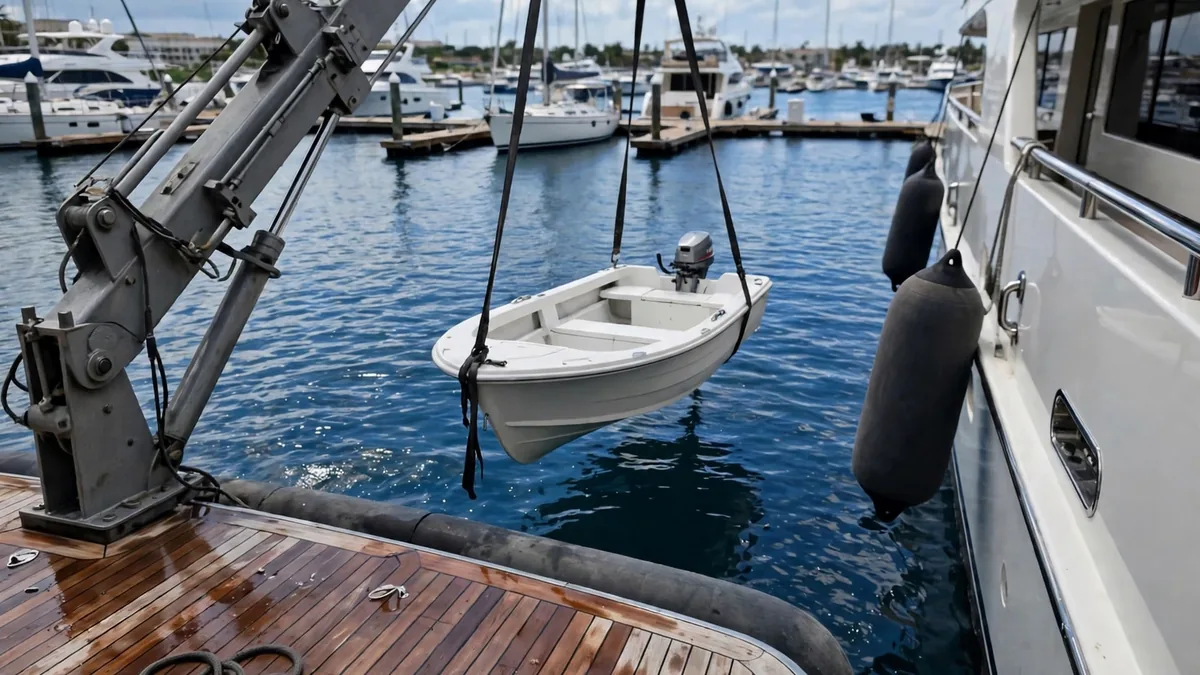
On the aft deck of a large yacht, in the early morning before the guests are awake, a small boat is waiting in its cradle, polished and fuelled and ready for the day. It is the tender, the yacht’s own runabout, and the only way to get it from the deck into the water is the crane standing beside it, a steel arm that can lift several tonnes, swing out over the sea, and lower the boat gently onto the waves. Watching it work looks effortless, and that is because every part of the machine is built for exactly this one job.
A luxury yacht tender crane is a deck-mounted lifting machine that picks up the tender, swings it over the side, and lowers it into the water, then lifts it back aboard at the end of the day. It works as a chain of movements: the pedestal turns, the boom rises, the winch pays out wire, and the tender floats free, each step controlled by one operator and guarded by safety devices that stop the lift if anything goes wrong. Here is how it all works, from the deck to the water.
How It Works
Step 1: The pedestal and the slewing ring do the turning
Everything starts at the base. The crane stands on a pedestal, a steel column bolted through the deck into the yacht’s structure, strong enough to carry the whole weight of the crane and its load. On top of the pedestal sits the slewing ring, a large ring of steel balls and gears that lets the upper part of the crane turn a full circle. A hydraulic motor drives the ring, so the operator can swing the boom smoothly from the tender’s cradle out over the water, and a brake holds it still the moment the control is released.
Step 2: The boom and the luffing rams set the reach
The boom is the crane’s arm, a tapered steel box that reaches out from the top of the pedestal. Its angle is set by luffing rams, thick hydraulic cylinders that push the boom up or pull it down, When the boom is raised, the hook comes in close to the yacht for lifting the tender out of its cradle, and when it is lowered, the hook swings out over the water. The boom is built light but strong, because every kilogram at the end of the arm loads the pedestal.
Step 3: The winch and the wire do the lifting
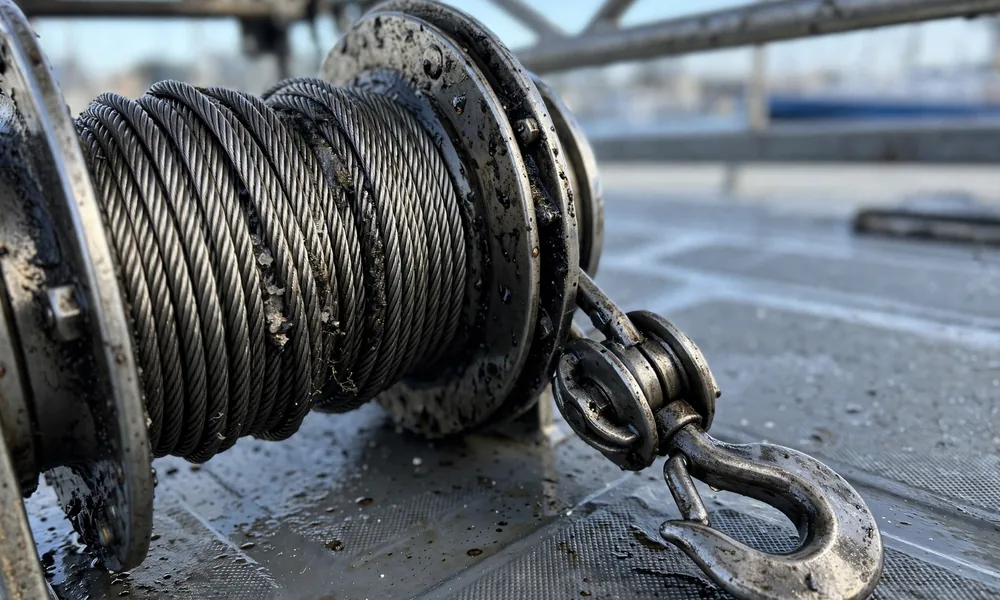
The lifting itself is done by the winch, a drum inside the crane that winds and unwinds the wire rope. An electric or hydraulic motor turns the drum, and the wire runs from the drum over sheaves in the boom to the hook block at the end. The winch lifts slowly and smoothly, which matters when the load is a polished boat worth a small fortune, and it holds the load still while the boom swings. A load limiter watches the weight at all times, and if the tender is heavier than the crane is rated for, the winch simply refuses to lift.
Step 4: Rigging and lifting points spread the load
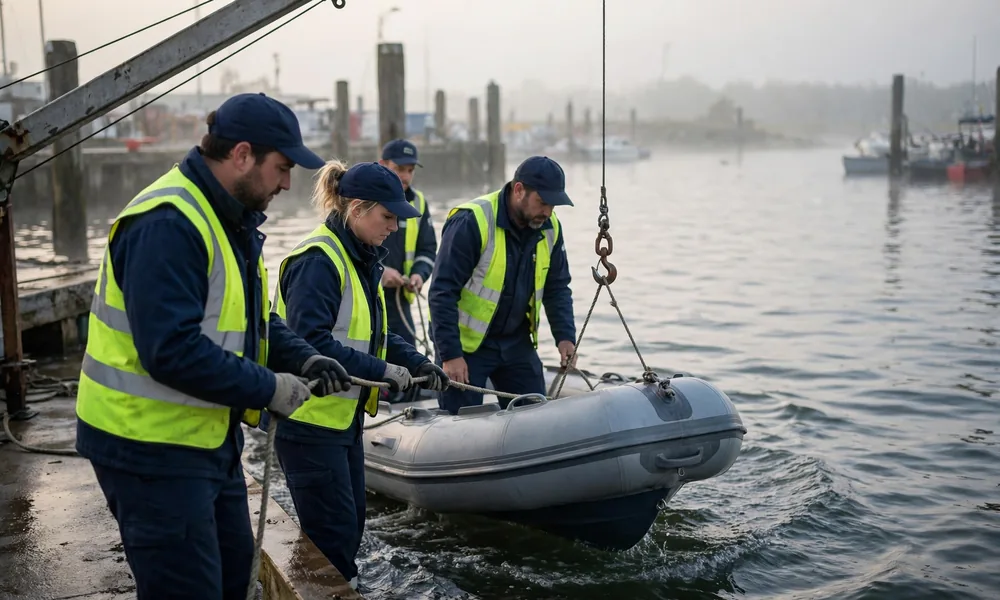
Before any lift, the crew rig the tender. Slings or a spreader bar are attached to the lifting eyes built into the tender’s hull, points that were designed into the boat when it was built, so the weight hangs evenly and the hull is never strained. The crew check every shackle and strop by hand, and the tender’s fuel, engine and loose gear are secured so nothing shifts in the air. A tag line, a rope held by a crew member on deck, steadies the tender as it rises, stopping it from swinging while the crane turns it towards the sea. The boat it lifts is often a small electric tender, and how a luxury electric dinghy works explains what is being lifted.
Step 5: Controls and safety devices guard every move
The operator controls the crane from a station on deck, with levers or a remote handset that move the slew, the boom and the winch, each spring-loaded to stop when released. Safety devices work silently alongside: a load moment limiter stops the boom from reaching too far with a heavy load, limit switches stop the hook before it hits the boom, and an emergency stop cuts all power at once. The crane is also fitted with a motion system that can ease the load down gently as the yacht rolls, so the tender is not dropped onto a rising wave. The same care governs how a luxury lifeboat davit works, the crane’s life-saving cousin.
Step 6: Launch and recovery over the side
The launch itself is the moment all of it comes together. The crane lifts the tender clear of its cradle, swings it out over the water, and lowers it slowly until the hull touches the sea and the wire goes slack. The whole launch takes only a few minutes when the crew are practised, yet every one of those minutes is planned, because a tender swinging on a wire beside a steel hull leaves no room for improvisation. The crew unhook the slings, the tender’s engine starts, and it pulls away from the yacht’s side. Recovery is the reverse, and the harder half, because the tender must be held steady beside a moving hull while the crew hook on in a swell. The crane lifts it clear of the waves, swings it back over the deck, and lowers it into its cradle, where it is lashed down for the night. The cradle it returns to is part of how a superyacht tender garage works, where the tender sleeps.
Luxury Yacht Tender Crane Specifications
A tender crane on a 50-metre yacht is a compact but powerful machine. These are the figures a typical one is built to.
| Specification | Typical value |
|---|---|
| Lifting capacity | Around 2 to 5 tonnes, depending on the tender it serves |
| Outreach | Several metres beyond the yacht’s side |
| Slew | Full 360-degree rotation on a steel slewing ring |
| Boom control | Hydraulic luffing rams setting the reach |
| Winch | Electric or hydraulic drum with wire rope and hook block |
| Lifting speed | Slow and controlled, for a polished boat |
| Load limiter | Stops the lift if the rated weight is exceeded |
| Controls | Deck station levers or a remote handset |
| Power source | Hydraulic power from the yacht’s systems |
What It Costs
A luxury yacht tender crane costs an estimate of $80,000 to $350,000, supplied and fitted, depending on its lifting capacity and how far it must reach. The pedestal, slewing ring and hydraulic system account for most of the price, and the cost rises when the crane must be fitted to a deck that was not built with one in mind. It is a small machine beside the price of the yacht, and without it the tender, and much of the fun of the yacht, would stay stuck on deck.
A Rare Fact
Here is a fact that shows how seriously these cranes are taken: before a tender crane is trusted with a boat, it is proof-load tested at a quarter more than its rated capacity. A crane rated to lift four tonnes must lift five tonnes, hold it, and show no sign of strain, before it is signed off for service. The test is repeated at intervals through the crane’s life, so the machine that lifts a family’s tender on a calm morning has already proven it can hold far more than it will ever be asked to carry.