Every morning on a large yacht, a quiet mountain of linen comes down to the laundry: sheets from a dozen cabins, towels from the bathrooms, tablecloths from dinner, and the crew’s own uniforms. By evening, all of it is back upstairs, washed, dried, pressed and folded, smelling faintly of fresh air. Nobody on board sees the work happen, and that is the point. A ship’s laundry is a small factory hidden below deck, and it runs like clockwork from dawn to dusk.
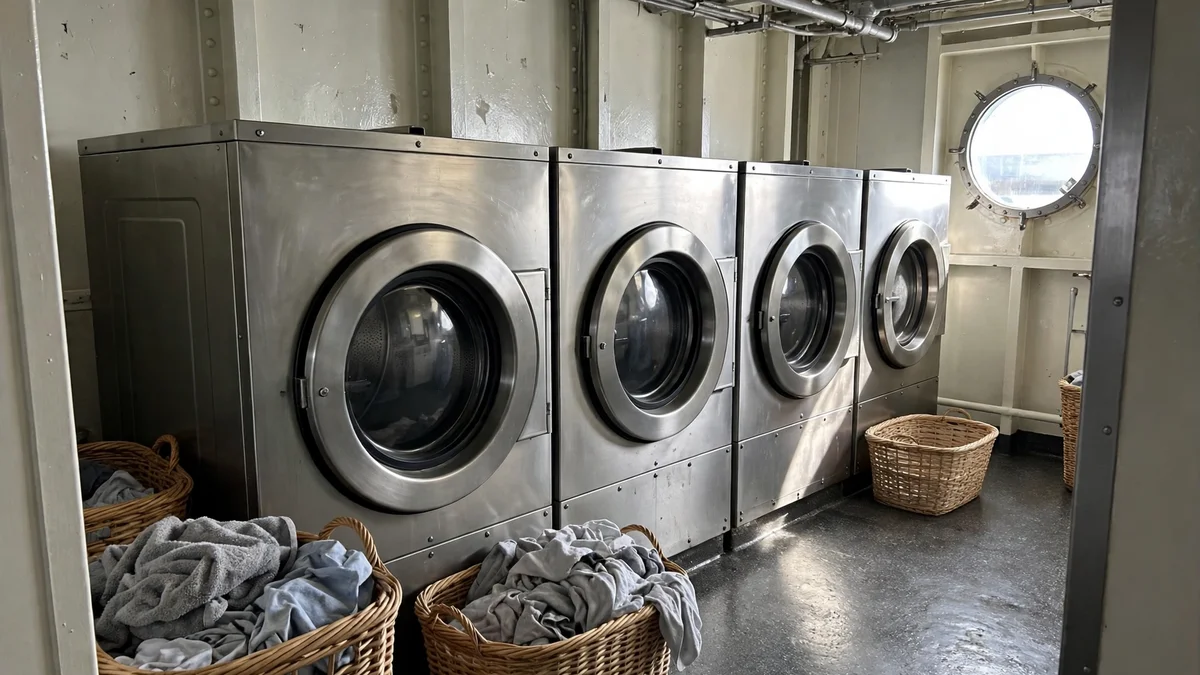
The scale is hard to grasp from shore. A yacht with twelve guests and a crew of twenty can produce several hundred kilos of laundry a week, and a cruise ship produces tonnes a day. The laundry has to keep up without ever stopping the ship, without shaking the cabins above, and without using more fresh water than the ship can make. That is why the laundry room looks less like a hotel back room and more like an industrial plant, with machines the size of wardrobes and a rhythm all of its own.
The work is organised in a strict sequence, and every item follows the same path from the moment it leaves a cabin to the moment it returns. Nothing is washed at random: the laundry team sorts, weighs, washes, dries, presses and folds in batches, and each batch is tracked so that a missing sheet can be traced to the machine it went through.
How a Luxury Ship Laundry Works
Step 1: Collection and sorting
Used linen travels down to the laundry in bags or down a chute from the cabin decks, and the first job is sorting. Sheets go with sheets, towels with towels, and delicate items are set aside for a gentler cycle. The crew checks every pocket and every item for stains, and stained pieces are pre-treated by hand before they go near a machine. Sorting matters because different fabrics need different water temperatures and spin speeds, and a single wrong batch can shrink a whole load of uniforms.
Step 2: Weighing and loading
Each machine is loaded to a precise weight, because an overloaded washer cleans badly and an underloaded one wastes water and power. The laundry team weighs each batch on a scale and records it, then loads the drum evenly so it spins without shaking. Detergent is dosed automatically from bulk tanks, measured to the gram for the weight of the load and the hardness of the ship’s water. Too much detergent leaves a residue; too little leaves the linen grey.
Step 3: Washing
The wash itself is a programmed cycle: a pre-wash to loosen dirt, a main wash at a temperature matched to the fabric, and several rinses to carry the detergent away. Sheets are washed hot enough to be hygienic, towels are washed to stay soft, and uniforms are washed cool enough to hold their colour. The machines are built for the sea, with drums mounted to absorb the ship’s motion and doors that seal tight against vibration, so a wash can run while the ship is under way and nobody above feels a thing.
Step 4: Drying
From the washer, the load moves to a dryer, a large drum that tumbles the linen in hot air. The dryers on a ship are vented carefully, because damp air in a steel hull means condensation and rust, so the exhaust is ducted outside and the heat is recovered where possible. Towels come out fluffy, sheets come out almost dry, and delicate items are dried on racks instead, away from the heat. The laundry team judges dryness by touch, because a sheet that goes to the press even slightly damp will crease as it cools.

Step 5: Pressing and ironing
The press is the heart of the finishing line. A roller iron, a heated drum the size of a table, pulls a sheet through in one smooth pass and returns it flat, crisp and warm. Tablecloths and napkins go through the same roller, and uniforms are finished on presses shaped for sleeves and collars. The heat of the roller also kills any germs the wash missed, which is why the press is the last hygiene step as well as the last cosmetic one. A good press operator can finish a king-size sheet in under a minute.
Step 6: Folding and inspection
Pressed linen is folded on long tables, and every piece is inspected as it is folded. A sheet with a mark goes back for another wash, a towel with a frayed edge is set aside for repair or replacement, and a uniform with a missing button is sent to the seamstress. The folding itself follows a standard pattern, so a stack of sheets is always the same size and fits the same shelf. This is the step where the laundry’s quality is really decided, because a fold hides nothing.
Step 7: Storage and delivery
Finished linen goes onto shelves in the linen store, organised by cabin and by type, so a steward can collect a full set for one cabin in a single trip. The store is kept dry and ventilated, because damp linen mildews quickly at sea, and the stock is counted every day so the ship never runs short. Deliveries go up in the morning, before guests wake, and the cycle begins again with the next load coming down. On a well-run ship, the laundry never stops, it just changes loads.

Specifications
| Detail | Typical figure |
|---|---|
| Washer capacity | Around 20 to 50 kg per machine |
| Dryer capacity | Roughly 25 to 60 kg per machine |
| Wash temperature | About 40 to 90 degrees, by fabric |
| Roller iron width | Around 1.5 to 2 metres |
| Daily throughput | Several hundred kilos on a large yacht |
| Water source | Ship’s watermaker, recycled where possible |
The laundry team works to a timetable set by the ship’s day. Cabin linen is collected after breakfast, table linen after dinner, and uniforms are washed overnight so they are ready for the morning shift. If a guest asks for a shirt to be pressed before dinner, it jumps the queue, and the team treats that as normal. The rule is simple: the laundry serves the ship’s schedule, never the other way round.
What It Costs
A ship laundry fit-out costs an estimated $100,000 to $500,000, depending on the number of machines and the size of the ship, with a full roller iron and several large washers at the top of that range. Those are estimates, and the machines are usually ordered with the ship rather than bought later. Running costs are steady: water from the ship’s watermaker, power, detergent bought in bulk, and the wages of the laundry team. The machines themselves last for years, and a well-maintained washer can survive a decade of daily use at sea.
The laundry is one of the ship’s hidden service rooms, working alongside how the laundry room is built, the galley that feeds the same guests, and the crew quarters where the laundry team sleeps. Guests never see any of it, which is exactly how the ship likes it.
A Rare Fact
On some ships, the laundry’s wash water is treated and reused for the next load, and the heat from the dryers is recovered to warm the wash water. A laundry that recycles both water and heat can cut its fresh-water use by a third, which matters on a ship that makes every litre it drinks.