A luxury ship turns so smoothly that guests on deck barely notice the change of course, yet the whole turn begins with a single flat blade hanging in the water behind the stern. That blade is the rudder, and though it looks simple from the quayside, it is one of the hardest working parts of the ship, pushing against tonnes of moving water every time the helm moves.
On a large ship the rudder can be taller than a house and heavier than several cars, so it cannot be made like a small boat part. It is cast, welded, shaped and balanced in a shipyard, then fitted to a steel shaft called the stock, tested under load, and only then trusted to steer a ship full of people. This is how a luxury ship rudder is made.
How It’s Made
Step 1: The steel is cast and the plates are cut
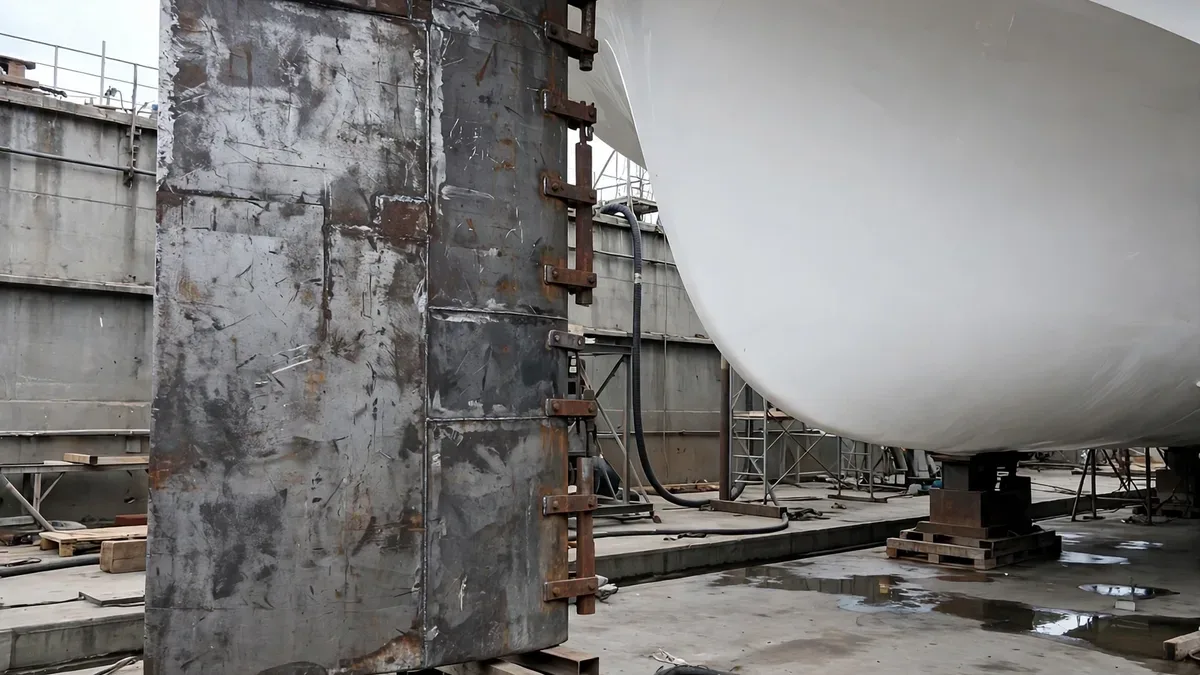
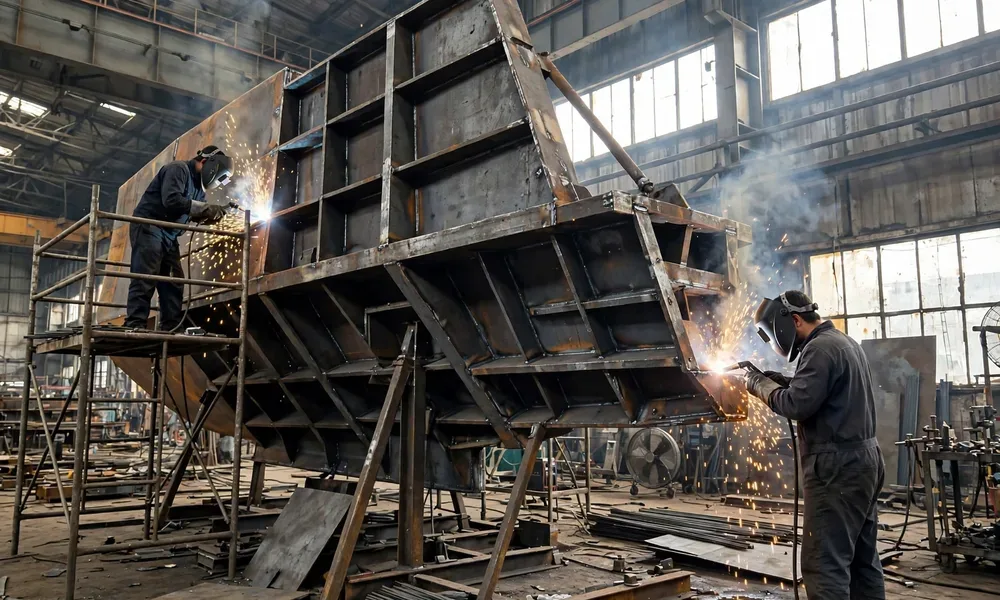
Every rudder begins with steel, chosen for strength and for the way it stands up to years in salt water. Some rudders are cast as a single heavy piece, poured as molten steel into a mould shaped like the blade, then left to cool slowly so it does not crack. Others are built up from thick steel plates, cut to shape with a torch and welded together around an inner frame, like a hollow wing with a strong skeleton inside.
Step 2: The blade is welded, shaped and faired
Once the plates are cut, welders join them along the edges, working in short runs so the heat does not warp the blade out of shape. Inside the hollow shell sit ribs and webs of steel, spaced to spread the load from the water across the whole blade. The welds are ground smooth, then checked with sound and dye tests that can find a crack far too small to see.
After welding, the blade is faired, which means its surface is smoothed until the curve is even from top to bottom. Workers run long straight edges and templates over the steel, marking high spots and grinding them down by hand. A smooth rudder is a quiet rudder, and on a luxury ship quiet matters, because vibration from a rough blade would hum through the hull and into the cabins above.
Step 3: The stock is forged and fitted
The stock is the thick vertical shaft that carries the rudder and turns it, and it is forged from a single piece of steel, heated until it glows and hammered into shape under a great press. Forging lines up the grain of the metal, which makes the stock far stronger than a shaft cut from a flat plate. It is then turned on a huge lathe until it is round and true along its whole length.
The stock is fitted through the top of the rudder blade and locked in place with a tapered joint and heavy bolts, so blade and stock move as one piece. Bearings are fitted where the stock passes through the hull, and a seal keeps the sea out of the steering gear room. The joint is tested by turning the stock back and forth under load, because any slack here would make the helm feel vague and the ship slow to answer.
Step 4: The rudder is balanced and weighed
A good rudder is balanced, which means part of its area sits ahead of the stock, so the water helps to turn it rather than fighting every movement. The designers work out the balance from the size of the ship and the speed she will sail at, and the yard checks the finished blade against those numbers, weighing it and measuring its centre of gravity.
Step 5: The blade is coated against the sea
Bare steel would rust away in salt water within a season, so the finished rudder is coated like the hull, with layers of paint that keep the sea off the metal. First comes a primer that grips the steel, then several coats of hard protective paint, and finally a smooth antifouling layer that stops barnacles and weed from growing on the blade.
Step 6: The rudder is hung, aligned and tested
The last step is hanging the rudder on the ship, which is done in dry dock, with cranes lowering the blade into place under the stern. The stock is lifted through its bearings, the steering gear is connected, and the rudder is aligned so it sits exactly in line with the keel when the helm is amidships. Even a small misalignment would make the ship pull to one side.
Then comes the test: the helm is turned from side to side while engineers watch the rudder move and listen for any knock or groan. The steering gear is run at full load, and the rudder is held hard over against the pressure of the water as the ship moves. Only when it swings smoothly, stops exactly where it should, and shows no leak at its seals is the ship ready to sail, and the way a luxury ship propeller works shows what the rudder must guide, since the propeller pushes the ship forward while the rudder decides where she goes.
| Spec | Detail |
|---|---|
| Blade | Curved steel blade, cast or welded from thick plates around an inner ribbed frame |
| Stock | Single forged steel shaft, turned true on a lathe and locked to the blade with a tapered joint |
| Balance | Part of the blade area sits ahead of the stock, so water helps turn it and eases the steering load |
| Bearings | Heavy bearings where the stock passes through the hull, with seals that keep the sea out |
| Coating | Primer, hard protective paint and a smooth antifouling top coat, checked for thickness |
| Movement | Swings from hard to port to hard to starboard, aligned exactly with the keel at amidships |
What One Costs
A luxury ship rudder is an estimated 150,000 to 600,000 dollars, depending on the size of the ship, the weight of the blade and how much of it is cast rather than welded. A smaller rudder for a large yacht sits near the bottom, while a rudder taller than a house, with a forged stock and custom steering gear, costs far more. The steel itself is only part of the price; the forging, the balancing and the dry dock time to hang it all add up, and the way a luxury ship helm works shows the quiet wheelhouse end of the same system, where a small turn of the wheel becomes a great force at the stern.
A Rare Fact
Some large rudders are built with a flap on their trailing edge, like a small rudder on the back of the big one, which swings further than the main blade and gives the ship extra turning power at slow speed. It lets a huge ship turn in a harbour without tug boats, using a trick borrowed from aircraft wings.

A luxury ship rudder is a quiet piece of engineering: a curved steel blade, a forged stock, careful balance and layers of paint, all working together so a gentle turn of the wheel can steer thousands of tonnes. It is rarely photographed and almost never noticed, yet without it the finest ship in the world would have no way to choose her course, and the way a luxury ship stern is made shows the strong structure the rudder hangs from, built to carry its weight through every sea.


