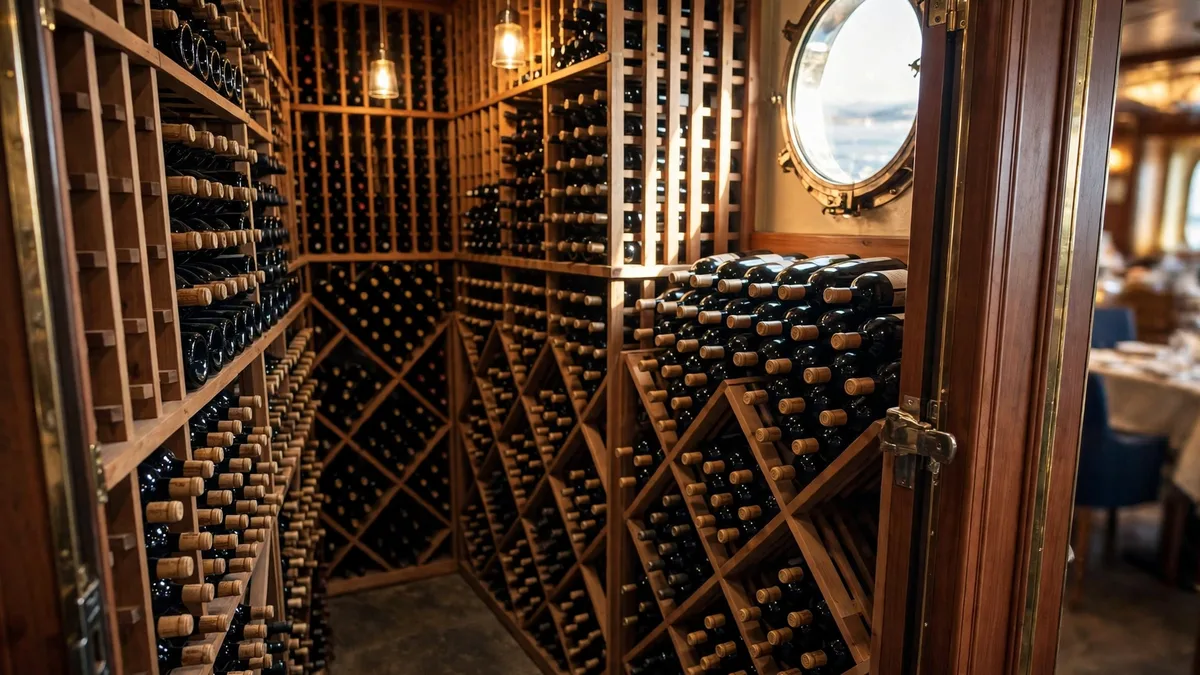
On a cruise ship, dinner for two thousand guests means wine for two thousand guests, and the bottles do not come from a cupboard. They come from a cold room the size of a small shop, tucked behind the main dining room, where the air is cool, the light is low, and the racks run floor to ceiling. The sommelier walks in with a list, takes a bottle from a numbered slot, and is back at the table before the first course arrives. Behind that quiet routine is a refrigeration plant, not a fridge.
A luxury ship wine fridge is a large refrigerated wine store on a cruise ship, usually a walk-in cellar beside the main restaurant, that holds hundreds or thousands of bottles at steady temperatures and humidity, with the bottles lying on wooden racks in separate zones for red, white, and sparkling wine. It works by running a remote compressor plant that pumps cold air through the room, with fans, thermostats, and alarms keeping each zone to the degree. It is not a yacht wine fridge scaled up: it is a cold room with its own machinery, its own power, and a team that runs it, and it has to keep working through a hot day in the tropics and a rough night at sea.
How It Works
Step 1: A remote compressor plant does the cooling
The cooling does not come from a machine in the room. It comes from a compressor plant in a machinery space nearby, where large compressors squeeze refrigerant gas and send it through coils in the cellar, and the heat is dumped overboard through the ship’s cooling water. The yacht wine fridge specs describe a single cabinet compressor, but a ship cellar runs on a plant with spare capacity, so one compressor can fail and the room stays cold.
Step 2: Separate zones for red, white, and sparkling
The cellar is divided into zones, because red, white, and sparkling wine are served at different temperatures. Whites and sparkling wine sit near 8 degrees, reds near 16 degrees, and each zone has its own thermostat, its own fan, and its own evaporator coil, so the cold air in one zone does not drift into the next. The zones are separated by insulated partitions and by doors that the sommelier team keep shut, and the thermostats are logged every hour, so a drift of a single degree is spotted before it reaches the bottles.
Step 3: Humidity and airflow protect the corks
Cold air is dry air, and dry air shrinks corks, so the cellar has to keep its humidity up as well as its temperature down. Humidifiers hold the room near 70 percent humidity, which keeps the corks swollen and sealed, and the bottles lie on their sides on wooden racks, so the wine touches the cork from the inside as well. Fans move the air gently around the racks, so no corner of the room is warmer than another, and the air is filtered, because a cellar that smells of diesel or cleaning chemicals will pass that smell into the wine through the cork.

Step 4: Racking, numbering, and the nightly count
Every bottle in the cellar has a place, and every place has a number. The racks are built from dark wood, slatted so the cold air can flow around each bottle, and the bottles are logged in the ship’s stock system by slot, vintage, and bin number. The sommelier team take what dinner needs and the stock is counted back at the end of service, so the cellar never runs dry on a wine the dining room has promised.
Step 5: Doors, seals, and alarms that never sleep
The cellar door is an insulated steel door with a magnetic seal and a lock, and it stays shut except when the team are working inside, because every opening lets warm dining-room air into the cold. If the temperature in any zone rises past its limit, an alarm sounds in the galley and in the engineering control room, and the engineers can switch in the spare compressor before the wine notices. The ship cocktail bar beside the dining room draws its bottles from the same cellar, and the bar team know the rule: take the bottle, shut the door, and never prop it open.
Step 6: Service at dinner, and the voyage home
At dinner the cellar becomes a kitchen. The sommelier team work from the evening’s orders, pulling bottles by number, checking the vintage against the list, and sending them to the tables on trays, while the white wines are chilled a little harder for the first pour. The ship espresso machine in the same galley works the same way, on a list and a routine, and the cellar is restocked at the next port, where new cases come aboard in refrigerated trucks and go straight into their zones. By the end of the voyage the cellar has served thousands of bottles, and the ones that remain are still at their serving temperature, waiting for the next sailing.
A ship wine fridge earns its place by doing a job nobody notices until it fails. It is a compressor plant, a set of fans, and a row of thermostats, wrapped in wood and insulation, and it turns a warm ship into a cellar that holds its temperature to the degree for weeks at sea. It is the quietest luxury on the ship, and at dinner it is the one that makes the wine taste the way the winemaker intended.
Ship Wine Fridge Specifications
| Feature | Typical Detail |
|---|---|
| Capacity | Hundreds to thousands of bottles, lying on wooden racks |
| Zones | Reds near 16 degrees, whites and sparkling near 8 degrees |
| Cooling | Remote compressor plant with spare capacity, chilled by ship water |
| Humidity | Held near 70 percent by humidifiers, filtered airflow |
| Racking | Dark wooden slatted racks, every bottle numbered by slot |
| Doors | Insulated steel door, magnetic seal, alarmed temperature limits |
| Power | Ship mains with backup, logged thermostats checked hourly |
How Much Does a Ship Wine Fridge Cost?
Prices are estimates and vary with capacity, zones and maker. A luxury ship wine fridge typically costs an estimated $60,000 to $250,000, including the cold room, the compressor plant, the wooden racking, and the fitting, with a large multi-zone cellar at the top and a single-room store lower. A spare compressor and a replacement set of door seals can add an estimated $10,000 to $40,000. It sounds like a lot for a cold room, but a cheap one warms up in the tropics, dries the corks, and spoils a cellar worth far more than the fridge itself.
A Rare Fact About Ship Wine Fridges
Here is a detail most passengers never notice: the largest ship wine cellars hold more bottles than a small wine shop. A big cruise ship can carry over five thousand bottles across its cellars, and the sommelier team track every one of them by number, vintage, and slot, the way a library tracks its books. The cellar is stocked before the voyage begins, sealed against the heat, and counted down bottle by bottle as the cruise goes on. It is the only fridge on the ship that has its own librarian.

The best ship wine fridges are the ones nobody notices, because the door opens, the bottle is cold, and the glass is perfect. Dinner is served, the sea is all around, and the wine tastes exactly as it should.


