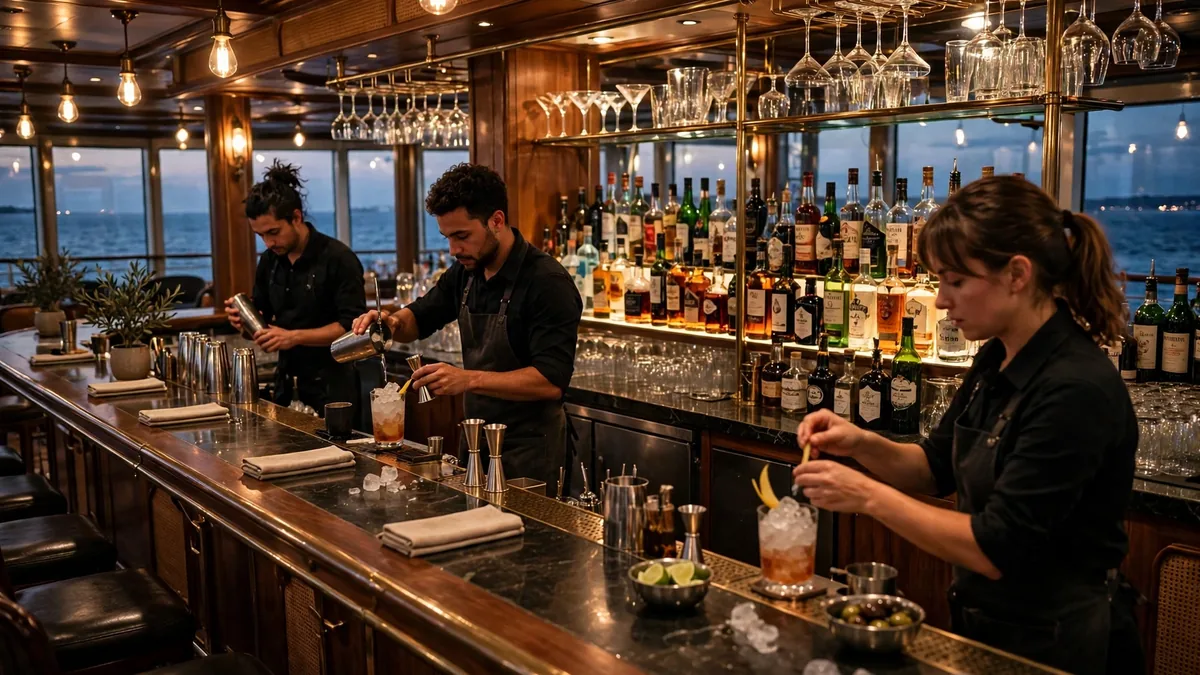
On the top deck of a luxury ship at dusk, the cocktail bar is the busiest room aboard. Hundreds of guests drift in after dinner, the counter is three times as long as any yacht bar, and a team of bartenders works shoulder to shoulder, shaking and pouring without pause while the ship cuts through the sea below. Bottles by the hundred line the shelves, ice arrives by the crate, and glasses are washed, polished, and sent back out in a loop that never stops.
A luxury ship cocktail bar is a high-volume mixing operation built into a cruise ship, with several stations along one long counter, a back room for storage and washing, and a team of bartenders serving thousands of drinks a night. It works by splitting the bar into identical stations, each with its own ice, bottles, and tools, and by running a glass-washing loop so fast that a glass can be back on the shelf minutes after it is returned. The scale is the difference: everything a yacht bar does for a dozen guests, a ship bar does for thousands.
How It Works
The stations: one bar, many bartenders
The counter is built in sections, each one a self-contained station with its own speed rail, ice bin, sink, and till, so that one station can be closed for cleaning while the others keep serving. A bartender owns one station for the night, and the stations are identical, so a bartender can step into any of them and find every bottle in the same place. The bar manager stands at the end of the counter, watching the queue and calling the orders, and the bartenders work in a rhythm: shake, pour, garnish, pass, and the next order is already waiting.
Ice at scale: crates, machines and the cold chain
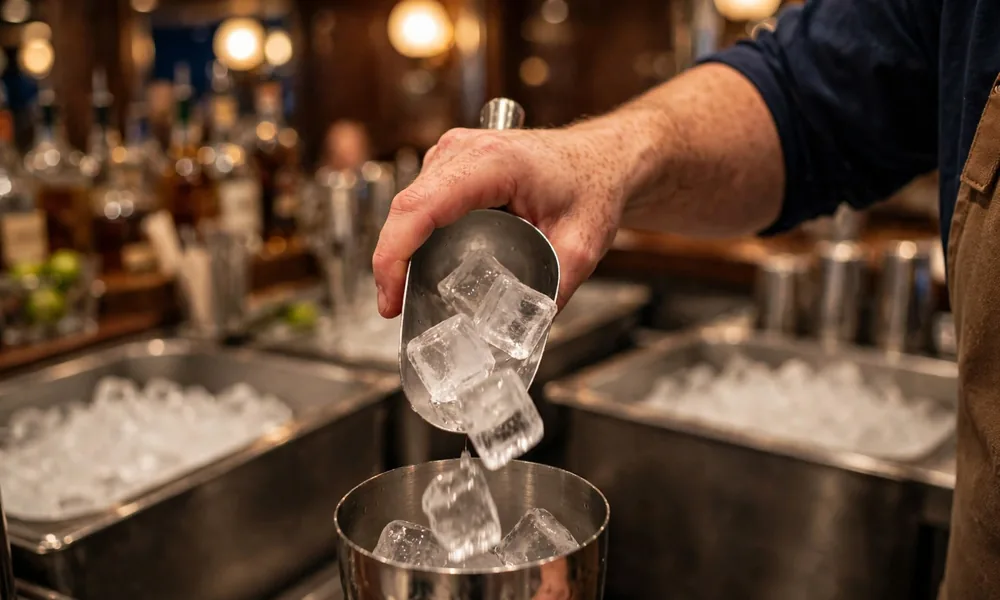
A ship cocktail bar uses ice by the tonne, not by the bag. Ice machines below the bar run around the clock, filling bins that the bartenders top up by the crate, and the cold stores hold days of backup ice in case a machine fails. The ice is made from filtered water, and the bar uses two kinds: small cubes for shaking, and large clear blocks for drinks served over ice, because a big block melts slowly and keeps a drink cold without watering it down.
The glass loop: wash, polish, serve, repeat
Glasses are the bar’s bottleneck, and the loop that moves them is the busiest part of the operation. A used glass is collected from a table, racked, and sent to a glass washer in the back room, where it is washed in seconds, then polished by hand and returned to the shelf, often within three minutes of being returned. The bar keeps hundreds of glasses in rotation, with spares stacked in the back room for the busiest hour, and a chipped glass is thrown away on the spot.
Fresh fruit, syrups and the prep shift
Long before the first guest arrives, a prep shift cuts the fruit, makes the syrups, and squeezes the juice for the night. Limes and lemons are cut by the hundred, herbs are picked and stored in damp cloth, and syrups are cooked in the ship galley and cooled in labelled bottles, so every station starts the evening with the same stock. The prep list is written from the previous night’s orders, so the bar makes more of what sold and less of what did not, and nothing at the garnish station is older than a day. A ship bar cannot send a steward ashore for a forgotten lime mid-voyage, so the prep shift is the bar’s insurance policy, and it is taken as seriously as the service itself.
Orders, tills and the rush after dinner
The rush starts the moment dinner ends, and the bar handles it with a system, not with shouting. Orders come in from the tables on handheld tills, the bar manager calls them out in sequence, and each bartender works the orders at their station in turn, so no drink waits longer than a few minutes. The tills track every drink sold, so the manager knows in real time which bottles are running low and which station needs help, and the restock trolley is already on its way before a bottle runs dry.
Closing a bar that never really closes
When the last guest leaves, the bar is stripped down station by station, with one station kept open until the very end for the stragglers. Glasses are washed and racked, the ice bins are emptied and wiped dry, the speed rails are restocked from the back room, and the bottles are counted against the night’s till readings. The ship cocktail bar build explains how the sectional counter was built to take that nightly routine, and by morning the bar looks untouched, the ice machines already running.
A ship cocktail bar works when the queue never stops moving. The drinks arrive cold, the glasses are polished, the ice never runs out, and the team behind the counter makes a thousand drinks a night look like a quiet evening. That is the whole job, and it is harder than it looks from the other side of the counter.
Ship Cocktail Bar Specifications
| Feature | Typical Detail |
|---|---|
| Counter | Sectional counter, several identical stations, each with speed rail, ice bin, sink and till |
| Team | A team of bartenders per service, plus a bar manager and glass polishers |
| Ice | Machines below the bar running around the clock, cubes and large clear blocks |
| Glass loop | Washed, polished and back on the shelf within minutes |
| Prep shift | Fruit cut by the hundred, syrups made daily in the galley |
| Orders | Handheld tills, orders called in sequence, restock by trolley |
| Closing | Stations stripped in turn, bottles counted against till readings |
How Much Does a Ship Cocktail Bar Cost to Run?
Prices are estimates and vary with ship size, menu and itinerary. Running a ship cocktail bar for a week typically costs an estimated $20,000 to $80,000 in stock, including spirits, fresh fruit, syrups, ice, and glassware, on top of the bar team’s wages. A single cocktail costs an estimated $10 to $22 in ingredients, with rare spirits and vintage champagne at the top of the range. The stock is loaded by the pallet at port, and the bar is one of the most profitable rooms on the ship.
A Rare Fact About Ship Cocktail Bars
Here is a detail most guests never notice: a glass at a ship cocktail bar can be washed, polished, and back on the shelf within three minutes of being returned to the bar. The glass loop is so fast that the bar owns far fewer glasses than the number of drinks it serves in a night, because each glass is used again and again before the evening is over. The best cruise ship restaurants ranks the restaurants that send the bar its crowd, and the loop is the reason the bar never runs out of glasses, even on the busiest night of the voyage: the glasses are not stored, they are circulated.
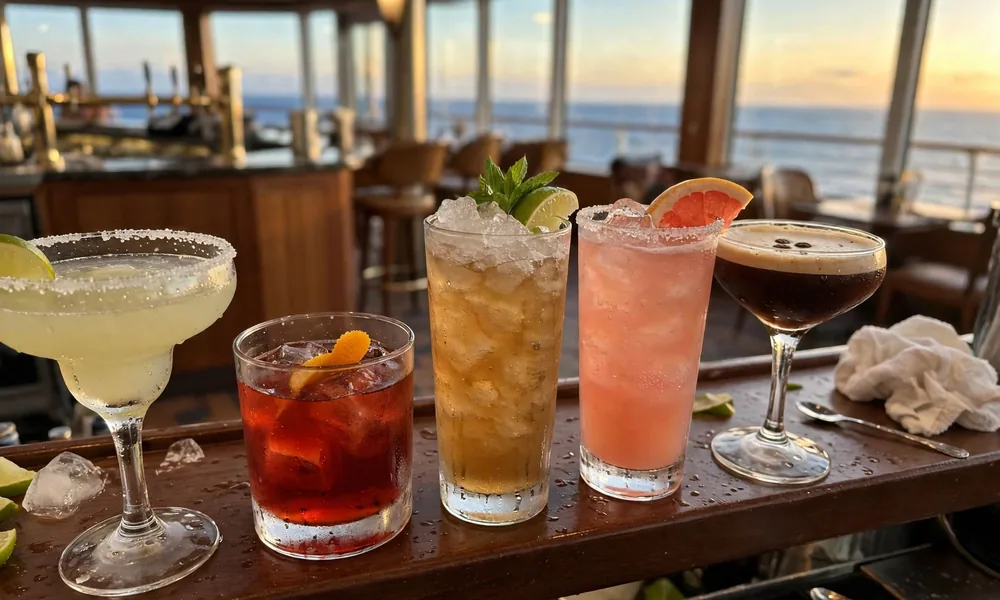
The best ship cocktail bars feel small even when they are big. The counter is long, but the bartender is close, the drink is in front of you in minutes, and the rest of the ship fades away for an hour. Then the glasses are cleared, the counter is wiped, and the bar is ready for the next sailing, the next port, and the next thousand drinks.


