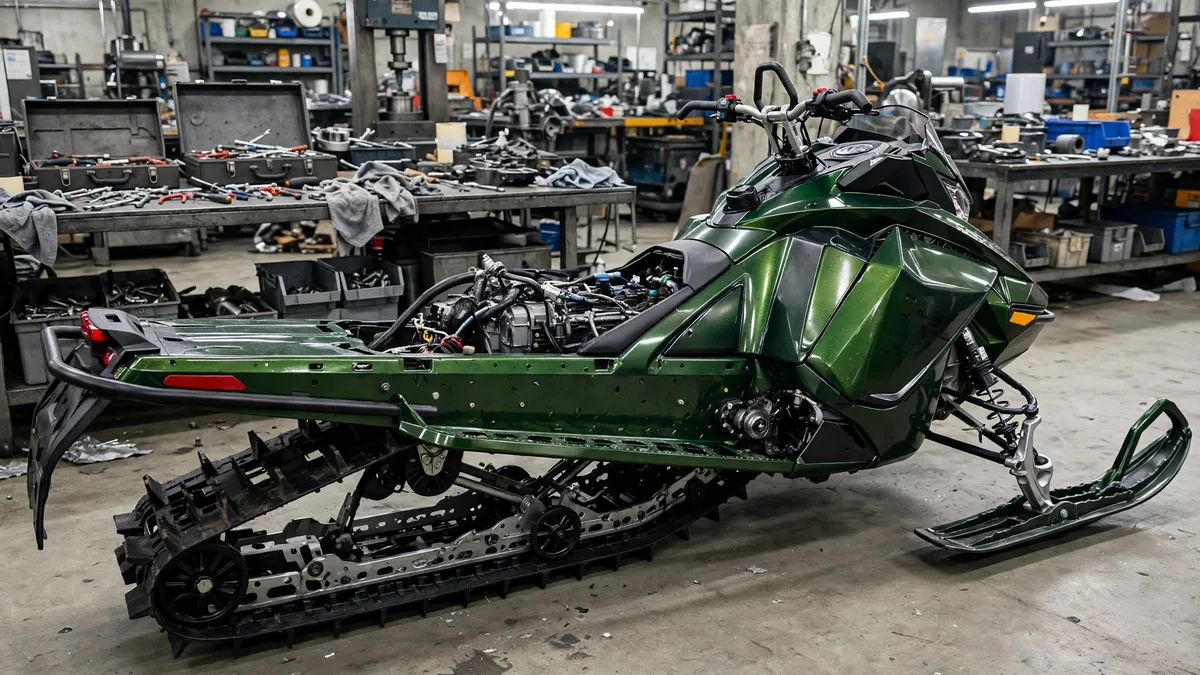
The first thing you notice on the factory floor is the cold. Not the cold of the winter outside, but the dry, filtered chill of a building that tests snow machines the way a wind tunnel tests aeroplanes. A row of half-built snowmobiles stands on jigs under bright white light, their aluminium tunnels gleaming, their tracks coiled like dark ribbons waiting to be fitted.
A luxury snowmobile is not a toy with a bigger engine. It is a small, fast, heated, hand-finished vehicle that has to work in the worst conditions a machine ever faces, while keeping its rider warm, dry, and comfortable at eighty kilometres an hour across open snow. The best of them cost as much as a family car, and the reason is visible in every weld, every stitch, and every gram of weight the engineers fought to save. This is how one is made, from bare metal to first snowfall.
How a luxury snowmobile is made
Step 1: The tunnel and chassis
Every luxury snowmobile starts as a tunnel, the long aluminium backbone that runs the length of the machine and carries everything else. Sheets of aircraft-grade aluminium are cut by laser, bent on a press brake, and welded into a rigid channel that forms the floor of the rider’s seat and the housing for the track. On a luxury model the tunnel is often heat-treated after welding to restore its strength, then anodised or powder-coated so road salt and slush cannot eat into it. The chassis is light, usually under 230 kilograms for the whole machine, and every gram matters when the engine has to push it through deep powder.
Step 2: The engine
The engine is the heart of the machine, and on a luxury snowmobile it is almost always a two-stroke or four-stroke twin of 850 to 900 cubic centimetres, built in a clean room away from the main line. Pistons, crankshafts, and cylinders are measured, matched, and balanced so the engine runs smooth at 8,000 revolutions per minute. Each engine is run on a dynamometer before it ever meets a chassis, and the test sheet travels with it down the line like a birth certificate. The difference between a good engine and a great one is measured in throttle response, and riders pay for the great one.
Step 3: The track and suspension
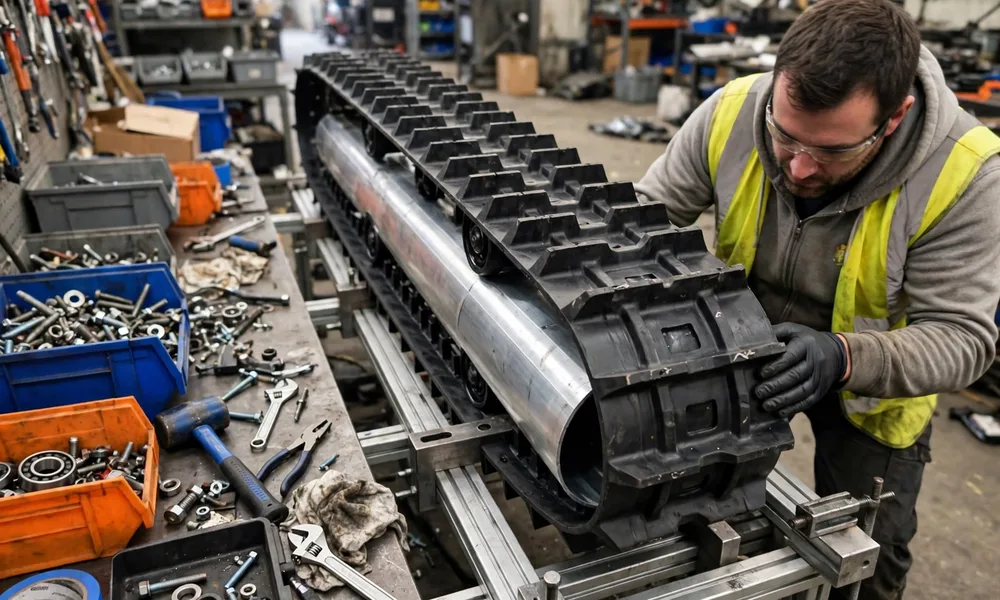
The track is what separates a snowmobile from every other vehicle on earth. A single wide rubber belt, reinforced with fibreglass cords and studded with moulded lugs, wraps around the rear of the machine and grips the snow. On a luxury model the track is typically 137 to 154 inches long, with lugs up to two inches tall for deep powder, and it is fitted with a suspension system of gas-charged shocks that can be adjusted from the handlebars. Fitting the track is a two-person job, and the tension is set with a gauge, because a track that is too tight robs power and one that is too loose can derail at speed. If you want to understand what the track does once the machine is moving, our guide to how a luxury snowmobile works follows the power from the engine to the snow.
Step 4: The bodywork and seat
With the mechanical parts in place, the machine gets its face. Body panels are moulded from composite plastics, painted in the factory’s paint shop, and fitted by hand so the panel gaps are even and the fasteners sit flush. Luxury snowmobiles get windshields shaped in a wind tunnel, hand grips that heat up at the touch of a button, and a seat that is more armchair than saddle, often with a heated pad and a storage compartment underneath. The dashboard is fitted next: a digital display that shows speed, engine temperature, fuel level, and a GPS map of the trail ahead. Every switch is tested by hand before the machine moves on.
Step 5: Wiring, heating, and electronics
A luxury snowmobile carries more wiring than many small cars, and all of it has to survive vibration, ice, and water. Wiring harnesses are assembled on boards, wrapped in protective sleeving, and routed through the chassis with clips that keep them away from hot exhaust parts and moving suspension arms. The electronic control unit is sealed against moisture and mounted on rubber isolators so the constant shaking of a trail does not crack its solder joints. Technicians run a full diagnostic scan on every machine, checking each sensor, each light, and each heater, and the results are logged against the machine’s serial number.
Step 6: Testing in the cold chamber
Before a luxury snowmobile leaves the factory, it is started cold. The machine is rolled into a chamber, the temperature is dropped to minus thirty degrees Celsius, and it sits overnight until every part is frozen solid. In the morning a technician turns the key, and the engine has to start on the first try. Any hesitation, any warning light, any unusual noise sends the machine back to the line for a fix. Only when it passes the cold test does it earn its final inspection sticker. This is also where the price starts to make sense, as our look at why a luxury snowmobile is so expensive explains in detail.
Step 7: Final inspection and first snow
The last step is human. An inspector walks around the machine with a checklist and a light, checking every bolt, every panel gap, every stitch, and every fluid level. The track tension is measured one last time, the ski alignment is checked with a laser, and the machine is washed and polished. Then it is crated or loaded onto a truck, often still smelling faintly of new paint and fresh rubber, and shipped to a dealer where it will wait for the first snowfall. For many buyers the wait ends at a mountain lodge, where a machine like this shares the trail with its bigger cousins, including the tracked workhorses described in our guide to how a luxury snowcat works.
Specifications
| Specification | Typical luxury snowmobile |
|---|---|
| Engine | 850–900 cc two-stroke or four-stroke twin, turbo optional |
| Power | 165–180 horsepower |
| Dry weight | 215–230 kg |
| Track length | 137–154 inches |
| Track lug height | 1.25–2.0 inches |
| Top speed | 160–180 km/h |
| Fuel capacity | 36–42 litres |
| Seat | Heated, two-up, marine-grade vinyl |
| Display | Digital gauge with GPS trail mapping |
| Cold start rating | Tested to minus 30°C |
Price
A new luxury snowmobile typically costs an estimated $18,000 to $28,000, depending on the engine, the track length, and the trim level, with flagship turbo models reaching beyond $30,000. That estimate covers the machine itself; a trailer, riding gear, and insurance are extra, and dealer preparation and freight usually add a few hundred dollars more.
A rare fact
Some luxury snowmobiles are built with a trick borrowed from racing: the engine’s exhaust valves are tuned to change their timing as the revs rise, which means the same machine can crawl quietly through a village at low speed and then scream up a mountain pass at full throttle without the rider touching a single setting.