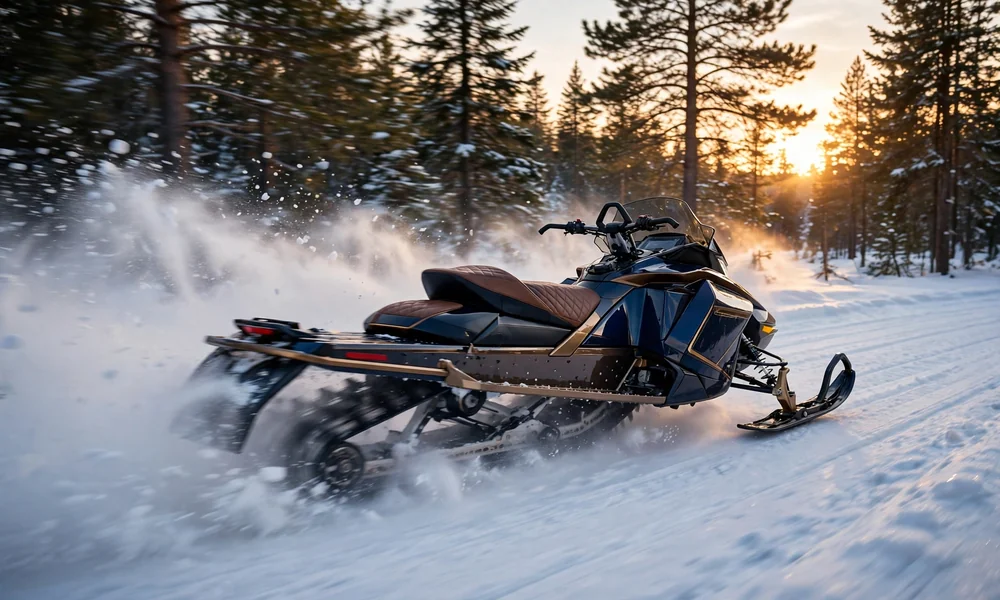
The snow is deep, the air is cold enough to sting, and the trail ahead winds through pine trees heavy with frost. A snowmobile comes around the bend, but it does not look like the rough, rattling machines you see at a rental yard. Its bodywork is sleek and dark, its windscreen is tall and clear, and the rider sits upright behind heated handlebars, warm and dry, with a display glowing softly in front of them. The machine moves with a quiet, confident hum, its wide track gripping the snow, and it leaves a clean, even trail behind it. This is a luxury snowmobile.
A luxury snowmobile is a snow machine built for comfort as much as for speed. It is made for owners who want to cross a frozen lake, reach a remote cabin, or ride a mountain trail in the depths of winter, without freezing, without being shaken to pieces, and without the machine breaking down miles from help. The engine is strong, the suspension is soft, the seat is heated, and the cabin, if you can call the space behind the windscreen a cabin, is designed to keep the wind and the cold away from the rider.

How a Luxury Snowmobile Works, Step by Step
Step 1: The track and how it grips snow
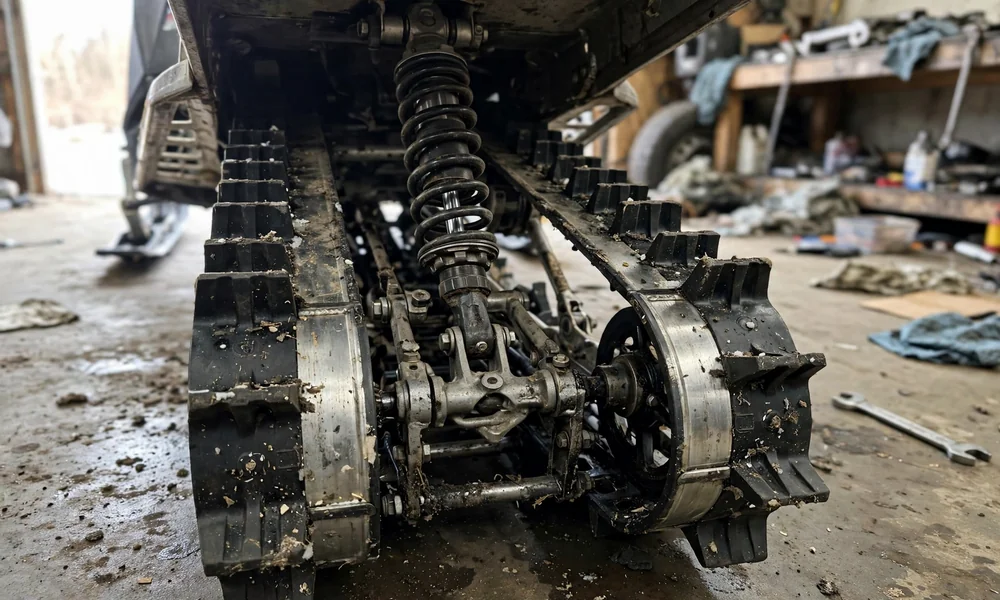
The heart of a snowmobile is its track, a wide, endless belt of rubber with lugs, small paddles, moulded into its surface. The track runs around the back of the machine, driven by a sprocket, and it spreads the weight of the snowmobile over a large area, so it floats on top of the snow instead of sinking into it. The lugs dig into the snow and push it backwards, and the reaction pushes the machine forwards, which is the same principle as a paddle steamer, turned upside down and made of rubber.
Step 2: The engine and the power
Most luxury snowmobiles use a two-stroke or four-stroke petrol engine, usually between 600 and 900 cubic centimetres, mounted low in the chassis. A two-stroke engine is light and powerful for its size, which is why it is popular on snowmobiles, while a four-stroke is quieter, cleaner and more fuel-efficient. Either way, the engine has to start in the cold, sometimes at twenty below zero, so it has a strong starter motor, a heated intake, and fuel injection that adjusts itself to the temperature.
Step 3: The transmission and the clutch
The transmission is controlled by a centrifugal clutch, which engages automatically as the engine speed rises. Twist the throttle, the engine revs, the clutch grips, and the machine moves off. Let go, the clutch releases, and the machine coasts. It is simple, tough and well suited to snow, where a manual gearbox would be a liability. The belt is the wear item, and a spare is carried under the seat, because a snapped belt in deep snow is a long walk home. The suspension thinking behind a snowmobile shares ideas with high-performance road machines, as shown in a guide to how a hypercar suspension works.
Step 4: Steering with skis
Steering a snowmobile is done with two skis at the front, turned by the handlebars through a simple linkage. The skis are wide, flat blades of steel or plastic, with a keel underneath that bites into the snow and a carbide runner that grips on ice. When the rider turns the bars, the skis angle into the turn, and the machine follows, leaning slightly into the corner like a motorcycle.
Step 5: Suspension and ride comfort
Ride comfort is where a luxury snowmobile earns its name. The rear suspension, which carries the track, is a long-travel design with a shock absorber that can be adjusted for the rider’s weight and the trail. The seat is wide, thickly padded and heated, and it is positioned so the rider sits upright, with a clear view over the windscreen. The footrests are wide and grippy, with room for big winter boots, and the windscreen is tall enough to throw the wind over the rider’s helmet.
Step 6: Heating, electrics and the display
The display in front of the rider is a small, bright screen that shows the speed, the engine temperature, the fuel level, and a navigation map. It is designed to be read with a glance, through a helmet visor, in bright snow glare. The machine also carries a GPS tracker, so a rider who gets stuck can be found, and many owners fit a heated storage box for gloves and a phone. The battery that powers all of this is kept warm by its position near the engine, and it is the same kind of storage used in electric vehicles, as explained in a guide to how an EV battery pack works.
Step 7: Safety and cold-weather care
Cold-weather care is part of owning a snowmobile. The machine is stored in a heated garage or under a cover, the fuel is treated so it does not go stale, and the track is checked for damage after every ride. Before a ride, the rider checks the skis, the track tension, the coolant and the belt, and carries a spare belt, a shovel and a tow rope. A snowmobile that is looked after will last for many winters, and the best luxury machines are built to be serviced easily, with panels that come off without tools and parts that are easy to reach. The brakes, which matter as much on snow as on a road, use the same principles as performance cars, as shown in a guide to how carbon ceramic brakes work.
Specifications at a Glance
| Feature | Typical Luxury Snowmobile |
|---|---|
| Engine | 600 to 900 cc, two-stroke or four-stroke |
| Power | 120 to 180 horsepower |
| Track width | 50 to 60 centimetres |
| Track length | 3.5 to 4 metres |
| Top speed | 130 to 170 kilometres per hour |
| Fuel tank | 35 to 45 litres |
| Weight | 220 to 280 kilograms |
| Seating | One or two, heated seat and handlebars |
What a Luxury Snowmobile Costs
A luxury snowmobile is a premium machine, and its price reflects the engine, the suspension and the comfort. As an estimate, a new luxury snowmobile might cost roughly $18,000 to $28,000, depending on the engine size, the track length and the level of equipment. A top-of-the-range model with the largest engine, electric suspension, a full display and a heated everything could cost an estimated $30,000 or more.
Those are estimates, and the running costs are modest by comparison. Fuel, oil, a spare belt and an annual service might cost a few thousand dollars a year, and insurance is usually reasonable. The real cost is the clothing and the trailer, and the time: a snowmobile is only useful for a few months of the year, so owners who buy a luxury machine tend to use it hard while the snow lasts.
A Rare Fact
The first snowmobiles were not built for fun at all. They were built in the 1920s and 1930s as winter ambulances and mail carriers, to reach isolated communities when the roads were buried in snow. The early machines were slow, open and freezing to ride, and the drivers wore fur coats and goggles. It took decades before anyone thought to heat the handlebars, and longer still before a snowmobile became something you would ride for pleasure on a cold, bright morning.
A luxury snowmobile is a machine built for winter, and it works because every part of it, from the track to the heated seat, is designed for snow, ice and cold. It does not fight the winter. It uses it.