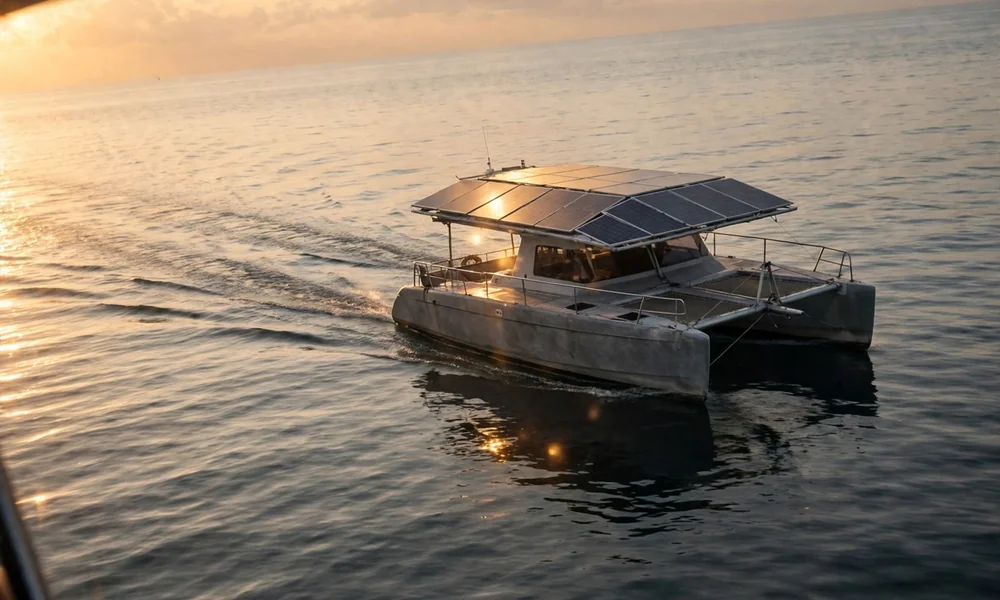
By mid-morning, the sun is high over the bay, and the solar catamaran at anchor is doing something unusual: it is filling its own fuel tank. The dark panels across its wide roof are drinking in the light, the battery display at the helm is climbing, and the boat has not burned a drop of fuel or made a sound all day.
A luxury solar catamaran is a boat that runs on daylight. Its roof is a power station, its hulls are battery rooms, and its motors sip the stored sunshine to move the boat in near silence. This is how it works, from the panels on the roof to the propellers under the twin hulls.
Catching the sun: the roof array
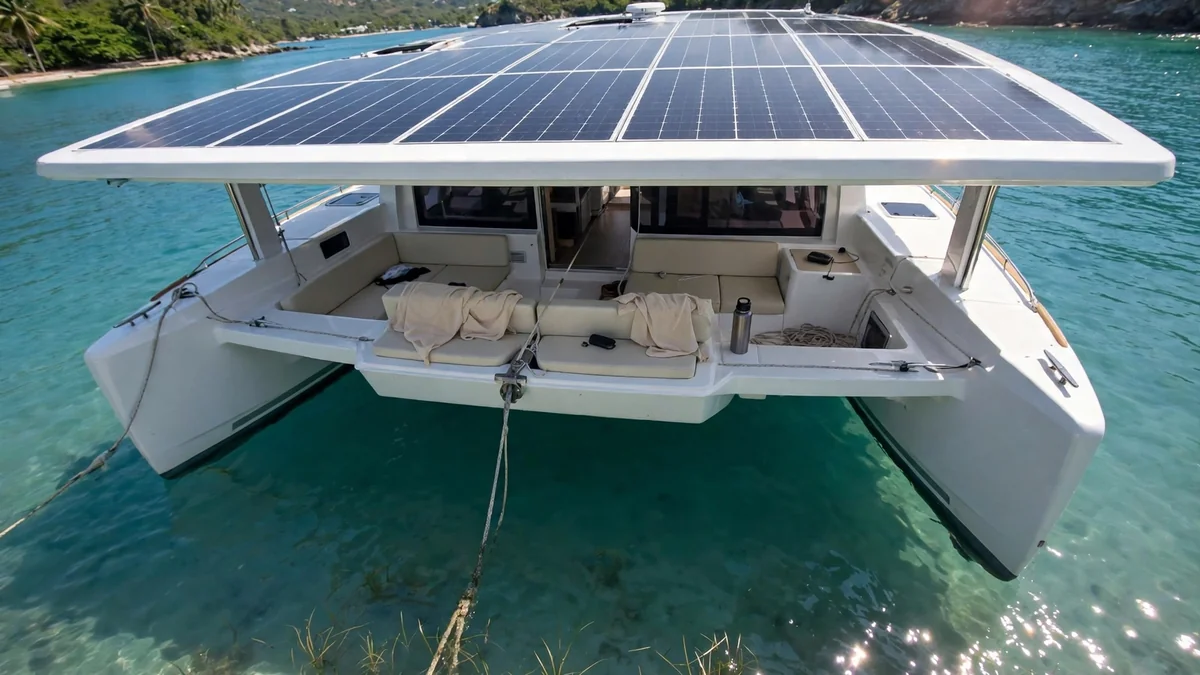
The work starts on the roof. A catamaran has a natural advantage here, because its wide beam gives it a broad, flat roof over the saloon, far larger than a single-hull yacht of the same length can offer. That roof is covered in solar panels, usually ten kilowatts or more on a luxury build, and every square metre of it is earning power from the moment the sun rises.
The panels are marine-grade, sealed against salt spray and built to flex slightly as the boat moves. They feed direct current down through the roof supports to the charge controllers below, which squeeze the most power from the array as the sun moves across the sky.
Storing it: batteries in the twin hulls
The power from the roof goes into the battery bank, which is split between the two hulls to keep the weight balanced. Lithium modules sit low in each hull, in ventilated compartments with cooling and fire protection, and they are wired together through the crossbeams so the two sides act as one large bank. A luxury build often carries several hundred kilowatt-hours of storage, enough to run the boat and its cabins for days.
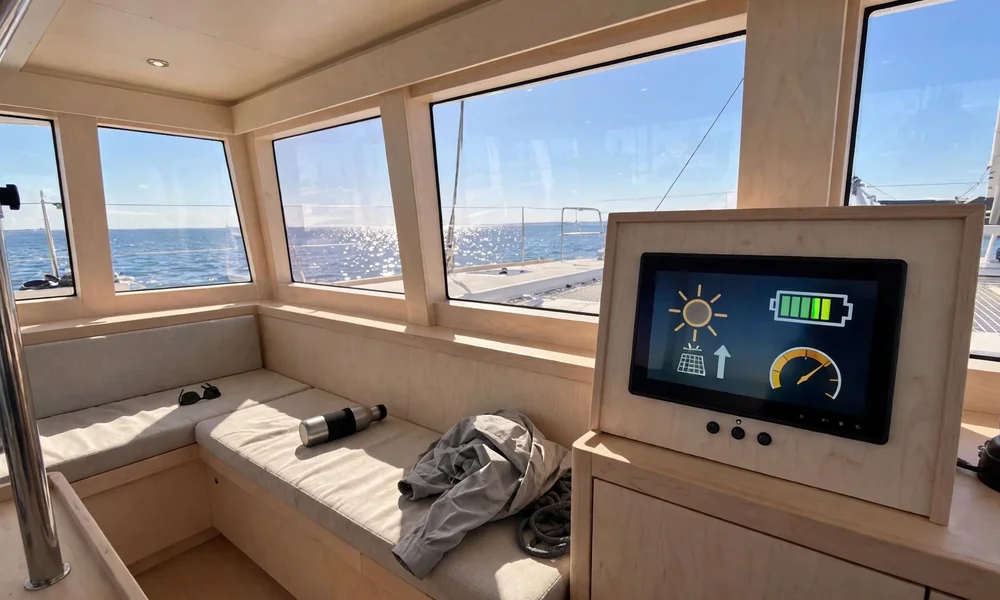
The bank is watched over by a battery management system that monitors every module. It balances the charge between them, keeps them cool, and shuts down a module that runs too hot. The crew can see the state of charge on the helm display at a glance, and the number becomes as familiar as a fuel gauge on a conventional boat.
Turning it into motion: twin electric motors
When the boat moves, the stored sunshine flows to two electric motors, one in each hull, each driving its own propeller. The motors are quiet, compact, and smooth, with no exhaust and almost no vibration, and because there are two of them, the catamaran can turn almost in its own length by running one forward and the other in reverse.
At a gentle cruising speed of six or seven knots, the motors draw modest power, and a full battery bank can carry the boat for hours. Push the speed up, and the power demand climbs steeply, so the crew learns to cruise slowly and let the sun keep up. Solar-powered catamarans, explained covers the same idea in simpler terms, and the lesson is the same: on a solar boat, speed is bought with sunshine, so gentle cruising goes furthest.
The energy brain: managing sun, storage, and speed
Between the panels, the batteries, and the motors sits the energy management system, the brain of the boat. It reads how much power the roof is making, how full the batteries are, how fast the boat is going, and how much power the cabins are drawing, and it balances all of it in real time. If the sun is strong and the batteries are full, it lets the motors take more. If clouds roll in, it trims the speed to protect the reserve.
The system also plans ahead. It knows that the evening will need power for cooking, lights, and air conditioning, so it saves enough for the night and tells the crew how far they can travel before sunset. The display shows the whole picture in plain numbers: power in, power out, and hours of cruising left at the current speed.
Living on sunlight: the cabins and the galley
A solar catamaran is not just a propulsion system. It is a floating home, and the cabins run on the same sunshine as the motors. The galley uses induction hobs, the air conditioning runs from the battery bank, and the water maker turns seawater into fresh water using solar power. At anchor, the boat can sit for days in a sunny bay without a generator, and the only sound is the water against the hulls.
That silence is the luxury. Guests sleep without a generator throbbing under the deck, and the boat leaves no smell of diesel behind it. Luxury solar yacht specs, explained lays out the numbers for a single-hull solar yacht, and the catamaran version follows the same pattern, with a bigger roof and a wider, steadier platform to put it on.
Topping up: shore power and sailing
Sunshine is the main fuel, but it is not the only one. In a marina, the catamaran plugs into shore power and charges its batteries overnight, just like an electric car. Some builds also carry a small backup generator for long cloudy stretches, used sparingly, and sailing catamarans can spin their propellers in the water while under sail, turning the motors into generators that add charge on a long passage.
Most owners find they rarely need the backup. A week of island hopping in sunny weather can run almost entirely on the roof, with the shore-power top-up at the marina doing the rest. How electric boat charging works explains the plugs, the chargers, and the charging speeds behind those marina stops, and the same kit serves a solar catamaran when the sun has had a day off.
Specifications
| Detail | Specification |
|---|---|
| Length | Around 15 to 19 metres |
| Beam | Around 8 to 9 metres |
| Solar array | Around 10 to 14 kilowatts peak |
| Battery bank | Around 150 to 350 kilowatt-hours |
| Electric motors | Two motors, around 50 kilowatts each |
| Cruising speed | Around 6 to 8 knots on solar power |
| Daily solar range | Around 30 to 50 nautical miles |
| Guests | Around 8 guests and 2 crew |
Price
The estimated price of a new luxury solar catamaran is around 2.5 million dollars, and that figure is an estimate only, because the cost depends on length, panel area, battery size, and the standard of the interior. The solar array and the battery bank account for a large share, followed by the twin hulls and the wide bridge-deck fit-out. A buyer is paying for a spacious, stable yacht that cruises on sunlight, anchors for days without a generator, and costs almost nothing to fuel on a sunny week.
A rare fact
Few people know that a solar catamaran can make power while it is sailing, even with the motors off. The panels keep charging whenever the sun is up, so a day spent sailing between islands can end with fuller batteries than it began with. The boat arrives at its anchorage with more energy than it left with, ready for a silent evening.
When the sun sets and the panels go quiet, the boat settles into its anchorage on the power it gathered during the day, lights glowing and air conditioning humming softly. It will do the same again tomorrow, and the day after, as long as the sun keeps rising.