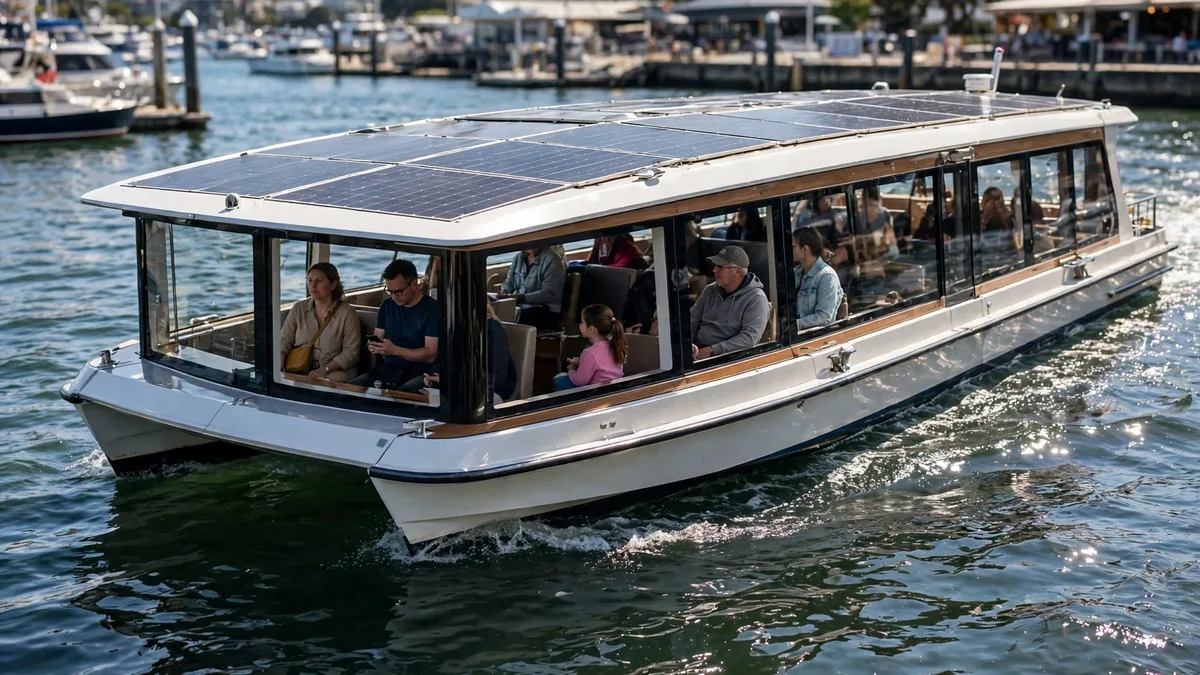
By mid-morning, the sun is high over the harbour, and the ferry at the quay is doing something unusual: it is filling its own fuel tank. The dark panels across its wide roof are drinking in the light, the battery display at the helm is climbing, and the boat has not burned a drop of fuel or made a sound all day. A luxury solar ferry is a boat that runs on daylight.
This is how a luxury solar ferry works, from the panels on the roof to the propellers at the stern, and why a boat with no engine room can still cross a harbour all day.
Step 1: The roof array catches the sun
The work starts on the roof. A ferry has a natural advantage here, because its wide, flat deck gives it a broad roof, far larger than a yacht of the same length can offer, and that roof is covered in solar panels, usually many kilowatts on a luxury build. The panels are marine grade, sealed against salt spray and built to flex slightly as the boat moves, and every square metre of them is earning power from the moment the sun rises. They feed direct current down through the roof supports to the charge controllers below, which squeeze the most power from the array as the sun moves across the sky, and the roof does a second job at the same time: it shades the passenger deck below, which keeps the lounge cool without running air conditioning all day. The guide to how a luxury solar ferry is made follows the build from the keel to the solar roof, and the array fitted there is what the whole working day depends on.
Step 2: The charge controllers turn sunlight into stored power
The power from the roof does not go straight to the motors. It goes first to the charge controllers, which watch the voltage of the array and the state of the batteries and decide how much power to take at every moment. In the morning, when the batteries are low and the sun is climbing, the controllers take everything the roof can give. In the middle of the day, when the batteries are nearly full, they ease off, because a battery forced full too fast is a battery that ages early.
Step 3: The batteries store the day for the evening
From the controllers, the power flows into the battery bank, which sits low in the hull in sealed, cooled compartments with fire protection. The bank is split into modules, and a battery management system watches every module for temperature and charge, balances the charge between them, and shuts down a module that runs too hot.
Step 4: The electric motors turn stored sunshine into motion
When the boat moves, the stored sunshine flows to the electric motors at the stern, usually pods or shaft-driven units that drive the propellers directly, with no gearbox and no exhaust. The motors are quiet, compact and smooth, with almost no vibration, and the captain controls them with simple levers, because an electric motor needs no warm-up and no gear changes. The ferry accelerates gently, the way an electric vehicle does, and it stops gently too, the motors reversing to slow the boat as it comes into the quay. The guide to how a luxury electric ferry is made follows the same battery-first build on a ferry that charges from the shore, and the difference here is the source: this ferry makes its own power while it works, instead of plugging in between crossings.

Step 5: The helm watches the sun, the batteries and the route
In the wheelhouse, the helm brings the whole system together on one display. The captain can see how much power the roof is making, how full the batteries are, how far the boat can go, and how much the motors are drawing, all at a glance. On a bright day the roof makes more than the motors use, and the batteries fill as the boat crosses.
Step 6: The lounge rides in silence
While the engineering works below, the passengers notice only the silence. The lounge is fitted with wide seats facing large windows, soft lighting and a small galley, and there is no engine vibration through the floor, no diesel smell and no exhaust smoke drifting past the windows. The boat moves so quietly that conversation stays easy even at full speed, and the only sound is the water slipping past the hull. The guide to how a solar catamaran works follows the same silent system on a twin-hull boat, and the ferry adds one thing the catamaran does not: a timetable, and a roof big enough to keep it, crossing after crossing, all day long.
Step 7: Docking, charging and the next crossing
At the end of each crossing, the ferry comes into the quay on its electric motors, the captain easing the levers back and letting the motors slow the boat to a gentle stop. If the sun is still up, the roof keeps charging while the passengers step off and the next ones step on, and the boat is ready for the next crossing in minutes, with no fuelling and no waiting.
The spec sheet at a glance
| Specification | Typical luxury figure | What it tells you |
|---|---|---|
| Hull material | Aluminium or glass fibre composite | How light the boat is, and how much roof and battery it can carry |
| Solar array | Often 20 kilowatts or more | How much power the roof makes in full sun |
| Battery bank | Often several hundred kilowatt-hours | How far the boat goes without sun, and how long the lounge runs |
| Motors | Electric pods or shaft-driven units | How quietly the boat moves, and how smoothly it docks |
| Cruising speed | Roughly 6 to 12 knots | How fast the crossings are, and how much power they use |
| Passengers | Often 50 to 150, in lounge seating | How many guests the cabin carries in comfort |
| Charging | Solar roof, plus shore connection at night | How the boat is ready for the next day |
| Range | A full day of crossings on sun and battery | How long the boat works without plugging in |
| Emissions | None while under way on solar power | How clean the air is around the boat |

What it costs
A luxury solar ferry typically costs an estimated $3 million to $15 million, depending on its size, its solar array, its battery bank and how lavish the lounge is fitted. The estimate covers the vessel alone, not the terminal, the crew or the running costs.
A rare fact
One detail few passengers ever learn is that a solar ferry can be more efficient in the afternoon than in the morning, and the reason is the panels themselves. Solar panels make more power when they are cool, and the breeze over the roof as the boat moves keeps them cooler than the same panels would be on a still rooftop ashore. A ferry under way is a moving, ventilated solar roof, and the boat that looks like it is working hard is, in the sunshine at least, working at its best.