A titanium exhaust on a luxury hypercar weighs about half as much as the steel system it replaces, and it sings a sharper note while it does it. The metal is stubborn stuff, hard to bend, hard to weld, and unforgiving of mistakes, which is why so few workshops will touch it and why the ones that do charge what they charge.
Each system is built by hand for one car, from thin-walled titanium tube that is cut, bent, welded and polished until it fits the car like a tailored suit. This is how a luxury titanium exhaust is made, from a stack of raw tube to the blue-tinted tips at the back of the car.

How It’s Made
Step 1: The tube is chosen and cut
The work starts with grade five titanium tube, an alloy of titanium, aluminium and vanadium that is strong, light and able to survive exhaust heat without scaling. The walls are thin, often less than a millimetre, which is where the weight saving comes from, but thin walls also mean the tube dents easily and cannot be forced, so every length is handled gently and stored in racks that keep it from rolling against anything hard.
Step 2: The bends are formed one at a time
Titanium does not bend the way steel does. It springs back, it work-hardens, and it cracks if it is pushed too far in one pass, so the bends are made slowly on a mandrel bender, a machine that pushes a shaped rod inside the tube while the tube is drawn around a form. The mandrel stops the thin wall from collapsing or wrinkling on the inside of the bend, which matters, because a wrinkled bend chokes the flow of gas and costs power.
Step 3: The sections are tacked together on the jig
With the bends and straights cut, the whole system is assembled on the jig and tacked together with small welds that hold each joint just enough to check the fit. The builder checks the clearances against the car, the bodywork, the suspension and the heat shields, because an exhaust that touches the body will buzz, rattle and eventually burn through the paint. A gap of a few millimetres is all that separates a perfect system from an annoying one.
Step 4: The joints are welded under argon
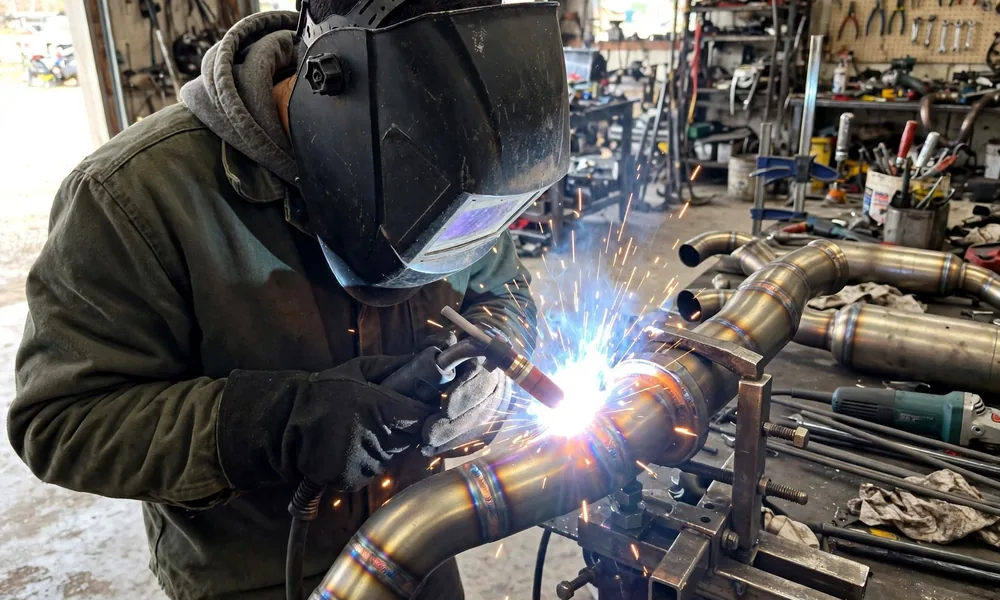
Titanium welding is done with a TIG torch under a blanket of argon gas, and the gas must cover not only the weld but the hot metal behind it, because titanium grabs oxygen and nitrogen from the air the moment it is hot, turning brittle and dull. The welder works inside a purge, with argon flowing through the pipe as well as over it, and the finished weld should be silver or straw coloured. A blue weld is acceptable. A grey, crusty weld is contaminated and must be cut out and done again.
Each joint is welded in short runs, letting the metal cool between passes so the thin tube does not warp. The welder moves around the system joint by joint, and a full exhaust can take a whole day of welding alone. When the last joint cools, the system is pressure tested, with air blown through and soapy water brushed over every weld, watching for bubbles that would betray a leak.
Step 5: The system is cleaned, polished and heat-tinted
Once the welding passes, the exhaust is cleaned in an acid bath that strips the surface scale and leaves the titanium bright, then it is polished by hand or with a soft wheel until it shines. Some builders leave the welds as they are, a neat stack of ripples that shows the handwork, while others polish the whole system to a mirror finish.
The famous blue and purple tint on a titanium exhaust comes from heat, and it appears the first time the engine runs, as the metal near the tips oxidises in a thin layer that bends light into colour. Some builders force the tint with a torch before delivery, working along the tailpipes until the colour flows from straw to gold to blue, but the best systems are left to colour themselves on the car, because a heat tint earned on the road never looks painted on.
Step 6: The exhaust is fitted and tuned by ear
The finished system goes onto the car, hung on flexible mounts that let it move as it heats and grows, because a titanium exhaust grows several millimetres longer when it is hot, and rigid mounts would crack. The tips are aligned in the bumper cut-outs, centred by eye and by measure, and the valves are wired to the car’s controls so the driver can open and close them.
Then the engine is started, and the builder listens. A titanium exhaust changes the note of a car, making it sharper, higher and more metallic, and the builder checks for rattles, leaks and drones at cruising speed. If the note is wrong, a baffle is changed or a pipe length adjusted, and the car is driven again, because the sound is part of what the owner paid for, and no one signs off an exhaust that sounds ordinary.
| Spec | Detail |
|---|---|
| Material | Grade 5 titanium, titanium with aluminium and vanadium |
| Wall thickness | Often under 1 millimetre, about half the thickness of steel |
| Weight saving | Roughly 40 to 50 percent lighter than an equivalent steel system |
| Welding | TIG welded under argon, purged inside and out, silver or straw welds |
| Heat resistance | Handles exhaust gas temperatures above 600 degrees Celsius |
| Build time | Several days of bending, welding, polishing and fitting |
The hardest part of a titanium exhaust is not the material itself but the discipline it demands. The metal punishes haste, dirty gas, or a careless weld, and there is no filler or paint that can hide a bad joint. That is why the best systems cost what they do, and why they last: a well-made titanium exhaust will outlive the car it is bolted to.
What One Costs
A luxury titanium exhaust typically costs an estimated $8,000 to $30,000, and the price is set mostly by the car it fits, the number of pie-cut bends, and the hours of welding. For what the finished system does once it is on the car, how a titanium exhaust works explains the gas flow and the valves, and why a titanium exhaust is so expensive breaks down the cost of the metal and the labour.
A Rare Fact
A titanium exhaust grows noticeably longer as it heats up, by several millimetres from cold to full temperature, which is why it hangs on flexible mounts and why the tips sit slightly short of the bumper when the car is cold. On some cars the tips creep out of the bumper as the engine warms, and creep back in as it cools.

A luxury titanium exhaust is thin tube, patient bending and clean welding, turned into a system that weighs half as much as steel and sounds like nothing else on the road. It is one of the few parts of a car where the owner can hear the money, every time the engine starts. For the turbo that feeds it hot gas in the first place, why a titanium turbocharger is so expensive explains the other titanium part of the same engine.