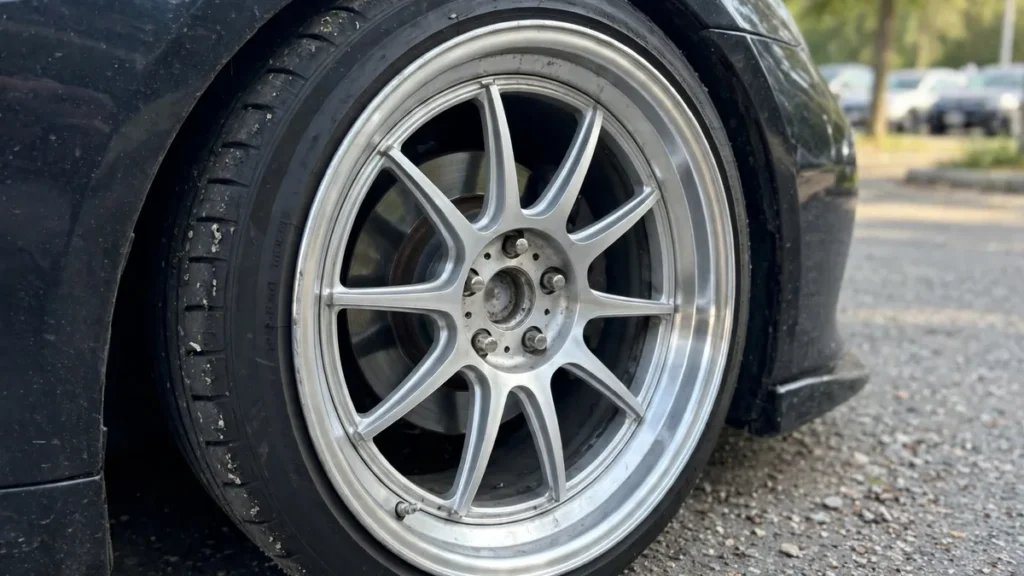
A carbon-fibre wheel looks like a normal wheel until you pick it up. Then it feels wrong, impossibly light for its size, like a prop from a film set rather than a part that has to carry a two-tonne car through a corner at speed. That lightness is the whole point, and it changes how the car steers, brakes and rides.
The wheel is not a single piece of carbon but a carefully engineered structure, with fibres running in different directions to carry the loads of acceleration, braking and cornering, all while spinning thousands of times a minute. This is how a luxury carbon-fibre wheel works, from the forces at the tyre to the fibres inside the rim.
How It Works
Step 1: The wheel carries the car on a cushion of air
The wheel’s first job is simple: it holds the tyre, and the tyre holds the car. The tyre is a ring of rubber inflated to a high pressure, and it is the tyre, not the wheel, that carries the weight, flexing slightly where it meets the road. The wheel’s job is to keep the tyre round, to hold it firmly on its beads, and to pass the forces between the tyre and the car without flexing itself.
A carbon-fibre wheel does this with far less mass than a metal wheel. A typical carbon wheel weighs about forty percent less than an equivalent aluminium wheel, and that saving matters twice over, because the wheel is unsprung weight, mass that the suspension has to control directly, and it is rotating mass, mass that the engine has to spin up and the brakes have to slow down.
Step 2: The spokes pass the driving and braking forces
When the driver accelerates, the engine’s torque travels through the driveshaft to the hub, and from the hub through the spokes to the rim and the tyre. When the driver brakes, the force runs the other way, from the tyre through the rim and spokes to the brake disc and the hub. The spokes are the bridge for all of it, and they are loaded in tension and compression thousands of times a minute.
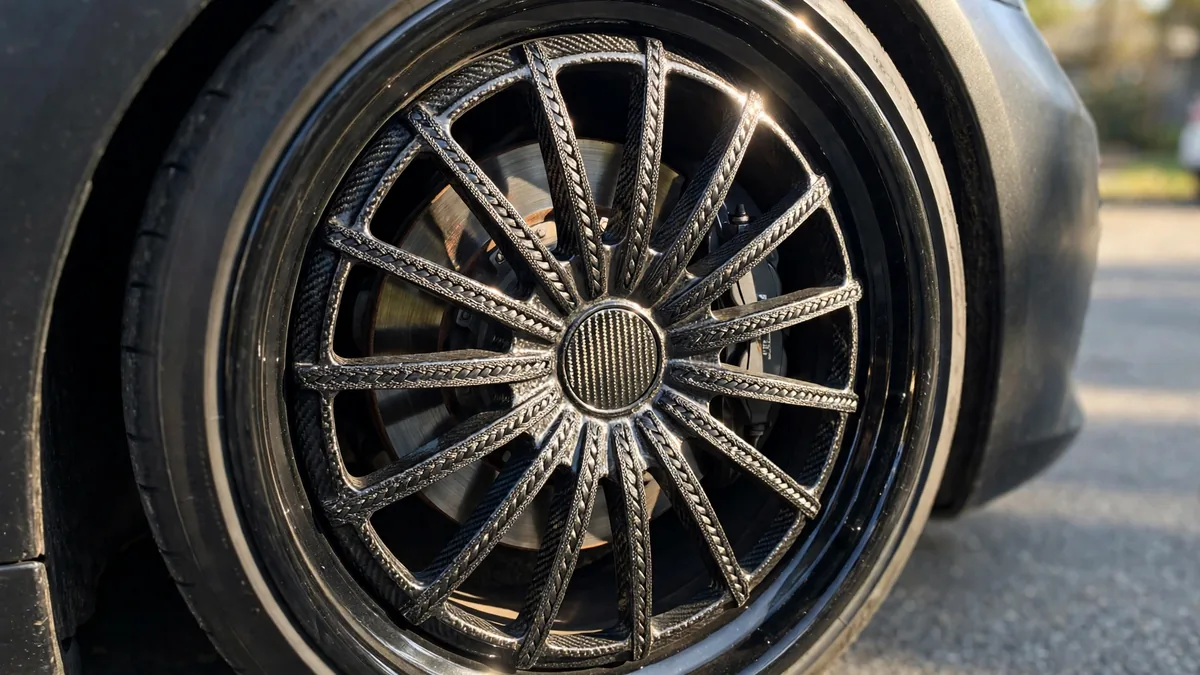
In a carbon wheel the spokes are not separate parts bolted to a rim. They are laid up as part of the same structure, with fibres running continuously from the hub out through the spokes and around the rim, so the load has an unbroken path to follow. There are no joints to work loose and no bolts to fatigue, which is one reason carbon wheels survive forces that would crack a cast metal wheel.
Step 3: The rim holds the tyre bead under pressure
The rim is a deep channel with a raised lip on each side, and the tyre’s beads sit against those lips, sealed by air pressure. At speed the tyre tries to pull away from the rim, and under hard cornering the bead is pushed sideways with a force of more than a tonne, so the rim must be stiff enough not to flex and let the seal break. A carbon rim is far stiffer than a metal one of the same weight, which is why it holds the bead so well.
Step 4: The hub and inserts take the bolt loads
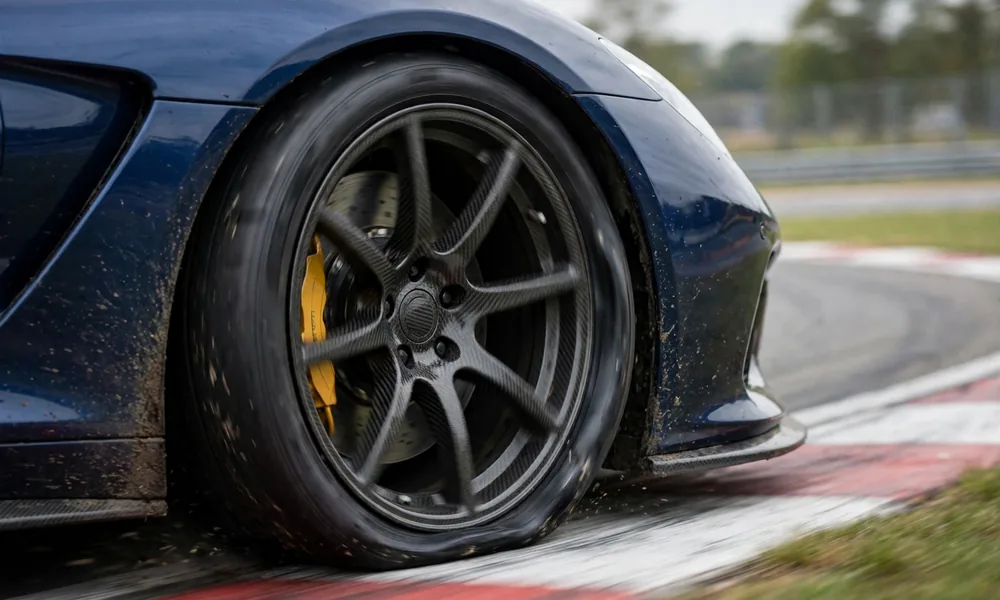
The centre of the wheel is its busiest part. The hub carries the wheel nuts or the single centre-lock nut, the brake disc bolts to it, and the driveshaft passes through it. Carbon fibre does not like point loads, so the hub area is reinforced with metal inserts, aluminium or titanium rings bonded into the carbon, which spread the clamping force of the nuts over a wide area.
The centre-lock nut, used on many hypercars, is tightened to an enormous torque, and the insert must take that load without crushing the carbon around it. The wheel is fitted and removed with a special long-handled wrench, and the torque is checked with a calibrated gauge, because a centre-lock that is under-torqued can work loose, and one that is over-torqued can damage the insert.
Step 5: Less rotating mass sharpens everything
The real magic of a carbon wheel is not the weight it saves on the scales but the weight it saves while spinning. A lighter wheel is easier to speed up and easier to slow down, so the car accelerates a fraction faster and the brakes work a fraction less hard. The effect is small on paper and obvious on the road, where the car feels more eager to change direction.
Step 6: The wheel is balanced, tested and monitored
Before a carbon wheel goes on a car, it is balanced on a machine that spins it and finds the heavy spot, and small weights are added until it runs true. An unbalanced wheel shakes the car at speed, and on a carbon wheel the balance is checked more often than on a metal one, because a small change in the tyre or a stone stuck in the tread shows up sooner on a lighter wheel.
The wheel is also tested to destruction in the factory, spun on a rig that simulates years of cornering and braking loads, and dropped onto a test rig that mimics a pothole strike. Wheels that pass are given a serial number, and their history is tracked, so a wheel that has taken a hard hit can be pulled from service and inspected, even if it looks perfect from the outside.
| Spec | Detail |
|---|---|
| Material | Carbon-fibre composite rim and spokes, metal hub inserts |
| Weight | About 40 percent lighter than an equivalent aluminium wheel |
| Construction | Continuous fibres from hub through spokes to rim, no bolted joints |
| Stiffness | Far stiffer than metal at the same weight, holds the tyre bead firmly |
| Fixing | Centre-lock nut or wheel nuts on bonded metal inserts |
| Inspection | Ultrasonic scan after any serious impact, serial numbered and tracked |
The hardest part of a carbon-fibre wheel is the trade it makes. It gives the car lightness, stiffness and a sharper feel, and in return it asks for care: no kerb strikes, no careless tyre fitting, and an inspection after any hard hit.
What One Costs
A single luxury carbon-fibre wheel typically costs an estimated $4,000 to $12,000, and a set of four can cost as much as a small car. The price is set mostly by the layup time, the autoclave cure and the testing, since every wheel is effectively handmade. For how the wheel itself is built, how a carbon-fibre wheel is made follows the layup and the cure, and why a carbon-fibre wheel is so expensive breaks down where the money goes.
A Rare Fact
The first carbon-fibre wheels on a production car were so light that engineers had to redesign the suspension around them. The dampers were tuned for a heavier wheel, and with the lighter wheel fitted, the car bounced over bumps it used to absorb, until the suspension was retuned to match the wheel it had never expected to carry.

A luxury carbon-fibre wheel is a structure of continuous fibres, working as one piece to carry the car, pass its forces and hold its tyre, all while weighing far less than metal. It makes the car quicker to turn, quicker to stop and more faithful to the road. For the exact numbers behind the part, the carbon-fibre wheel specifications list the sizes, weights and ratings.