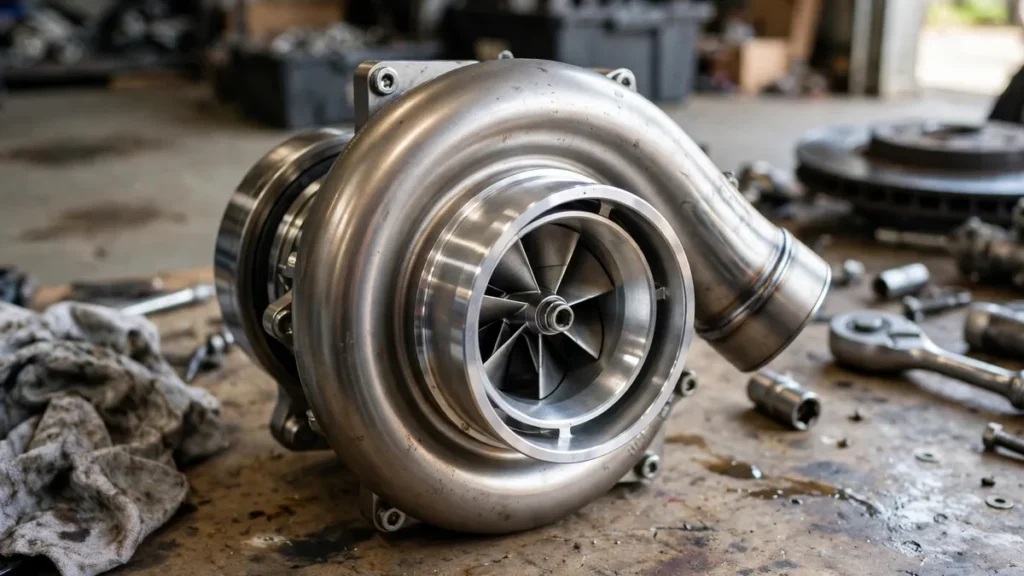
A hypercar engine is a paradox. It must be small enough to fit behind the driver, light enough not to ruin the handling, and powerful enough to push the car past 200 miles per hour. The answer is a turbocharger: a tiny turbine that steals energy from the exhaust and uses it to force more air into the engine. More air means more fuel can burn, and more fuel means more power, all from an engine half the size it would otherwise need.
The finest turbochargers are built with titanium. The turbine wheel sits in the exhaust stream, where gases arrive at nearly 1,000 degrees Celsius, and it spins faster than a jet engine. Steel would be too heavy to spin up quickly, and ordinary alloys would soften and fail. Titanium is light, strong and heat-proof, which is why it sits at the heart of the fastest road cars. Here is how a luxury titanium turbocharger works, from exhaust to boost.

How It Works
Step 1: Exhaust gases rush out
Every time a cylinder fires, hot exhaust gas rushes out of the engine at high pressure. In a normal car, that gas simply flows away down the exhaust pipe, and its energy is wasted. In a turbocharged hypercar, the exhaust is routed first through the turbocharger. The gas arrives in pulses, one from each cylinder, and each pulse hits the turbine like a gust of wind hitting a windmill.
Step 2: The turbine wheel spins
Inside the turbocharger sits the turbine wheel, a small disc of titanium blades no bigger than a saucer. The exhaust gas strikes its curved blades and spins it, faster and faster, until it is turning at 150,000 revolutions per minute or more. That is roughly 2,500 turns every second. The wheel is carved from a single piece of titanium on a five-axis machine, because a welded wheel could never survive the forces at play. The wheel is balanced to a tolerance finer than a human hair, because at that speed even the smallest imbalance would tear the turbocharger apart.
Step 3: The shaft carries the spin
The turbine wheel is joined by a steel shaft to a second wheel on the other side of the turbocharger, the compressor wheel. The two wheels are one spinning assembly, so when the exhaust spins the turbine, the compressor spins with it. The shaft runs in bearings fed with engine oil, which both lubricates and cools it. Without that film of oil, the shaft would seize in seconds at these speeds and temperatures.
Step 4: The compressor forces air in
The compressor wheel draws in fresh air from outside and flings it outwards at high speed, squeezing it into the engine’s intake. Compressed air is denser, so each cylinder can be filled with far more oxygen than it could breathe on its own. In a hypercar, the turbocharger can more than double the amount of air the engine takes in, which is the same as making the engine twice as big without adding its weight. The compressor housing is shaped like a snail shell, guiding the air smoothly outward so none of its energy is wasted in turbulence.
Step 5: The intercooler cools the charge
Compressed air gets hot, and hot air is less dense, which undoes some of the turbocharger’s work. So the air passes through an intercooler, a radiator for air, before it reaches the engine. Cool, dense air flows into the cylinders, the fuel burns more completely, and the engine makes more power with less strain. The intercooler is one of the reasons a modern turbocharged engine feels so strong across the whole rev range.
Step 6: The wastegate controls the boost
Too much boost would destroy the engine, so a valve called the wastegate watches the pressure. When the boost reaches its target, the wastegate opens and lets some exhaust gas bypass the turbine, holding the turbocharger at a safe speed. In a hypercar, the wastegate is controlled electronically and can adjust hundreds of times a second, keeping the boost exactly where the engineers want it, whether the driver is cruising or flat out. A driver who listens carefully can hear the wastegate flutter at full boost, a soft chattering that means the system is holding its nerve.
Step 7: The blow-off valve protects the turbo
When the driver lifts off the throttle, the intake suddenly closes, and the compressed air has nowhere to go. A blow-off valve opens and vents the trapped air with a sharp hiss, the sound every turbo car owner knows. Without it, the pressure wave would slam back into the compressor wheel and stall it, causing the delay drivers call turbo lag. With it, the turbocharger stays spinning, ready to boost again the instant the throttle reopens.
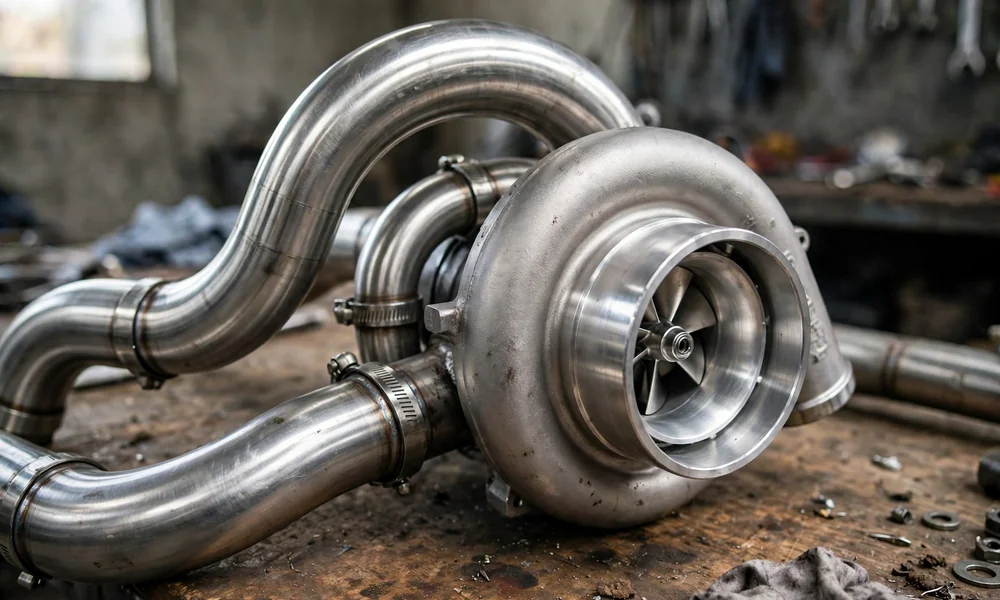
Key Specifications
The figures below describe a typical luxury hypercar titanium turbocharger; individual builds vary.
| Specification | Typical figure |
|---|---|
| Turbine wheel material | Titanium alloy |
| Maximum shaft speed | 150,000 to 200,000 revolutions per minute |
| Exhaust gas temperature | Up to 1,000 degrees Celsius |
| Boost pressure | 1.5 to 2.5 bar above atmospheric |
| Turbochargers per engine | Two, one per bank of cylinders |
| Compressor wheel material | Aluminium alloy |
| Bearing type | Oil-fed journal or ball bearings |
| Power gain | Roughly doubles engine output |
How Much Does It Cost?
A pair of titanium turbochargers on a luxury hypercar typically costs from around $15,000 to $40,000 as part of the engine package, depending on the size, the materials and the tuning. That is an estimate based on current flagship models, and a single replacement unit can cost several thousand dollars on its own. Most of the cost sits in the titanium turbine wheel, the precision balancing and the heat-resistant housing. To see the materials thinking behind the engine, read Aston Martin Valkyrie materials engineering for how exotic metals are chosen. For the structure that holds the engine, aluminium versus steel car chassis compared weighs the metals around it. And the Aston Martin Valkyrie specs explained shows a car where forced induction is only part of the story.

A Rare Fact
Here is something few drivers ever learn: a turbocharger can keep spinning for minutes after the engine is switched off. At full speed, the turbine wheel carries so much momentum that it takes time to slow down, and if the engine stops, the oil supply to its bearings stops too. That is why older turbocharged cars had to idle for a minute before being switched off, so the turbo could cool and slow while the oil still flowed. Modern hypercars solve this with electric oil pumps that keep cooling the turbo after shutdown, a small detail that saves a very expensive part.
A titanium turbocharger is a windmill that breathes fire. It takes waste energy from the exhaust, spins it into speed no piston could match, and uses it to force air into an engine that would otherwise need to be twice as big. From the first pulse of exhaust gas to the hiss of the blow-off valve, every part of it works at the edge of what metal can survive. When a hypercar surges forward and the driver feels the boost arrive like a second engine waking up, the little titanium wheel at the heart of it is doing exactly what it was made to do.