A truck used to be a tool. It hauled, it towed, it got dirty, and nobody asked it to be comfortable. A luxury truck keeps all of that muscle and then adds something nobody expected from a pickup: silence, soft leather, and a cabin that feels more like a private lounge than a work vehicle. Close the door and the world outside simply disappears. The engine hums rather than roars, the seats adjust in a dozen ways, and the ride over a broken road feels like gliding over glass.
That transformation does not happen by bolting nice seats into an ordinary pickup. A luxury truck is designed from the ground up as two vehicles in one: a heavy-duty hauler underneath and a first-class cabin on top. Every part, from the frame to the stitching, is built to a standard that would embarrass most luxury sedans. Here is how a luxury truck is made, from the first steel frame to the final polish, and why it costs as much as a small house in some towns.

How It’s Made
Step 1: A frame built to carry a house
Every luxury truck starts with a ladder frame, two long steel rails joined by crossmembers, strong enough to tow a boat and carry a tonne of cargo in the bed. The steel is high-strength, often hydroformed into shapes that would be impossible to bend by hand, and the frame is fully boxed rather than open, which makes it stiffer and quieter. Before anything else is attached, the frame is dipped in a rust-proof coating and baked, because a truck that costs six figures must not rust from the inside out. Engineers measure the frame to within a millimetre, since everything that follows, the engine, the suspension, the cabin, depends on this skeleton being perfectly straight.
Step 2: An engine tuned for effortless power
The engine is usually a large V8 or a powerful turbocharged diesel, built for torque rather than top speed. Torque is the twisting force that lets a truck pull a heavy trailer up a hill without strain, and a luxury truck can produce more of it than most sports cars produce horsepower. The engine is assembled by hand in many plants, with each bolt tightened to an exact torque and recorded. Around it go a heavy-duty transmission with ten speeds, a cooling system big enough for desert heat, and an exhaust tuned to a deep, quiet note rather than a loud bark.
Step 3: Suspension that erases the road
A truck that can carry a tonne must have strong springs, but strong springs usually mean a harsh ride. Luxury trucks solve this with adaptive air suspension, bags of compressed air at each corner that a computer adjusts hundreds of times a second. On a rough track it rises to clear rocks. Hit a pothole and the air spring absorbs the blow before it reaches the cabin. The result is a vehicle that rides like a limousine when empty and still works like a truck when loaded, a trick that took years of engineering to get right.

Step 4: A cabin trimmed like a tailor’s shop
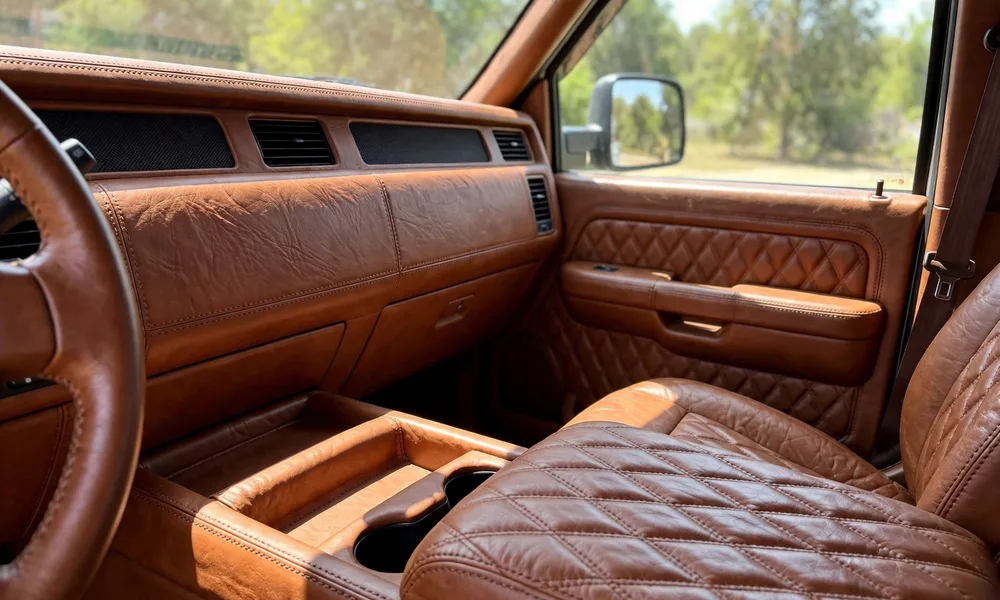
The cabin is where the luxury is most obvious, and it is also where the most hand work goes in. Hides of full-grain leather are inspected by eye and touch, and only the cleanest sections are cut for seats, door panels and the dashboard. Stitching is done by hand or by machines guided by craftspeople, with double seams that will not split after a decade of use. Real wood, brushed aluminium and soft-touch plastics replace the hard, hollow panels of an ordinary pickup. The seats are heated, cooled and massaging, with adjustments for the lower back and thighs, and the rear seats in the biggest models recline like armchairs. Sound-deadening material is layered into the floor, the roof and the doors, and the glass is laminated to block noise, so a conversation at motorway speed needs no raised voice.
Step 5: Technology that thinks ahead
Once the cabin is trimmed, the electronics go in, and a modern luxury truck carries more computing power than early spacecraft. Cameras watch every side of the vehicle, radar monitors the road ahead, and sensors in the bed weigh the load and adjust the suspension to match. The driver gets a large touchscreen, a digital instrument display, and a head-up display that projects speed and directions onto the windscreen. Trailer assist systems steer a reversing trailer automatically, and driver aids can keep the truck centred in its lane on a long motorway run.
Step 6: Testing, paint and the final polish
Before delivery, each truck is driven over a test track with bumps, water and steep slopes, then checked for rattles, leaks and panel gaps. The paint is applied in multiple coats, with a clear layer polished by hand, because the finish on a luxury truck is expected to look flawless in sunlight. The bed is sprayed with a tough protective coating, the chrome is inspected piece by piece, and the interior is detailed until not a speck of dust remains. Only then is the truck given its badges and shipped to a dealer. The whole process, from raw steel to showroom, takes many days and involves hundreds of workers, which is one reason the price is so high. If you want the numbers behind the build, the luxury pickup truck specs explained guide breaks down the engines, towing figures and dimensions in detail.
Specifications
| Feature | Typical Luxury Truck |
|---|---|
| Engine | 5.0-litre V8 petrol or 6.7-litre turbo diesel |
| Power | 400 to 500 horsepower |
| Torque | Up to 1,200 Nm in diesel form |
| Towing capacity | Around 5,500 to 6,500 kg |
| Suspension | Adaptive air suspension, four-corner |
| Cabin | Leather, real wood trim, massaging seats |
| Length | Around 5.8 to 6.2 metres |
The Price
A luxury truck typically costs an estimated $75,000 to $110,000, with the most richly equipped models passing $120,000 once every option is ticked. That is roughly double the price of a basic work pickup, and the gap is explained by the hand-finished cabin, the air suspension, the larger engine and the long list of driver aids. Owners accept that because the truck does two jobs at once, hauling on weekdays and carrying the family in comfort at weekends, and because a well-kept luxury truck holds its value better than most large vehicles. For the full story behind the sticker, read why a luxury pickup truck is so expensive.
A Rare Fact
Some luxury trucks are so quiet inside that engineers had to add a faint, artificial engine note through the speakers, because drivers found the silence unsettling and kept checking whether the engine was still running. The cabin is quieter at motorway speed than many luxury sedans were a decade ago, which is remarkable for a vehicle shaped like a brick and built to tow six tonnes. The same obsession with quiet explains the laminated glass, the sealed doors and the acoustic windscreen, all of which add weight and cost for the sake of a few decibels.
A luxury truck is proof that a working vehicle does not have to feel like work. Underneath it is still a serious hauler, with a frame, engine and suspension built for heavy loads, but on top of that sits a cabin finished with the care of a luxury saloon. If the idea of a big vehicle built to this standard appeals to you, the story of how a luxury SUV is made follows a similar path, with a different kind of body on top of the same obsession with comfort and strength.