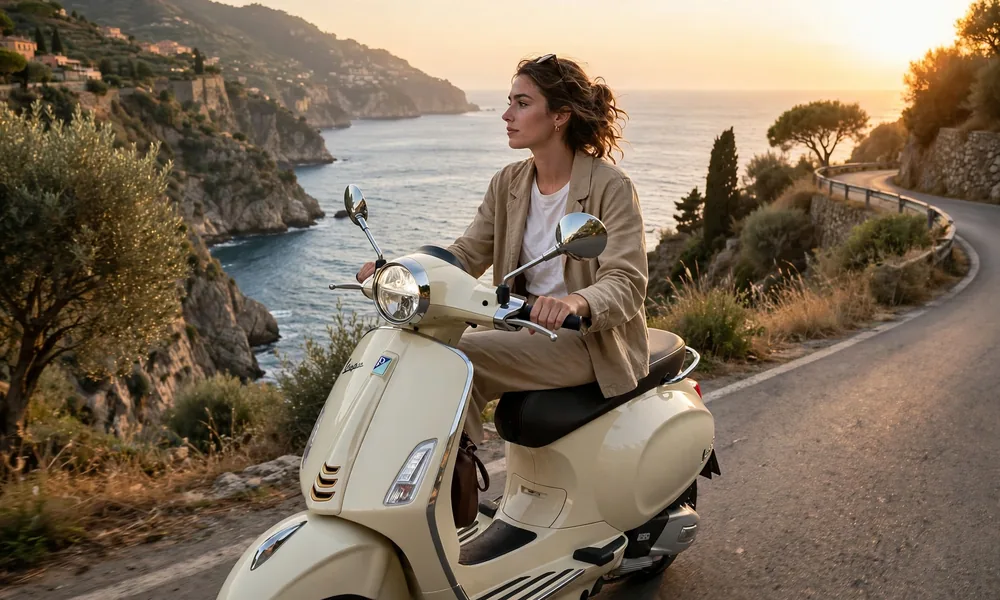
The little cream scooter was parked in a narrow lane in Tuscany, leaning on its stand in the late afternoon sun, and a crowd of tourists had stopped to photograph it. It sounded old, and happy, and entirely sure of itself. That is a luxury Vespa, a machine that has been made the same way, from the same pressed steel, for nearly eighty years.
A Vespa is not a motorcycle with a step-through frame, and it is not a modern scooter with a plastic body. This is how a luxury Vespa works, from the throttle in your right hand to the small rear wheel that does all the pushing.

Step 1: The steel monocoque carries everything
Most modern scooters are built around a plastic body clipped onto a steel tube frame. A Vespa is different. The steel panels are pressed, welded and finished by hand, and the seams are smoothed until they disappear under the paint. The monocoque carries the engine, the fuel tank, the seat and the rider, and it gives the scooter a solid, planted feeling that a plastic-bodied machine never has. The monocoque is checked for rust inside the leg shield every winter, because rust that starts unseen will spread along the seams.
Step 2: The engine breathes through the body
The engine is a single-cylinder four-stroke, usually between 150 and 300 cubic centimetres, mounted low at the rear and driving the back wheel directly. The engine is cooled by air and by a fan, and it is built to run for hours at modest revs rather than to chase top speed. The power goes to the rear wheel through a continuously variable transmission, a belt and pulley system that changes ratio smoothly as the scooter speeds up. The belt and the rollers of the transmission are changed on schedule, because a worn belt will slip and rob the scooter of its pull.
Step 3: Twist the grip and the scooter moves
The controls are famously simple. The right grip is the throttle, the right lever is the front brake, the left lever is the rear brake, and on modern models that is all there is to it. Twist the right grip and the transmission engages, the scooter pulls away smoothly, and the speed rises with the twist. The brakes are discs, front and rear, with anti-lock braking on the luxury models, and the scooter stops in a short, straight line even on wet cobbles. The brake fluid is changed every two years, because old fluid absorbs water and makes the brakes feel spongy in the wet.
Step 4: The front suspension steers through the body
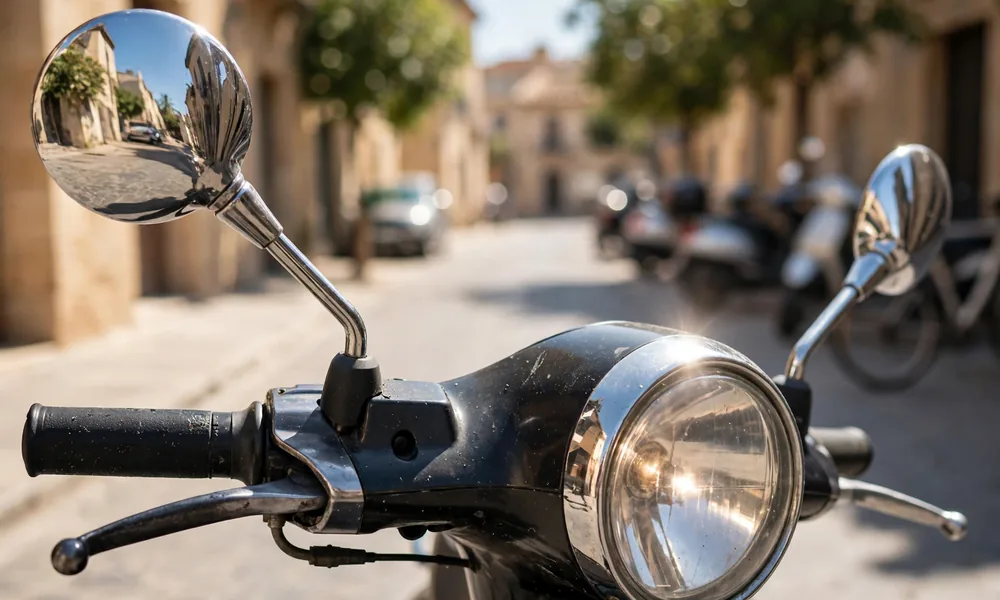
The front wheel of a Vespa is steered by a single-sided arm that runs up through the body to the handlebar, a design that looks odd and works beautifully. The arm carries a shock absorber and a spring, and it lets the wheel move up and down over bumps while the handlebar stays steady. The front suspension arm is greased at every service, because a dry arm will squeak over every bump and wear its bearings oval.
Step 5: Electrics, lights and the little details
Below the steel skin, a Vespa carries a simple electrical system: a battery under the seat, a generator driven by the engine, and wiring that runs through the monocoque to the lights, the horn, the starter and the dashboard. The same philosophy of simple, visible mechanics runs through other small two-wheelers, and the guide to how a luxury moped works shows the same ideas in an even smaller machine. The battery is kept on a trickle charger through the winter, because a flat battery left for months will never hold a full charge again.
Step 6: Riding it, from cold start to cruise
Starting a luxury Vespa is a small ritual. Turn the key, press the starter, and the engine catches with a soft putter. Let it warm for a minute, twist the grip gently, and the scooter pulls away without a jerk. The bigger two-wheeled machines work on the same principles with more power, and the guide to how a luxury motorcycle works sets out how a full-sized engine and gearbox change the same simple job. The tyres are checked for flat spots after a long lay-up, because a tyre that has sat in one place all winter will thump for the first miles.
The spec sheet at a glance
| Specification | Typical luxury figure | What it tells you |
|---|---|---|
| Engine | 150–300 cc single-cylinder | How much power it makes |
| Power | 12–24 hp | How strongly it pulls |
| Top speed | 90–130 km/h | How fast it can go |
| Fuel consumption | 2.5–3.5 L/100 km | How little fuel it uses |
| Fuel tank | 7–9 litres | How far it goes on a tank |
| Weight | 130–160 kg | How heavy it is to move |
| Seat height | 770–800 mm | How easily riders reach the ground |
| Wheels | 11–12 inches | How nimble it is in traffic |
| Brakes | Discs front and rear, ABS | How it stops in the wet |
Keeping it in good shape
A luxury Vespa lasts longest when it is ridden often and serviced on time. Change the oil and the filters on schedule, and keep the chain of services stamped in the book, because a full history is worth money when the scooter is sold. Wash the steel body with fresh water after rides on salted winter roads, and wax it twice a year so the paint never gets a chance to bubble. Check the tyres for cracks, the brakes for wear and the battery for charge every spring, and store the scooter indoors, under a cover, with the tank full and the battery on a trickle charger. A Vespa that is ridden, washed and serviced regularly will still start on the first kick after decades, while a neglected one will rust quietly in a garage and cost more to save than it is worth.
What it costs
A luxury Vespa typically costs an estimated $7,000 to $15,000, depending on the model, the engine and the finish. The estimate covers the scooter alone, not the insurance, the helmet or the servicing. The electric scooters that share the city streets work on different principles, and the guide to how a luxury electric scooter works shows how a battery and a hub motor replace the engine and the gearbox.
A rare fact
One detail few riders ever learn is that the Vespa’s name, which means wasp in Italian, was given to it because the first prototype buzzed like a wasp and its narrow waist and wide rear looked like the insect from above. The name was almost an accident, a remark made by the factory owner when he first saw the machine, and it stuck so firmly that the company built its whole identity around it. It is a rare thing in engineering, a machine named for how it looks and sounds rather than what it does.
A luxury Vespa works by keeping everything simple and doing it beautifully. There is no excess in the design, and nothing that is there is there by accident. Eighty years after the first one, the formula has barely changed, and the little cream scooter in the Tuscan lane is proof that it never needed to.


