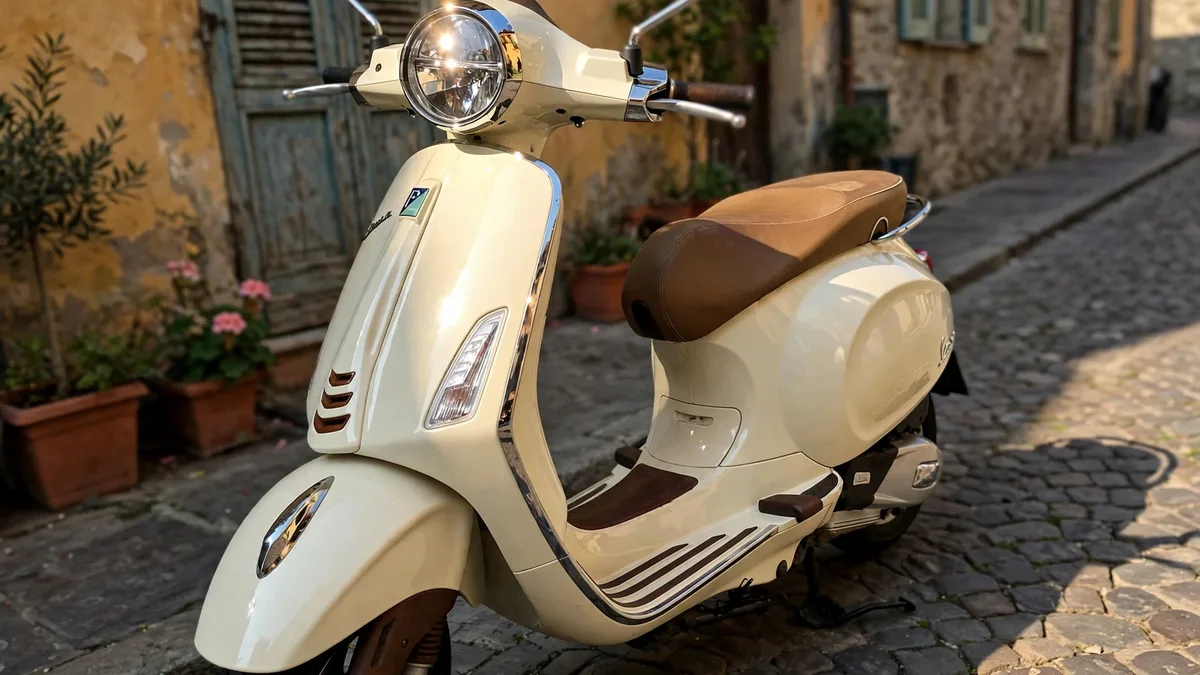
The little cream scooter was parked outside a cafe in Florence, and a man in his forties was crouched beside it with a brochure in his hand, comparing the numbers on the page with the machine in front of him. Engine, three hundred cubic centimetres. Power, twenty-three horsepower. Weight, one hundred and fifty-eight kilos. He read them twice, then looked at the scooter again, and the numbers still did not explain why it cost more than his first car.
A luxury Vespa spec sheet is short, but every figure on it is a decision the factory made about how the scooter should feel. This guide explains each number in plain words, so the sheet reads like a description of the ride, not a list of codes.
The spec sheet at a glance
| Specification | Typical luxury figure | What it tells you |
|---|---|---|
| Engine | Single-cylinder, 150–300 cc | How much power, and how it is delivered |
| Power | 12–24 hp | How quickly it pulls away, and how it climbs |
| Top speed | 60–80 mph | How fast it goes, flat out |
| Weight | 130–160 kg | How heavy it feels to move, park and ride |
| Seat height | 790–810 mm | Whether both feet reach the ground |
| Fuel tank | 7–8 litres | How far it goes between fill-ups |
| Fuel consumption | 70–90 mpg | How cheap it is to run |
| Front wheel | 12 inches | How it steers over bumps and cobbles |
| Brakes | Discs, front and rear, ABS | How it stops, in the wet as well as the dry |
| Body | Pressed-steel monocoque | What carries everything, and how it is made |
Engine and power: small, and deliberately so
The engine is a single-cylinder four-stroke, usually between one hundred and fifty and three hundred cubic centimetres, mounted low at the rear and driving the back wheel directly. Power is twelve to twenty-four horsepower, which sounds modest by motorcycle standards, and it is meant to be. The belt and the rollers of the transmission are changed on schedule, because a worn belt will slip and rob the scooter of its pull. How that engine and transmission work together is set out in how a luxury Vespa works, from the throttle in your right hand to the small rear wheel that does all the pushing.
Top speed: a number you will rarely use
Top speed runs from about sixty to eighty miles an hour, depending on the engine, and it is measured with a light rider on flat ground in still air. It is a real figure, but it is not the figure that decides whether you enjoy the scooter. A scooter that reaches fifty quickly and sixty slowly is a better city machine than one that does the opposite.
Weight and seat height: the figures that decide the fit
Weight, one hundred and thirty to one hundred and sixty kilos, is the figure that decides how the scooter feels when it is not moving. The same philosophy of simple, visible mechanics runs through other small two-wheelers, and the guide to how a luxury moped works shows it in a machine built for even shorter journeys.
Fuel tank and consumption: cheap to run, often to fill
The fuel tank holds seven to eight litres, which sounds small, and it is, but the consumption of seventy to ninety miles per gallon means a full tank still carries the scooter a hundred and fifty miles or more. That price is explained in why a luxury Vespa costs so much, where the hand-built steel body and the paint that takes days account for most of it.

Wheels and brakes: small wheels, serious stopping
The front wheel is twelve inches, which is small by motorcycle standards, and it is the figure that shapes the steering. The brakes are discs, front and rear, with anti-lock braking on the luxury models, and the scooter stops in a short, straight line even on wet cobbles. Twist the right grip and the transmission engages, the scooter pulls away smoothly, and the speed rises with the twist. The brake fluid is changed every two years, because old fluid absorbs water and makes the brakes feel spongy in the wet.

The steel body: the figure that is a material
The body is a pressed-steel monocoque, a single structural shell that is both the frame and the bodywork, and it has been built that way since the first model in 1946. The monocoque is checked for rust inside the leg shield every winter, because rust that starts unseen will spread along the seams. The weight of the steel is the price of that solidity, and it is why the scooter weighs more than a plastic rival with the same engine. It is also why a Vespa can be repaired, repainted and ridden for decades, while a plastic scooter is written off when its body cracks. The paint is applied in multiple coats, with sanding and polishing between each one, until the finish is deep, glossy and free of any orange-peel texture.
Electrics and the little details
Below the steel skin, a Vespa carries a simple electrical system: a battery under the seat, a generator driven by the engine, and wiring that runs through the monocoque to the lights, the horn, the starter and the dashboard. The dashboard is a round dial, sometimes with a small digital display beside it, and it shows speed, fuel and little else, which is the point. The lights are bright and well placed, the horn is loud enough for city traffic, and the mirrors are chrome and adjustable by hand. The luggage rack, if fitted, is polished metal, not plastic painted silver, and it carries a surprising amount for a machine this size. The answer is more than you expect, and less than you hope, and every Vespa owner learns the exact shape of it within a week.
Price: what the numbers add up to
A new luxury Vespa typically costs an estimated $8,000 to $15,000, depending on the model, the engine and the finish, and that estimate covers a machine that is slower than a motorcycle costing half as much. The money goes into the steel body, the paint, the leather and the chrome, and into the fact that so few of them are made. The spec sheet never mentions resale value, but it is the figure that softens the purchase price more than any other.
A rare fact worth knowing
Here is the detail the spec sheet never explains: the Vespa was designed in 1946 for people who had never ridden a motorcycle, and its most famous feature, the step-through frame, was there so a rider in a suit, or a dress, could step onto it without swinging a leg over a hot engine. Every figure on the modern spec sheet, from the low seat height to the small wheels, still follows that first brief: a machine for people who want to arrive looking as good as they did when they left.
Read the sheet in this order, and it stops being a list of codes. The biggest number on the page is rarely the one that matters most.