The old car started on the third try, which its owner considered a good morning. There was a brief cough from the carburettors, a puff of pale smoke, and then the straight-six settled into a slow, uneven idle that sounded nothing like a modern engine and everything like a memory. The driver smiled, checked the oil pressure gauge, and pulled gently away from the kerb, double-declutching into second with a practised flick of the wrist.
A luxury vintage car does not work like a modern car that happens to be old. Its systems were designed in an era before electronics, when a driver was expected to listen, feel and adjust, and when a mechanic could fix most faults with a spanner and a timing light.

What Keeps a Luxury Vintage Car Running
The basic cycle is the same as in any petrol car: air and fuel mix, a spark ignites the mixture, the explosion pushes a piston down, and the crankshaft turns that motion into drive at the wheels. What is different is how each step is done. Fuel is metered by a carburettor, not an injector; the spark is timed by a mechanical distributor, not a computer; and the gearbox is a manual box with synchromesh that is only partly synchronised, so the driver’s skill is part of the system.
Step 1: Fuel and the Carburettor
Fuel starts in a steel or brass tank, often at the rear, and is drawn forward by a mechanical pump driven off the engine, or in some cars by gravity alone. The carburettor mixes the fuel with air in the right proportion, using jets and venturis that respond to the speed of the air rushing through. A choke enriches the mixture for a cold start, and the driver learns to use it by ear, easing it off as the engine warms. Too rich and the car smokes and fouls its plugs; too lean and it hesitates and runs hot.
Step 2: Ignition and the Distributor
The spark comes from a coil and a distributor, a small mechanical device that sends a high-voltage pulse to each spark plug in turn. Inside the distributor, contact breaker points open and close as a cam turns, and a vacuum advance and a centrifugal advance move the timing earlier as the engine speeds up. The system is simple, but it needs regular care: the points wear, the gap closes, and a tired distributor will make the engine misfire under load. Many owners now fit electronic ignition inside the original housing, keeping the look while removing the most frequent maintenance job. The engine itself is described in how a luxury vintage car is made.
Step 3: The Engine and Cooling
Most luxury vintage cars use a large, slow-revving engine, a straight-six, a V8 or a V12, built from cast iron with generous bearings and a long stroke. They make their power at low revs, with a deep, unhurried torque that suits a heavy car. Cooling is by water, circulated by a mechanical pump through a radiator at the front, with a thermostat that keeps the temperature steady. Overheating in traffic is the classic vintage problem, and a good radiator and a healthy water pump are worth more than any polish.
Step 4: The Gearbox and Clutch
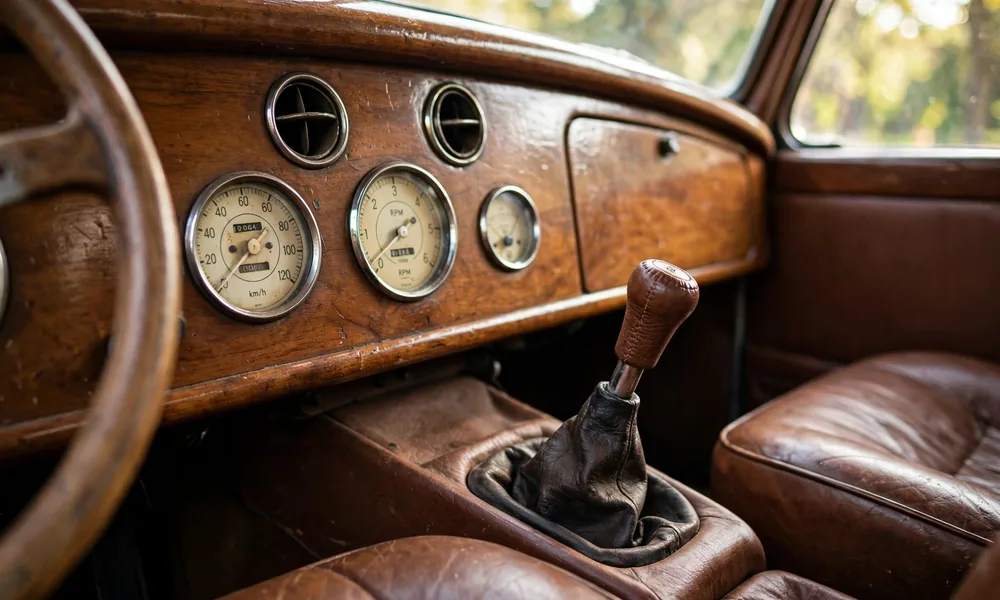
Drive reaches the wheels through a manual gearbox, usually with four speeds, and a single dry-plate clutch. The synchromesh, if fitted at all, is often only on the higher gears, so the driver must double-declutch into first or second, matching the engine speed to the road speed with a blip of the throttle. It sounds complicated, and at first it is, but after a few hundred miles it becomes second nature. The clutch is heavy by modern standards, and the gear lever moves through a long, deliberate gate.
Step 5: Suspension, Steering and Brakes
The chassis is usually a separate steel frame with the body bolted on top, and the suspension is by leaf springs or coil springs with lever-arm dampers, giving a soft, rolling ride rather than the flat cornering of a modern car. Steering is by a worm-and-peg or recirculating-ball box, with no power assistance, so the wheel is heavy at parking speed and lightens up once the car is moving. Brakes are drums all round on the earliest cars, or discs at the front on later ones, with no servo on many models, so the driver must press firmly and plan ahead.
Step 6: Electrics, Instruments and the Body
The electrical system is a 6-volt or 12-volt setup with a dynamo rather than an alternator, charging the battery slowly and struggling to keep up with headlights, wipers and a heater all at once. The instruments are mechanical: a speedometer driven by a cable from the gearbox, an oil pressure gauge fed by a pipe from the engine, and a temperature gauge that reads a bulb in the cylinder head. The specifications of a luxury vintage car show how the numbers behind that experience compare with a modern car.
Key Specifications
| Feature | Typical Range |
|---|---|
| Engine | Straight-six, V8 or V12, 3.0 to 6.0 litres |
| Power | 120 to 250 hp |
| Top speed | 150 to 200 km/h (93 to 124 mph) |
| Gearbox | Four-speed manual, synchromesh on higher gears |
| Brakes | Drum brakes, or front discs on later cars |
| Electrics | 6-volt or 12-volt, dynamo charging |
| Weight | 1,500 to 2,200 kg |
| Fuel use | 15 to 25 litres per 100 km |
These are typical ranges for luxury cars of the 1930s to the 1960s, and they vary widely by make and year. A pre-war car will be slower than a 1960s grand tourer, but both share the same mechanical character: big engines, manual gearboxes and a ride that prioritises comfort over cornering.
What a Luxury Vintage Car Costs to Run
Buying prices vary enormously by rarity and condition, so treat these as estimates. A presentable luxury vintage car can start at an estimated $50,000 to $100,000, a well-restored example can cost $150,000 to $400,000, and a rare, matching-numbers car with known history can pass $1 million at auction. Running costs are also higher than a modern car: an annual service, insurance, storage and repairs can add an estimated $5,000 to $15,000 a year. Regular use helps: a car that is driven gently and often stays healthier than one that sits in a garage for years.
Parts are a world of their own. Some are still made by specialists, some are remade by small workshops from original drawings, and some must be found second-hand through owners’ clubs. The clubs are one of the great pleasures of vintage ownership, a network of people who know exactly which seal fits which year. A modern grand tourer is a different kind of machine, as how a luxury roadster works shows.
A Rare Fact
Some luxury vintage cars were delivered with a tool kit that was itself a work of art: a fitted leather or wood case with spanners, screwdrivers and a jack, each tool stamped with the maker’s name and shaped for that exact car. A complete original tool kit can now be worth thousands on its own, and collectors will pay a premium for a car that still has its original tools, books and keys.
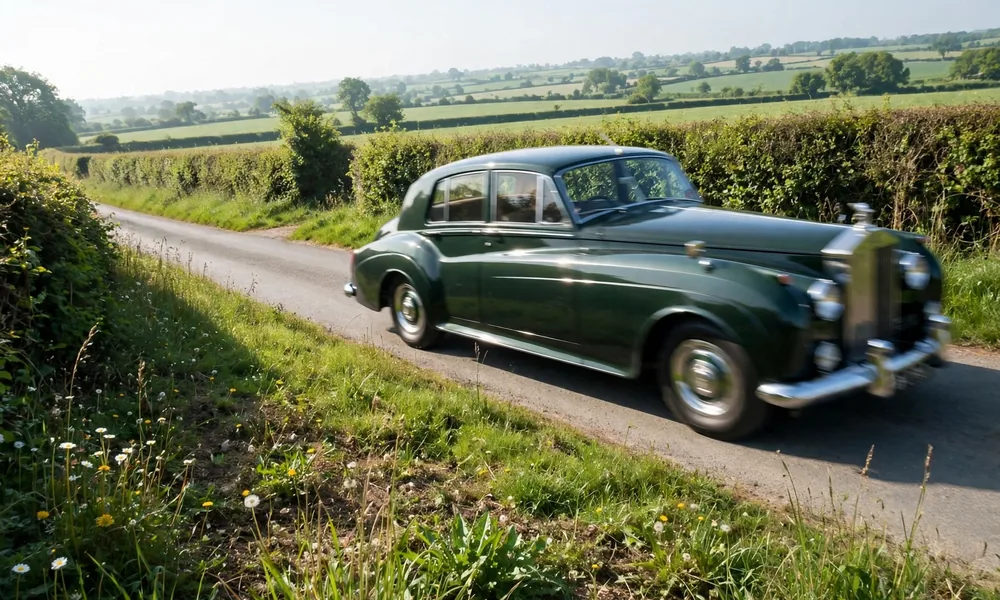
A luxury vintage car asks more of its driver than a modern car, and gives more back. It asks for patience on a cold morning, attention to the gauges, and a hand that knows the gearbox. In return it gives a sound, a smell and a feeling that no modern car can reproduce.


