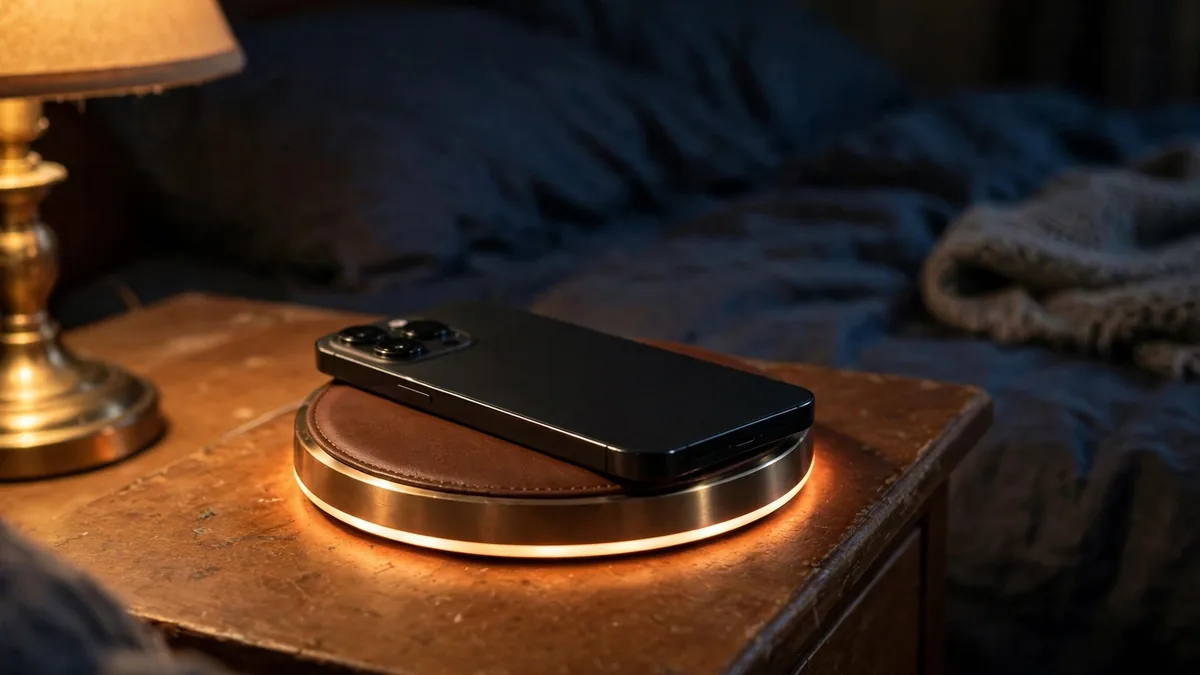
It is late, the lamp is low, and the phone in your hand is down to its last few percent. You set it down on a small round pad, you hear nothing, you plug in nothing, and yet a soft ring of light wakes up around the edge of the pad. By morning the phone is full. A luxury wireless charger is made to look like furniture.
This is how a luxury wireless charger is made: the materials are chosen, the copper coil is wound, the electronics are built, the case is shaped and finished, the parts are assembled, and the finished charger is tested for heat, safety and speed before it is packed. The phone it charges has its own story, and the guide to how a luxury smartphone is made follows that device from glass and metal to the finished handset, where the receiving coil inside the phone is the other half of the partnership described here.
Step 1: Choosing the materials
Every luxury wireless charger starts with a decision about what it should feel like. The top is usually full-grain leather, chosen because it grips the phone gently, ages well, and feels warm to the touch instead of cold and slippery. Under the leather sits a ring of machined aluminium or stainless steel, polished or brushed until it catches the light, and under that sits a heavy base that keeps the pad from sliding across a desk.
Step 2: Winding the copper coil
The heart of the charger is a flat spiral of copper wire, wound with the patience of a watchmaker. A machine feeds fine copper wire, thinner than a sewing thread and coated in a clear insulating varnish, around a form in a perfect spiral, turn after turn, until the coil is the width of a phone and only a few millimetres thick. The spacing matters: if the turns touch, the coil can short, and if they drift apart, the magnetic field weakens and the phone charges slowly.
Step 3: Building the electronics
While the coil is being wound, a second line builds the charger’s brain. A small printed circuit board carries the chips that turn mains power into the high-frequency current the coil needs, and it carries the sensors that watch for trouble. When a phone is placed on the pad, the charger sends out a tiny test pulse, listens for the phone’s answer, and only then begins to deliver real power. The same quiet conversation happens in other small devices, and the guide to how a luxury smartwatch works explains how a watch manages its own power, sensors and charging in a space far smaller than this pad.

Step 4: Shaping the case
The case is where engineering becomes furniture. A block of aluminium is milled on a computer-controlled machine, cutting away metal until only a smooth ring remains, and the edges are polished by hand until no sharp corner is left. The leather top is cut to size, its edges are burnished and stitched with a fine thread, and it is glued to the metal frame under pressure so that no air bubble can lift it later.
Step 5: Assembling the charger
Assembly brings the three worlds together: coil, electronics and case. A worker sets the coil and its ferrite shield into the base of the case, solders the coil’s two fine wires to the circuit board, and screws the board into place so that it cannot rattle. The leather top is lowered over the coil, the metal ring is closed around it, and the whole charger is pressed together and left to set.
Step 6: Testing for heat, safety and speed
Every finished charger is put through a long test before it leaves the factory. It charges a phone from empty to full while sensors record the temperature of the coil, the board and the leather top, and any charger that runs hotter than its limit is pulled aside. It is tested with phones of different sizes, with a case on and a case off, and with the phone placed slightly off centre, because real people do not place their phones with ruler precision. It is also tested with a coin left on the pad, to prove it will refuse to heat the coin, and it is left running overnight to prove it will not drift or overheat while its owner sleeps.
Step 7: Finishing and packing
The last step is the quietest. Each charger is wiped clean, checked once more under a bright light, and given a final polish. It is placed in a fitted box with a braided cable and a power adapter matched to its speed, and a small card explains that the pad works best on a flat surface and that a very thick phone case may slow it down. The box itself is part of the product: it is rigid, lined, and made to be kept, because a luxury charger is often a gift, and the first minute with it is part of what the buyer paid for.
The luxury wireless charger at a glance
| Part | Typical luxury figure | What it tells you |
|---|---|---|
| Charging coil | Flat copper spiral with a ferrite shield | How efficiently power reaches the phone |
| Power output | Typically 15 watts for a phone | How quickly a phone fills from empty |
| Electronics | Board with foreign-object detection and heat sensors | How safely it handles coins, keys and heat |
| Case | Machined metal ring, leather top, weighted base | How the pad feels and survives daily use |
| Cooling | Heat spread through the metal case | How cool the pad and phone stay |
| Cable and power | Braided cable with a matched power adapter | Whether it can reach its full speed |
What it costs
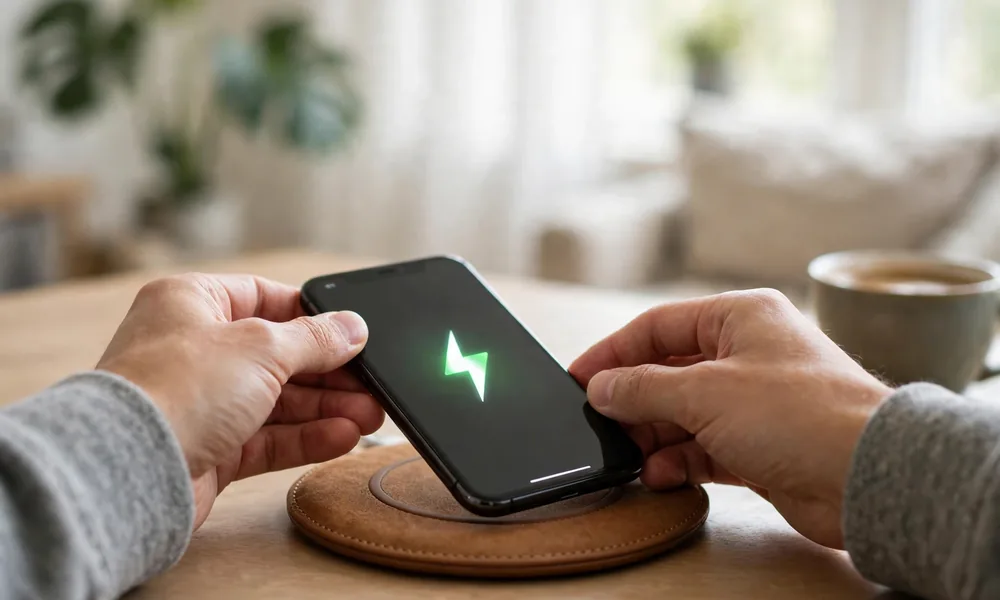
A luxury wireless charger typically costs an estimated $120 to $300, depending on its materials, its charging speed and whether it can charge two or three devices at once, and the estimate covers the pad, its braided cable and its matched power adapter. A single-device leather and metal pad sits near the lower end of that range, while a larger pad that charges a phone, a watch and a pair of earbuds together sits near the top.
A rare fact
One detail few owners ever learn is that a wireless charger and a phone agree on their charging plan before a single watt of real power flows, exchanging a short coded handshake through the very coil that will carry the charge. The phone tells the charger its battery level, its temperature and how much power it can accept, and the charger answers with what it can offer, and the two renegotiate that agreement again and again as the battery fills. The same careful pairing lies behind the smallest devices we charge, and the guide to how luxury earbuds are made follows a pair of earbuds through a factory where a battery smaller than a fingertip must be charged just as safely.
Put the steps together, materials first, then coil, electronics, case, assembly, testing and packing, and a luxury wireless charger stops looking like a simple disc on a table and starts looking like what it is: a small piece of precision engineering dressed as furniture, built to do its hardest work in silence, every night, for years.


