It is just past six in the morning, and the watch on the bedside table lights up before its owner does. It has counted the hours of sleep, checked the heart rate through the night, and worked out the weather for the run ahead. A luxury smartwatch is a computer, a health clinic and a piece of jewellery at the same time, and it does all three without ever being plugged into a wall.
Inside that small case is a surprising amount of engineering. Sensors read the body, a processor makes sense of the signals, a battery keeps it all running for days, and a display shows the result in a glance. This is how a luxury smartwatch works, from the sensor on your skin to the screen on your wrist.

Step 1: Sensors on the back read the body
On the back of the watch, pressed against the skin, sits a cluster of sensors. Green lights shine into the wrist and measure how much light the blood absorbs, which tells the watch how fast the heart is beating. Other sensors read the temperature of the skin, track movement with an accelerometer, and measure the electrical signals of the heart when the wearer touches the crown with a finger.
The case is sealed against water and sweat, and the sensor window is made from sapphire or ceramic, materials that stay clear and scratch-free after years against the skin. The making of the case itself is a craft of its own, as the guide to how a luxury smartwatch is made shows, with the metal machined and polished before the electronics ever go in.
Step 2: A tiny processor makes sense of the signals
The raw signals from the sensors mean nothing on their own. A processor the size of a fingernail takes them in, compares them with patterns learned from thousands of hours of data, and turns them into numbers a person can use: heart rate, sleep stages, step counts, calories and stress levels. It does this work on the watch itself, rather than sending everything to a phone, so the answers arrive instantly and the watch keeps working when the phone is left behind.
The processor is built to sip power. It wakes fully only when it has work to do, and the rest of the time it idles, checking the sensors on a slow rhythm. It is a whole computer, shrunk to fit a space the size of a coin.
Step 3: The display shows it all at a glance
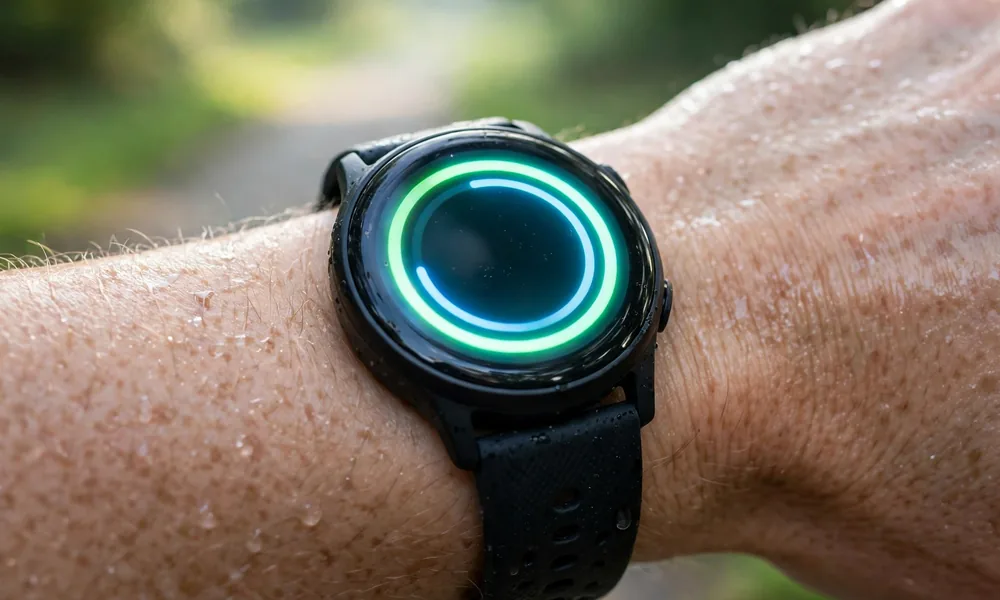
The face of the watch is a bright, sharp display, usually an OLED panel, where each pixel makes its own light. That matters on a watch, because a display that lights only the pixels it needs uses far less power than one that lights the whole screen. The screen is covered by sapphire crystal on a luxury watch, a material almost as hard as diamond, which is why the face stays clear after years of knocks against doors and desks.
Below the display, a touch layer reads taps and swipes, and a rotating crown and buttons give a physical way to scroll without covering the small screen with a finger. The watch face itself is software, so it can show the time in the morning, the heart rate during a run, and a map on a walk, changing its job as the day changes. Smart glasses take the same idea further out onto the face, and the guide to how luxury smart glasses work shows a display that sits in front of the eyes instead of on the wrist.
Step 4: The battery keeps it running for days
Power is the hardest problem in a smartwatch. The battery is a thin lithium cell, curved to fit the case, and it must run the sensors, the processor, the display and the radios for a day or more between charges. Luxury watches manage this by being ruthless about power: the display dims when the wrist drops, the radios sleep between syncs, and the sensors slow down when the wearer is still.
Charging is wireless. The watch sits on a small puck or cradle, and power passes through the case without any plug or port, which is also what keeps the watch waterproof.
Step 5: The radios connect it to the world
A luxury smartwatch talks to the world through three radios. Bluetooth links it to the phone in a pocket, Wi-Fi lets it fetch data on its own, and on the most expensive models, a mobile connection lets it make calls and receive messages with no phone anywhere near. A GPS receiver tracks runs and walks, fixing the watch’s position from satellites overhead.
The watch also pays. A secure chip stores a token that stands in for the bank card, and a tap of the wrist on a payment terminal buys a coffee without the wallet ever leaving a pocket. Action cameras use the same mix of tiny sensors and tough cases in a different shape, as the guide to how a luxury action camera works explains.
Step 6: Software ties it all together
None of the hardware matters without software, and the watch runs a small operating system that manages the sensors, the battery and the screen as one system. Apps on the watch show the weather, the calendar and the messages, while the phone app holds the long history: months of sleep, training and heart data, drawn as charts the wearer can actually read.
Updates arrive over the air, and the watch quietly improves over the years it is worn, gaining new health features and new watch faces without any visit to a shop. It is the part of the watch its owner never sees, and the part that makes all the other parts useful.
Specifications at a glance
| Feature | Typical luxury figure |
|---|---|
| Case | Steel, titanium or ceramic, about 41 to 45 mm |
| Display | OLED, sapphire crystal cover |
| Sensors | Heart rate, temperature, motion, ECG |
| Battery life | About 1 to 3 days, depending on use |
| Water resistance | About 50 to 100 metres |
| Connectivity | Bluetooth, Wi-Fi, GPS, mobile on some models |
| Charging | Wireless, about 1 hour to full |
What it costs
A luxury smartwatch typically costs between about $800 and $3,000, and these are estimates, not fixed prices. The price rises with the case material, with the choice of strap, and with the finish of the dial, and some gold and ceramic models cost far more.
A rare fact
A smartwatch can hear your heartbeat without touching your chest. The green light on its back shines into the skin and watches the blood surge with each beat, because blood absorbs green light more than the surrounding tissue does. The sensor sees the tiny change in reflected light, many times a second, and counts the beats from that flicker.
From the green light on its back to the sapphire on its face, a luxury smartwatch works by turning the wrist into a window on the body. The sensors listen, the processor understands, and the display tells the story, all day, every day, from a machine smaller than a matchbox.


