On a workbench under a bright lamp, a technician picks up a shell no bigger than a thumbnail and holds it up to the light. Inside it, in a space smaller than a sugar cube, there must somehow fit a speaker, several microphones, a battery, a computer chip and a radio.
That smallness is the whole story of how luxury earbuds are made. Every part is shrunk until it barely fits, then fitted by hand, then tested by ear, because no machine can yet judge whether a pair of buds sounds right. From the driver to the charging case, this is how a luxury pair comes together, step by step, on the factory floor.

Step 1: The driver is wound, glued and tuned
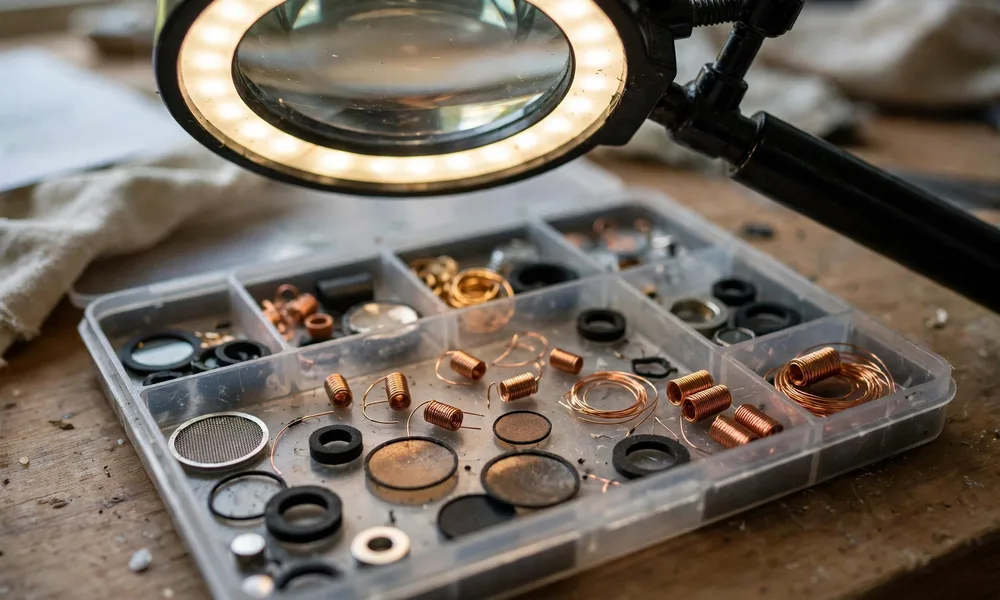
The heart of each bud is its driver, a loudspeaker about ten millimetres across, and it is made first. A coil of copper wire finer than a hair is wound by machine around a tiny former, then glued to a diaphragm, a disc of paper, plastic or beryllium so thin it feels like nothing at all. A magnet the size of a lentil is set behind it.
Each driver is then tested on its own, before it ever meets a shell. It is played a sweep of tones while a microphone listens, and drivers that do not match are set aside. Luxury makers pair drivers that measure almost identically, so the left bud and the right bud sound like one instrument, not two. The pairing is strict: a driver that would pass in a cheap pair is rejected here. The same obsession with matching tiny parts is what shapes how luxury headphones are made, where bigger drivers get the same treatment at a larger scale.
Step 2: The shell is moulded and polished
While the drivers are being tuned, the shells are moulded from tough plastic or resin in steel moulds polished to a mirror shine, because any roughness in the mould shows on the finished bud. The two halves of each shell are moulded separately, with tiny posts and slots that will lock them together later. After moulding, each shell is trimmed by hand, its edges smoothed, and its surface polished until it gleams. A shell that fails the polish check is ground down and started again.
Step 3: The battery and the circuit board go in
The smallest battery in consumer electronics is the one inside an earbud, a cell about the size of a pea, and it is made on its own line. It is a sealed lithium cell, wound and filled in a dry room where the air is kept almost free of moisture, because moisture inside a battery is a slow failure waiting to happen. Each cell is charged, discharged and measured, and only cells that hold their charge within a narrow band are sent to the assembly line.
Step 4: The microphones are set and sealed
Each bud carries several microphones, and placing them is one of the fiddliest jobs on the line. The microphones are smaller than grains of rice, and each one must sit exactly in its pocket, facing exactly the right way, with a fine mesh over it to keep out dust and sweat. A microphone set a fraction of a millimetre off will hear the world wrong, and the noise cancelling that depends on it will suffer. The way those microphones work with the chip is set out in the guide to how luxury earbuds work. Workers seat them with tweezers and check their position under magnification.
Once the microphones are in, the two halves of the shell are joined. A thin bead of adhesive is laid around the seam, the halves are pressed together in a jig, and the joint is cured under ultraviolet light. Then the bud is tested for sealing: it is placed in a small chamber, the air pressure is changed, and a sensor watches for leaks.
Step 5: The charging case is built alongside
The buds and the case meet for the first time at a pairing station. The buds are set into their cradles, the lid is closed, and the case charges them while a computer checks that each bud takes charge properly and reports its battery level. A case that charges one bud slowly is pulled from the line. It is a quiet test, but it catches the faults that would otherwise show up as a dead bud on a Monday morning.
Step 6: Tuning, testing and the final listen
The last step is the one no machine can do alone. Each finished pair is played music in a quiet room, and its sound is measured against a target curve drawn by the maker’s acoustic engineers. The drivers are adjusted in software, tiny equaliser changes that nudge the bass up or the treble down, until the pair matches the house sound.
Then comes the human listen. A tester wears the pair, walks, shakes their head, taps the controls and listens for rattles, buzzes and dropouts. The buds are dropped, sprayed with water and shaken in a machine that imitates a run. Only pairs that pass every test are boxed, with their eartips, cable and case, in packaging that is itself checked for scuffs. The final human check is the same last word that finishes how a luxury smartwatch is made, where the numbers are checked first and a person has the last say.
At a glance
| Part | How it is made | Why it matters |
|---|---|---|
| Driver | Coil wound, glued to a diaphragm, paired by measurement | Left and right buds sound like one instrument |
| Shell | Moulded, hand-polished, colour through the plastic | Smooth, sealed and scratch-proof |
| Battery | Sealed cell made in a dry room, charge-tested | Hours of listening from a pea-sized cell |
| Circuit board | Machine-soldered, hand-wired under a microscope | Chip, radio and sensors in a sugar-cube space |
| Microphones | Seated by tweezers, sealed, pressure-tested | Clean hearing for calls and cancelling noise |
| Case | Moulded, hinged, hinge cycled thousands of times | Charges the buds three or four times over |
Luxury earbuds typically cost an estimated $200 to $550, and some handmade or limited models cost more. The price is not mostly in the materials, which are tiny, but in the making: the paired drivers, the hand assembly under microscopes, the pressure testing and the tuning that makes each pair sound like the one before it. A maker who sells millions of pairs can spread that cost, but a luxury pair still carries the hours of careful handwork that went into something smaller than a sugar cube.
A rare fact: the diaphragm inside a luxury earbud driver is often thinner than a human hair, and in the most expensive pairs it is made from beryllium, a metal so light and stiff that it can move fast enough to reproduce the highest notes without bending. Beryllium is toxic as a dust, so the diaphragms are formed in sealed rooms by workers in protective gear, and the finished disc is worth more than the rest of the bud’s parts put together. It is one of the few places in electronics where a poison becomes a musical instrument.
So the next time a pair of buds disappears into your ears and the world goes quiet, remember the workbench, the tweezers and the lamp. A luxury earbud is not poured out of a mould.