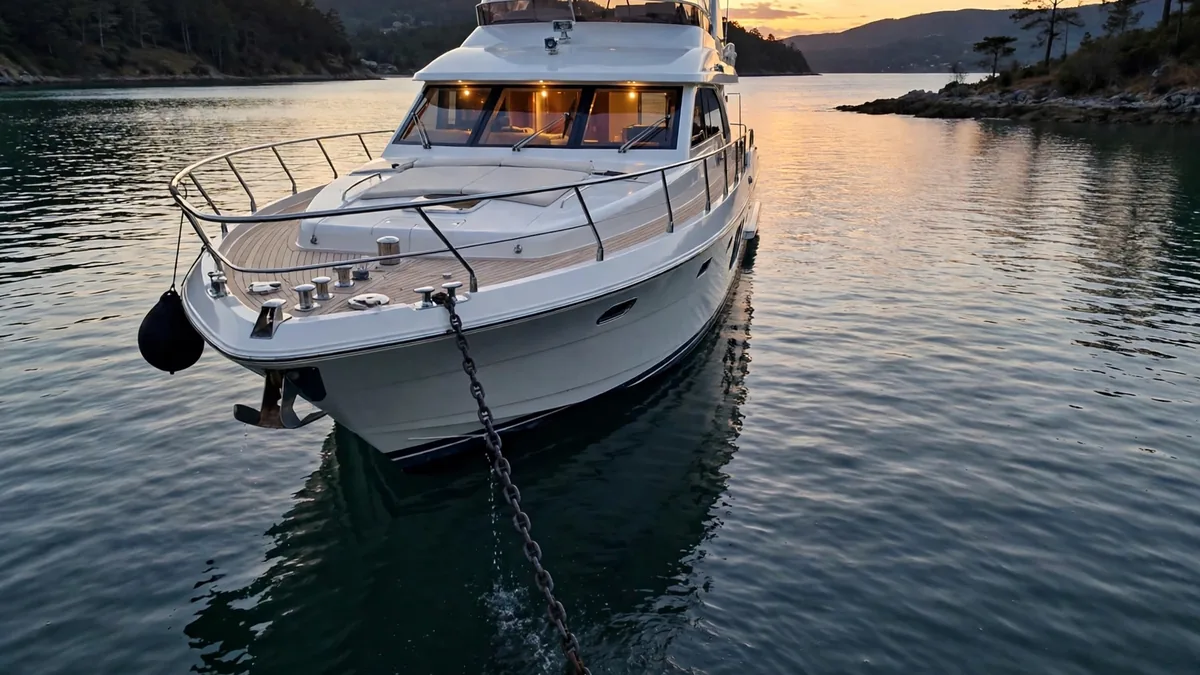
The anchor drops with a rumble of chain, splashes into the bay, and disappears. A minute later the yacht swings gently and stops, held in place by something no one on board can see.
An anchor does not work the way most people imagine. It does not hold a yacht by weight alone, and it does not grip like a claw in soft mud by magic. It works because its shape lets it dig into the seabed and bury itself, and because the chain lying on the bottom absorbs the shocks of wind and waves, so the pull on the anchor stays low and steady.
On a luxury yacht, where the anchor and its chain can weigh several tonnes and the windlass that hauls them is a machine in its own right, every part of the system has to work together. Here is what really holds a luxury yacht in place, from the moment the anchor leaves the bow to the moment it is weighed again.
1. The anchor leaves the bow and falls
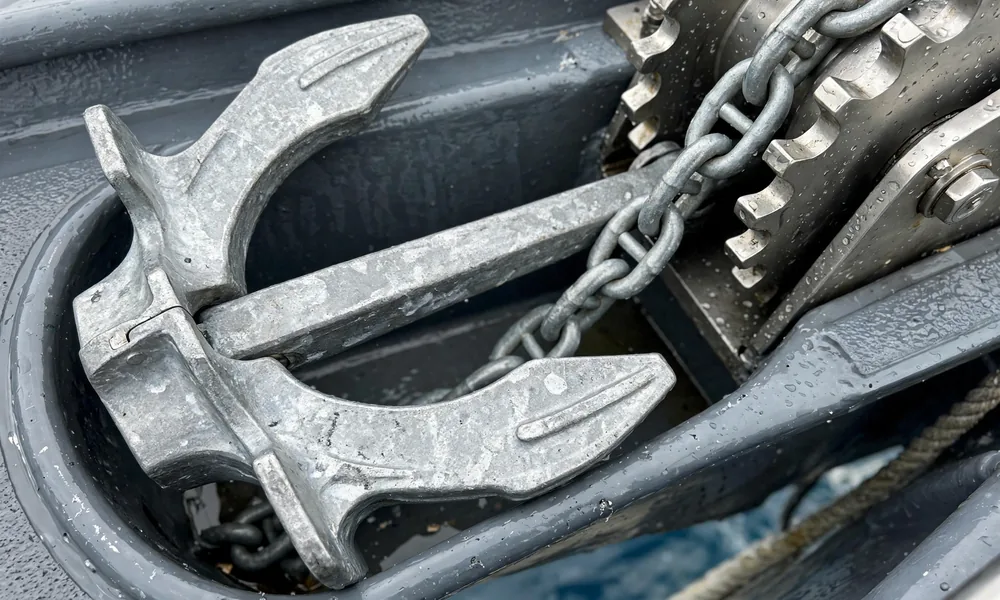
The anchor lives in a pocket at the bow, held by the windlass, and when the captain gives the order, the brake is released and the anchor drops. It falls by its own weight, pulling chain behind it, and the crew controls the speed with the windlass brake so the chain does not pile up in a heap on top of the anchor.
Modern yacht anchors are shaped to set quickly: a pointed tip, a heavy shank, and broad flukes that slice into sand, mud, or gravel. The machine that controls this drop is described in how a luxury ship anchor windlass works, the powerful winch that lowers and hauls the ground tackle.
2. The flukes dig in and set
Once the anchor is on the bottom, the yacht drifts back slowly, paying out chain, and the pull of the chain drags the anchor along the seabed. The flukes catch, tip forward, and dig in, burying themselves deeper as the pull increases.
The crew knows the anchor is set when the chain goes taut and the yacht stops moving, and they confirm it by taking a bearing on a landmark or watching the GPS, making sure the yacht is not dragging. Setting takes patience: rushing it, or dropping too little chain, leaves the anchor skating across the bottom instead of digging in. The chain itself is part of the system, and how a luxury ship anchor chain works explains how its weight and catenary curve absorb the shocks of wind and waves.
3. The chain absorbs wind and waves
The chain does as much work as the anchor. When a yacht lies at anchor, the chain does not run in a straight line from the bow to the anchor; it hangs in a curve, called a catenary, with much of its length lying on the seabed. When a gust hits the yacht, the chain lifts off the bottom, link by link, and that lifting absorbs the energy of the gust, so the pull on the anchor stays gentle and steady instead of jerking.
This is why the length of chain matters so much. The rule of thumb is to pay out five to seven times the depth of water, so there is enough chain on the bottom to act as a spring. The specification sheet for the whole system is set out in the luxury yacht anchor specifications, where anchor weight, chain size, and scope are listed together.
4. The yacht swings and rides out the weather
Once set, the yacht swings slowly around its anchor as the wind shifts, tracing a circle whose radius is roughly the length of chain paid out. The anchor holds through the night while the crew sleeps in shifts, one person always awake, checking the yacht’s position against the GPS anchor alarm.
In a storm, the anchor’s holding power is tested to its limit. The chain lifts clear of the bottom, the anchor takes the full load, and the flukes must stay buried. This is why crews choose their anchorage carefully, looking for good holding ground, shelter from the wind, and enough swinging room. A yacht that drags its anchor in a storm is in real danger, and the anchor watch is one of the most important jobs on board.
5. Weighing anchor and stowing it away
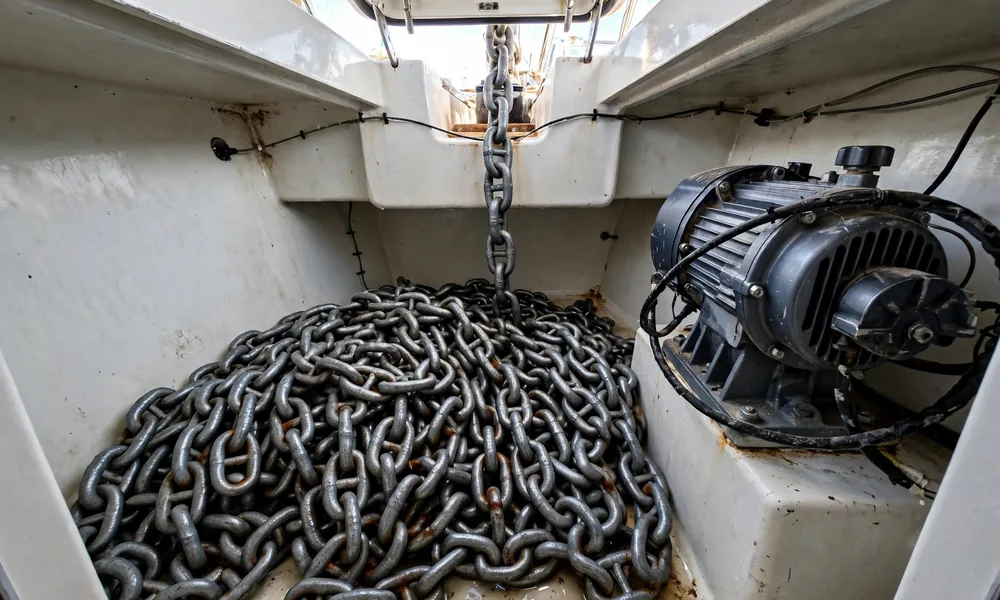
When it is time to leave, the windlass hauls the chain in, link by link, until the yacht is directly over the anchor. The crew then breaks the anchor out of the seabed, which can take considerable force if it has buried itself deeply, and the windlass lifts it clear of the water. The anchor is washed as it comes up, so mud and weed do not stain the bow or clog the chain locker, and it is stowed in its pocket, ready for the next anchorage.
The chain is inspected as it comes in, link by link, for wear, corrosion, and twisted links, and the windlass is checked for oil and brake wear. A chain that has been in the water for years will show it, and the crew replaces worn sections before they fail. When the anchor is home and the bow is clean, the yacht is under way again, and the system that held it all night is ready to do it all over again at the next bay.
What Really Holds a Luxury Yacht in Place: Specs
| Specification | Typical range |
|---|---|
| Anchor weight | About 40 to 150 kilograms |
| Chain size | About 10 to 16 millimetres in diameter |
| Chain length | About 80 to 150 metres |
| Scope ratio | About 5 to 7 times the water depth |
| Holding power | Many times the anchor’s own weight |
| Windlass pull | About 1,000 to 5,000 kilograms |
| Anchor types | Plough, claw, and scoop designs |
| Chain inspection | Every season, and after heavy weather |
What Does a Luxury Yacht Anchor Cost?
A complete anchoring system for a luxury yacht is estimated to cost roughly $15,000 to $80,000, depending on the size of the yacht and the quality of the gear. The anchor itself is estimated at roughly $2,000 to $10,000, the chain at roughly $5,000 to $20,000, and the windlass at roughly $8,000 to $50,000. A high-holding-power anchor for a 40-metre superyacht can be estimated at $10,000 or more on its own, which is a small price for the only thing that keeps the yacht off the rocks.
A Rare Fact
The largest anchors ever made weighed more than 30 tonnes each, fitted to the biggest ships in the world, and they were so heavy that they had to be cast in one piece and moved by special cranes.
An anchor is the most honest piece of equipment on a yacht. It has no electronics, no software, and no glamour, and it works in the dark, underwater, where no one can see it. Yet every quiet night at anchor, every calm morning in a beautiful bay, depends on a shaped piece of steel buried in the mud and a length of chain lying on the bottom. That is what really holds a yacht in place.


