Walk across a luxury yacht deck barefoot on a hot day and the deck does a lot of quiet work you never think about. It stays cool enough to stand on, it grips when your feet are wet, and it sheds the water from a wave or a washdown without a puddle in sight. The wood is warm and dry minutes after a downpour, the black seams flex under your step, and the deck never feels slippery, even when the boat is rolling. It feels simple, but the deck is a working system, not just a floor.
A luxury yacht deck is the walking surface of the yacht, and it works by combining a curved, stiff structure with a teak or synthetic wearing surface, flexible sealed seams, and drainage that moves water off the boat. The camber sheds rain, the wood grips and stays cool, the caulking keeps water out of the cabin below, and the structure carries the weight of guests, furniture and equipment. Every part has a job, and when one part fails, the deck shows it quickly, in a leak, a puddle or a loose plank.
How It Works
Step 1: The curve that sheds water
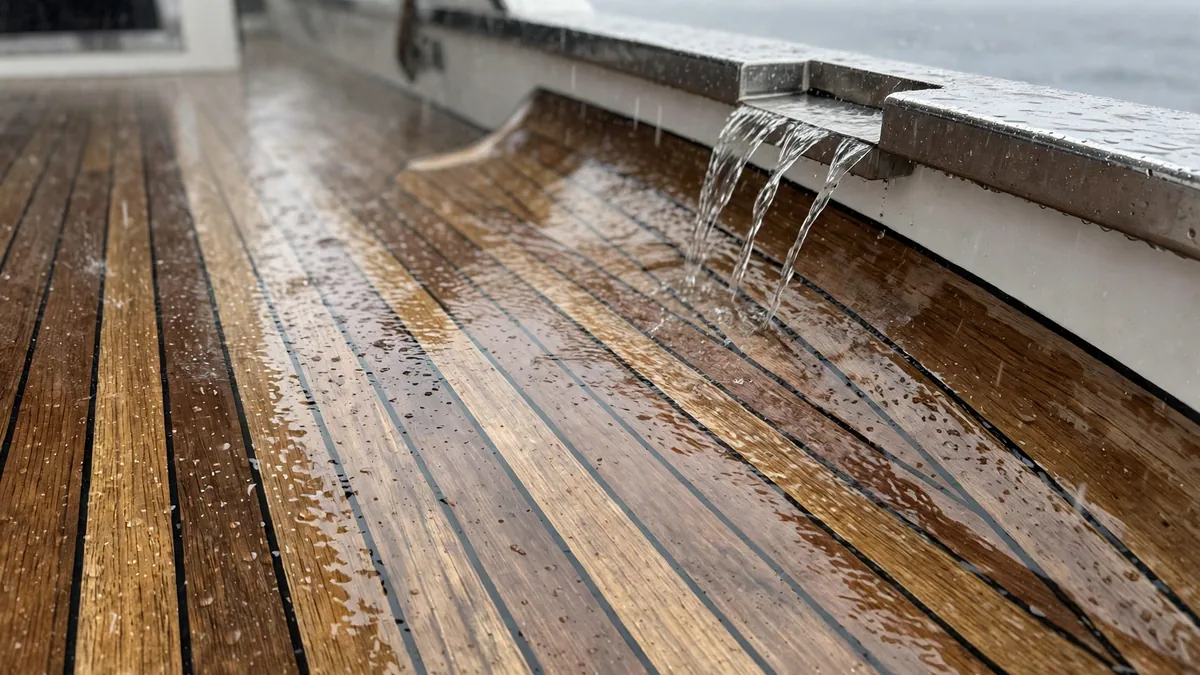
The first thing a yacht deck does is move water off the boat, and it does that with its shape. The deck is built with camber, a gentle curve that is higher at the centreline and lower at the edges, so rain and spray run outward to the scuppers, the small openings that let water over the side. The curve is slight, only a few centimetres over the width of the deck, yet it is enough that water never pools. A flat deck would hold puddles that stain the wood, soak into seams and make the surface slippery, so the curve is the deck’s first and most important trick.
Step 2: The wood that grips and stays cool
The surface itself does the second job. Teak is dense, oily and rough enough to grip bare feet when it is wet, and it stays cooler in the sun than bare fibreglass, which can burn feet on a hot afternoon. The wood also moves very little as it takes up and gives off moisture, so the planks stay flat through wet winters and dry summers. Synthetic teak works the same way, with a textured surface that grips and a pale colour that reflects heat. The deck is left bare, never varnished, because varnish would be slippery when wet and would peel in the sun.

Step 3: The seams that keep water out
The black lines between the planks are the deck’s waterproofing. Each seam is filled with a flexible caulking, usually a two-part polysulphide or a modern polyurethane sealant, that bonds to the sides of the planks and stays elastic as the wood swells and shrinks. When the deck gets wet, the teak swells and squeezes the seams shut, which is why the crew wash the deck down every morning. A seam that is too hard will crack as the wood moves, and a seam that is too soft will squeeze out underfoot, so the caulking has to be exactly the right hardness for the climate.
Step 4: The structure that carries the load
Under the teak sits the real deck, and it carries everything. On a modern yacht it is usually a fibreglass sandwich or an aluminium deck, stiffened from below with beams and frames, and it takes the weight of guests, deck furniture, winches and the anchor gear. The teak is only a wearing surface, not the structure, and it is glued and screwed to the base so the two move as one. If the structure flexes too much, the seams open and the glue fails, which is why the deck is built far stiffer than a floor in a house would ever need to be.
Step 5: The drainage that protects the cabin below
Water that runs off the deck has to go somewhere, and the drainage system is designed so it never goes below. Scuppers at the deck edge carry water over the side, and the hatches and skylights in the deck are raised on coamings, low walls that stop water running in. Every bolt hole for a cleat, a winch or a handrail is sealed with a bedding compound, because a leak through a deck fitting is the most common cause of damp in the cabin below. The crew check those seals every season, because a small leak left alone will rot the structure from the inside.
Step 6: The daily care that keeps it working
The deck only keeps working if it is cared for, and the care is simple but constant. It is washed with fresh water every morning, which keeps the wood cool, swells the seams shut and washes the salt away. It is scrubbed across the grain, never along it, so the soft grain is not worn away and the surface stays even. Once or twice a year it is sanded lightly and the seams are checked, and every few years the caulking is replaced. A deck that is looked after will stay grippy, dry and beautiful for decades, while a neglected one turns grey, slippery and leaky in a few seasons.

The deck also works as a safety surface. Its grip is what keeps guests on their feet when the boat rolls, its drainage is what keeps the cabin dry in a storm, and its strength is what lets the crew work the anchor and the sails without worrying about the floor beneath them. A yacht deck that looks good but does not work is a hazard, and the crew know it before the guests ever do.
Yacht Deck Specifications
| Feature | Typical Detail |
|---|---|
| Surface | Teak planks or synthetic teak, sanded bare |
| Camber | Gentle curve, higher at the centreline |
| Seams | Flexible black caulking, watertight |
| Structure | Fibreglass sandwich or aluminium, beam stiffened |
| Drainage | Scuppers at the edges, raised hatch coamings |
| Care | Daily fresh-water wash, scrub across the grain |
How Much Does a Yacht Deck Cost?
Prices are estimates and vary with yacht size, wood and yard. A new teak deck for a large luxury yacht can run an estimated $100,000 to $500,000 or more, with the wood itself a large part of the cost, because good teak is scarce and slow grown. A synthetic teak deck typically costs an estimated $50,000 to $200,000 for the same yacht, and needs far less care. Re-caulking an existing deck, with new seams and a fresh sanding, typically costs an estimated $10,000 to $40,000. The full build is described in how a yacht deck is made, and the yacht anchor chain and the yacht bow show the parts of the boat the deck has to work with every day.
A Rare Fact About Yacht Decks
Here is a detail most owners never notice: the black seams between the teak planks are not just there to keep the water out. On the old wooden ships, the seams were filled with oakum and pitch, and the job of hammering the caulking in was called caulking the deck, which is where the phrase comes from. A well-caulked deck was so tight that a sailor could pour a bucket of water on it and watch it run off the sides without a drop leaking below, and the crew still wash the deck down every morning, the way sailors have for centuries.