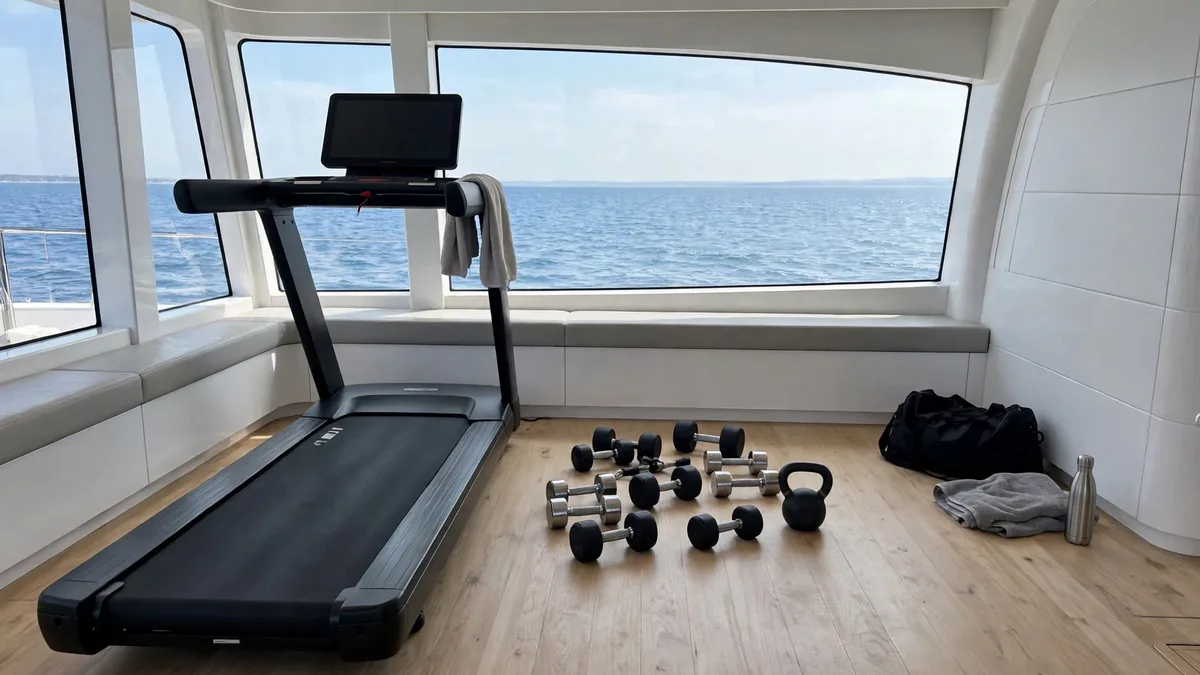
A gym on a superyacht has to do something no gym on land ever has to do: stay perfectly usable while the floor beneath it is moving. The yacht rolls with the swell, pitches over waves and heels in a turn, yet the treadmill must run smoothly, the weights must stay where they are put, and the person training must feel safe enough to push hard.
That is why a yacht gym is not a hotel gym carried aboard. This is how a luxury yacht gym is made.
How It’s Made
Step 1: The gym is placed where the yacht moves least
Every yacht gym starts with a choice of location, and the naval architects make it before the interior designers get involved. The middle of the yacht, low down and close to the centreline, moves least in a swell, so the gym usually sits on a lower deck near the middle of the hull. That one decision shapes everything that follows, from the size of the room to the machines that can safely go in it.
The room itself is drawn around the training that will happen inside it. A treadmill needs a long, clear run, a rack needs space to lift safely, and a stretching area needs open floor, so the designers work out the equipment list first and build the room to fit it, rather than squeezing machines into whatever space is left over.
Step 2: The deck is strengthened to carry the weight
Gym equipment is heavy, and on a yacht every kilogram matters. A commercial treadmill can weigh more than two hundred kilograms, a rack of dumbbells adds hundreds more, and a loaded barbell can drop with a force many times its own weight. The deck beneath the gym is therefore reinforced with extra steel frames and thicker plating, spreading the load into the hull structure below.
At the same time, the builders plan for the weight to be balanced.
Step 3: Floating floors and fixings tame the motion
With the structure ready, the gym floor goes in, and it is not an ordinary floor. A thick rubber and cork sandwich sits on a floating frame, separated from the deck by vibration mounts, so the thud of a dropped weight and the hum of a treadmill are absorbed before they reach the cabins below. The floor is also slightly sprung, giving a runner’s knees a kinder surface than bare steel.
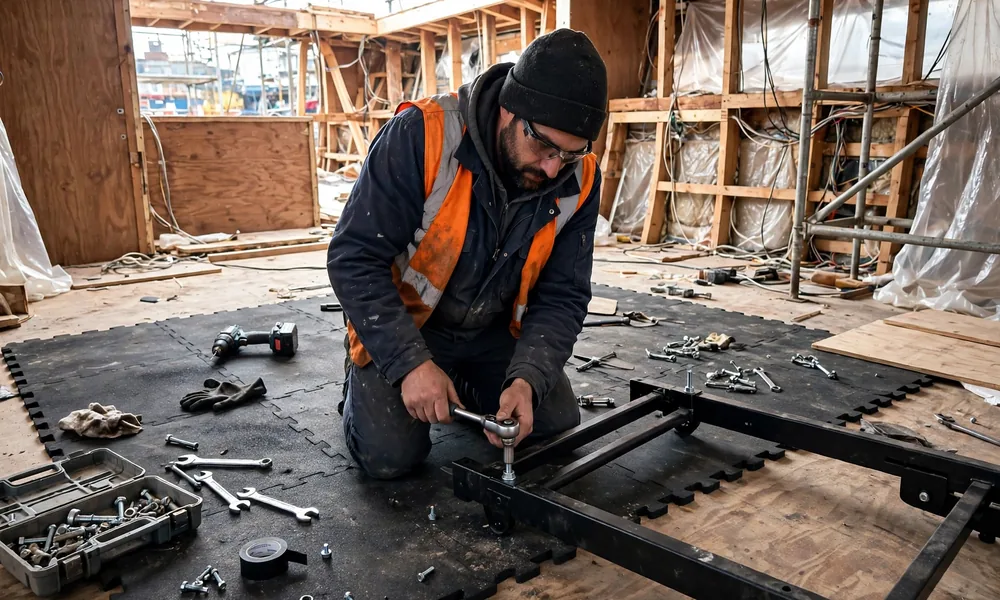
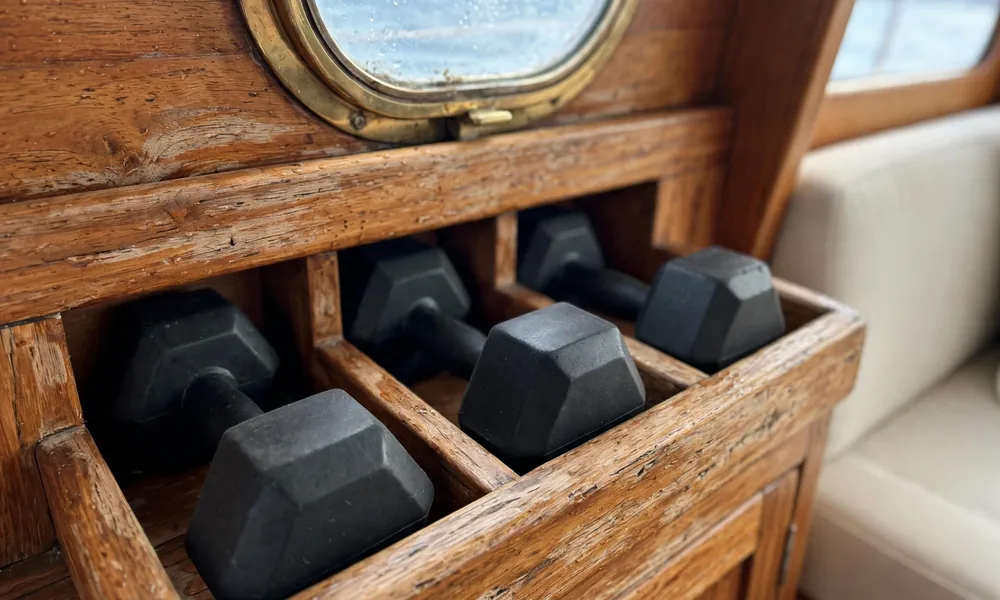
Every machine is then bolted down through the floor to the reinforced deck. Treadmills sit on anti-vibration pads, racks are fixed to the floor and the wall, and dumbbells live in recessed trays with raised lips, so nothing slides when the yacht rolls. The fixings are rated for forces far beyond normal use, because a loose weight on a moving yacht is a danger to everyone in the room.
Step 4: Machines are chosen for the sea, not the showroom
The machines themselves are picked for how they behave at sea. Treadmills for yachts have wider belts, stronger motors and heavier frames than home models, so they stay steady when the deck moves beneath them. Rowing machines and bikes are chosen because they keep the user seated and braced, and free weights are kept to manageable sizes, with magnetic and rack-mounted options replacing loose plates wherever possible.
Every machine is also protected against salt air. Frames are powder-coated or made from marine-grade stainless steel, bearings are sealed, and electronics are housed in cases that keep out damp and spray.
Step 5: Air, light and sound are tuned for training
A gym that is hot, stuffy or noisy will not be used, so the next stage is the climate. A dedicated air-handling unit feeds the gym with cool, dry air, and extra ventilation clears the heat and humidity that a hard workout produces.
Light is handled with the same care. Large windows, where the design allows them, give a view of the sea and natural daylight, while the artificial lighting is bright, even and free of glare on screens. Acoustic panels in the ceiling and walls absorb the noise of the machines, so a workout at dawn does not wake the guests sleeping one deck below.
Step 6: The gym is tested under way before delivery
The final stage happens at sea. During trials the gym is used while the yacht is under way, with the crew running on the treadmill, lifting on the rack and testing every fixing as the hull rolls through real waves. Engineers listen for rattles, watch for movement in the machines and check that nothing has worked loose after hours of motion.
Anything that shifts, squeaks or slides is fixed before the yacht is handed over, and the test is repeated until the room is silent and steady. Only then does the gym become what it was designed to be: a place where a guest can train as hard as they would on land, without ever noticing that the floor is moving beneath them.
| Spec | Detail |
|---|---|
| Location | Low and central, near the middle of the hull where motion is least |
| Floor | Floating rubber and cork floor on vibration mounts over a reinforced deck |
| Equipment | Marine-grade treadmill, rack, dumbbells, rower and bike, all bolted down |
| Corrosion protection | Powder-coated and stainless frames with sealed bearings and electronics |
| Climate | Dedicated quiet air handling with extra ventilation for workout heat |
| Testing | Used under way during sea trials until every fixing stays silent and steady |
The hardest part of building a yacht gym is not the machines but the compromise between them. Every kilogram of equipment is a kilogram that cannot be spent elsewhere, and every square metre of gym is a square metre that cannot be a cabin, so the designers fight for a room that feels generous while weighing as little as possible.
What One Costs
A luxury yacht gym typically costs an estimated $250,000 to $900,000 to build and fit out, and the price is set mostly by the machines, the reinforced deck and the floating floor rather than the size of the room. A compact gym with a treadmill, a rack and a bike sits near the bottom of the range, while a full training suite with a sauna, a plunge pool and a personal trainer’s station costs far more. The machines alone can account for half the bill, and how a luxury yacht pool is made shows what the wet side of a yacht wellness deck involves, while how a yacht stabilizer works explains the system that keeps the whole room steady enough to train in.
A Rare Fact
Some superyacht gyms hide a clever trick in the floor: a section of deck that can be raised or lowered on hydraulic rams, turning the flat gym floor into a stepped platform for classes, or dropping it to create a sunken area for yoga and stretching without moving a single machine.
A luxury yacht gym is a reinforced room, a floating floor and a set of machines built to survive salt air and a rolling sea, finished so quietly that a guest can forget the ocean is moving at all. It is one of the smallest rooms on a superyacht, and one of the hardest to get right. For the wider story of the vessel it sits inside, how a luxury yacht is made follows the whole yacht from steel to sea trials.