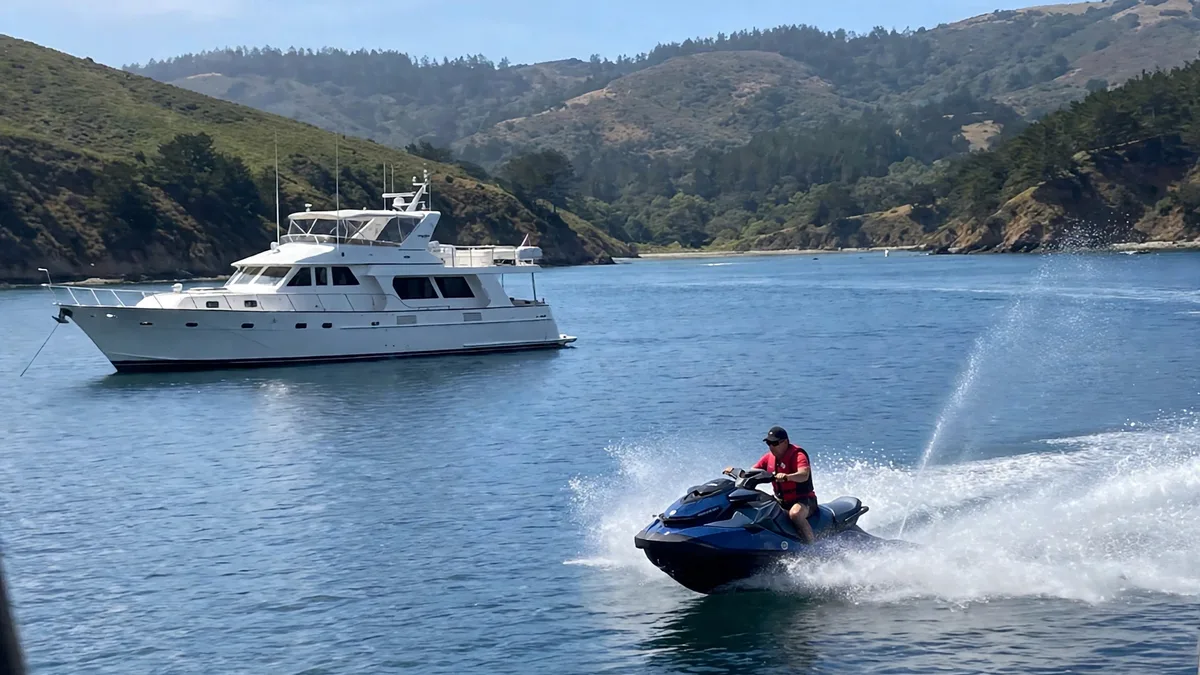
At anchor in a calm bay, a large white yacht lies still in the late afternoon sun, its swim platform lowered to the water. A door in the stern swings open, a small craft slides out on rails and splashes gently into the sea, and a rider climbs aboard, presses a button and twists the throttle. The little craft leaps forward, skims across the bay with a plume of spray behind it, and the people on the yacht deck watch it carve a wide turn around the anchorage. It is the yacht’s jet ski, tender and toy in one, and the fastest way to leave the mother ship and explore the coast.
A luxury yacht jet ski is a small, fast personal watercraft carried aboard a yacht, kept in a tender garage or on a swim platform and launched whenever guests want to ride, scout a beach or nip ashore. Unlike a standalone jet ski on a trailer, it must be compact enough to fit the garage, light enough for the yacht’s crane, and tough enough to live in salt water. It has no propeller, no rudder and no exposed drive, only a jet pump hidden in the hull that turns engine power into thrust. This is how it works, from the launch off the mother ship to the ride back aboard at sunset.
How It Works
Launch from the yacht: garage, crane and swim platform
The day starts in the tender garage, a dry bay in the stern where the jet ski sits on a cradle, strapped down and covered against salt spray. The crew open the transom door, slide the cradle out on rails or lift the craft with the yacht’s small crane, and lower it gently onto the water beside the swim platform. The rider climbs down the platform steps, settles on the seat and clips on the safety lanyard, a cord that stops the engine if the rider falls off. The garage itself is a piece of engineering worth knowing, and the way it stores and launches tenders is what a luxury yacht tender garage does at work shows, with the same rails, cradle and transom door.
The jet pump: thrust with no propeller
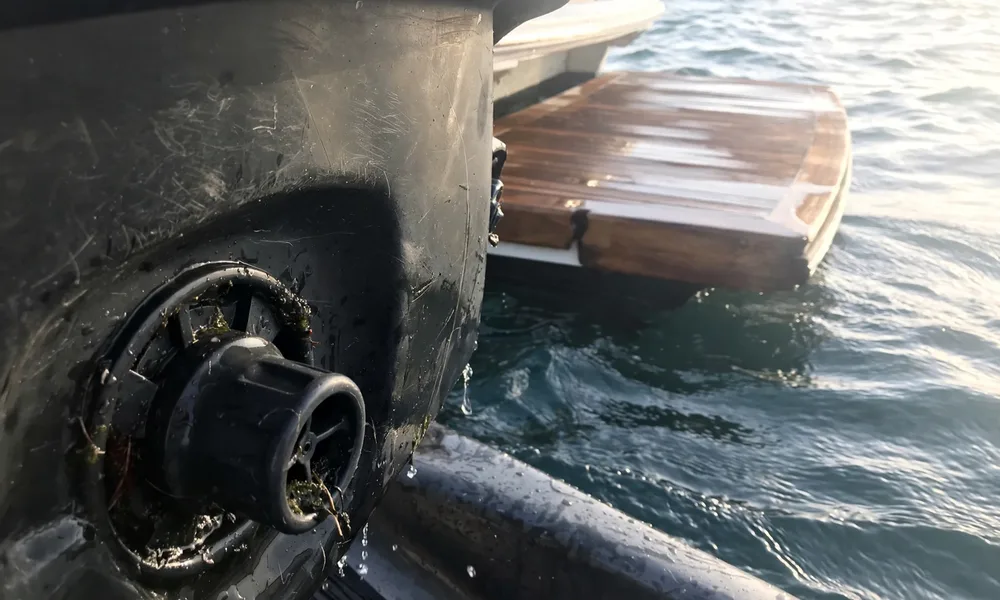
Under the seat, the engine drives a shaft that runs back through the hull to a jet pump, a tube with a spinning impeller inside it, hidden completely beneath the waterline. The impeller draws water in through a grate in the bottom of the hull, spins it faster and forces it out through a narrow nozzle at the stern, and the push of that water jet drives the craft forward. Because there is no propeller sticking out below the hull, the jet ski can run in shallow water over sand and weed, and it is safer for swimmers nearby. The nozzle at the back can pivot from side to side, and that is how the craft steers, by aiming the jet left or right instead of turning a rudder.
The engine: compact power in a sealed hull
The engine is a compact marine motor, usually a small petrol engine, sealed inside the hull with its air intake high up and its exhaust routed through the water to keep it quiet. It is cooled by the sea itself, with water from the jet pump looped around the engine block, so the motor stays cool even on a hot day at full throttle. A luxury yacht jet ski uses a supercharged or high-output engine for its size, because a tender must be quick enough to be fun and strong enough to tow a guest on an inflatable. The fuel tank is small, tucked low in the hull for balance, and the whole engine bay is lined with foam that soaks up noise, so the craft hums rather than roars across the bay.
Steering, reverse and the ride
Steering a jet ski feels different from steering a boat, because the craft only turns when the jet is pushing water. The rider twists the handlebar, the nozzle pivots, and the jet pushes the stern sideways, swinging the nose around in a tight turn. At slow speed, the craft is clumsy and drifts with the wind, so the rider uses short bursts of throttle to nudge it into place beside the yacht. A reverse bucket drops down over the nozzle to throw the jet forward, letting the craft back up to the swim platform, and a brake on some luxury models drops the bucket partway to slow the craft quickly. The hull has a deep V at the front to cut through chop and a flatter rear to lift the craft onto the plane, so it skims instead of ploughing through the water.
Docking back aboard at sunset
When the ride is over, the rider brings the jet ski back to the swim platform at idle speed, the crew catch a line and guide the craft onto its cradle. The engine is flushed with fresh water from a hose on the platform, washing the salt out of the cooling passages and the jet pump, and the hull is rinsed and wiped down before the craft is lifted back into the garage. The battery is left on a trickle charger overnight, the fuel is topped up, and the safety lanyard is clipped to its hook, ready for the next morning. The electric cousins of this craft work on the same jet pump idea with a battery instead of a petrol engine, as a luxury electric jet ski does at work shows, and the classic petrol stand-alone craft is what a luxury jet ski does at work shows.
| Specification | Typical machine |
|---|---|
| Role aboard | Yacht tender and guest toy, stored in the tender garage |
| Drive | Jet pump with spinning impeller, no exposed propeller |
| Engine | Compact marine petrol engine, cooled by sea water |
| Steering | Pivoting jet nozzle, with reverse bucket for backing up |
| Launch | Cradle on rails or yacht crane, from the stern transom door |
| Hull | Deep V front to cut chop, flat rear to lift onto the plane |
| Safety | Lanyard that stops the engine if the rider falls off |
| Aftercare | Fresh-water flush, rinse and trickle charge after every ride |

A luxury yacht jet ski costs an estimate of $15,000 to $35,000, depending on its engine power, its size and whether it is built to fit a particular yacht’s tender garage. The price covers the craft, the cradle and straps, the safety lanyard and the cover, but not the yacht’s crane or garage, which are part of the mother ship. Owners often choose a model that matches the yacht’s garage dimensions exactly, so the craft slides in and out without a struggle, and a spare lanyard and a flush kit are kept aboard for every trip.
Here is a rare fact worth knowing. The first personal watercraft were not jet skis at all but small motorboats with propellers, and the jet pump that defines the modern jet ski was borrowed from fire boats, which used jets to manoeuvre in tight harbours without a rudder. The first stand-up jet skis of the 1970s were so tippy that riders spent more time in the water than on the craft, and it took a decade of wider hulls and sit-down seats before a jet ski became something a guest could ride without falling off. A modern yacht jet ski is stable enough for a first-time rider, fast enough to thrill, and small enough to disappear into the stern of a yacht when the day is done.


