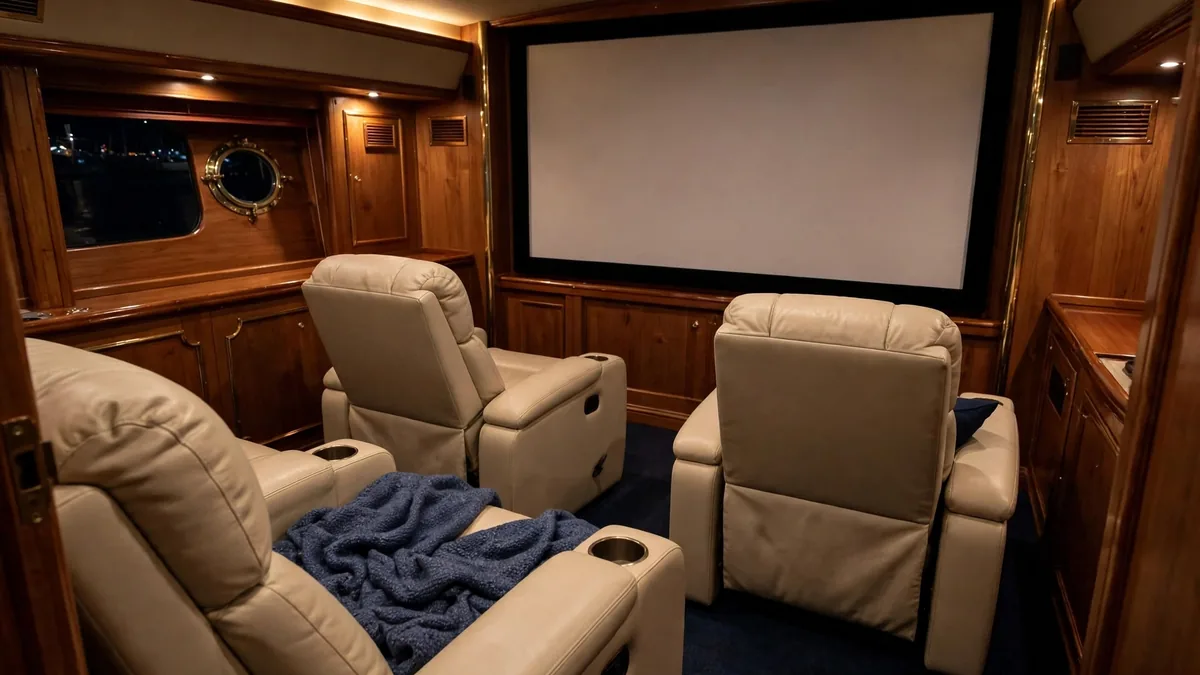
Below deck on a superyacht, behind a door that looks like any other cabin door, there is a room with no windows, no daylight and no view of the sea. The lights go down, the screen glows, and eight people sink into recliners while the boat rolls gently beneath them. It is a private cinema at sea, and it is one of the hardest rooms on a yacht to build, because everything that makes a cinema work, darkness, silence and a perfect picture, has to be created inside a steel hull that moves, hums and vibrates.
A cinema on land is a box with a screen. A cinema on a yacht is a box inside a moving box, and every part of it has to fight the sea. The screen must stay steady while the hull rolls, the sound must not leak into the cabins next door, and the projector must survive salt air and vibration. Building one means designing the room, the seating, the sound and the picture as a single system. This is how it is done.
How It Is Made
Step 1: The room is chosen and soundproofed
Everything starts with the room itself, usually a space low in the hull where there are no windows to let in light and no neighbours who need quiet at odd hours. Builders line the walls, floor and ceiling with layers of dense acoustic material, sealing every gap so sound cannot escape into the cabins above or next door. The door is made heavy and tight-fitting, more like a studio door than a cabin door, and the ventilation is routed through silencers so the hum of the air conditioning never reaches the seats.
Step 2: The seating is built and bolted down
The seats are the heart of the room, and they are built like furniture and bolted like machinery. Recliners are upholstered in leather or velvet, sized for long films, and mounted on rails fixed through the deck so they cannot slide when the yacht rolls. Rows are tiered on a stepped platform so every guest sees the screen over the head in front, and the spacing is generous, because nobody on a superyacht wants to climb over a stranger to reach the aisle.
Step 3: The screen and projector are installed
The picture comes from a projector hidden in a booth or a ceiling housing at the back of the room, throwing its beam across to a screen that can be three metres wide or more. Fitters mount the projector on a damped bracket so the vibration of the engines never shakes the image, and they align it with lasers so the picture lands square on the screen, edge to edge. The screen itself is a special acoustically transparent fabric, so the speakers can hide behind it and the sound seems to come from the actors’ mouths.
Step 4: The speakers and sound system are fitted
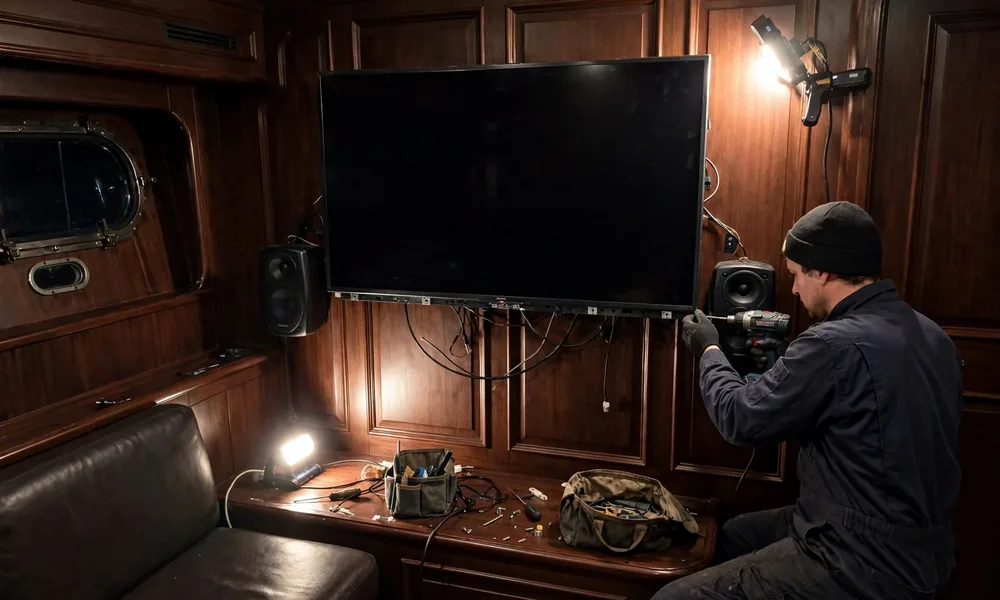
Sound is where a yacht cinema earns its keep, and it takes more speakers than most people expect. A surround system places speakers all around the room, behind the screen, in the walls and in the ceiling, each one aimed at the seats and each one wired back to a rack of amplifiers hidden in a ventilated cupboard. Fitters tune the system with a microphone at every seat, measuring how the room colours the sound and adjusting each channel until a whisper from the left sounds like a whisper from the left.
Step 5: Lighting, controls and finishes go in
With the picture and sound in place, the room is finished like a small theatre. Dimmable lights are set into the ceiling and along the floor so guests can find their seats without ruining the picture, and the walls are covered in dark fabric or wood that swallows reflections. A single control panel, often a tablet on the arm of the front seat, runs the projector, the sound, the lights and the blinds, so the crew can start a film with one touch.
Step 6: It is tested in the dark, at sea
Before the yacht is handed over, the cinema is tested the way it will be used, in the dark, with a full audience, while the yacht is under way. Testers play films with quiet dialogue and loud action, checking that whispers are clear and explosions do not rattle the walls, and they watch for any shake in the picture as the hull rolls. Only when a film plays cleanly from the first frame to the credits, with no shake, no hum and no leaked sound, is the cinema signed off.
| Specification | Typical figure |
|---|---|
| Seating | Usually 6 to 12 recliners, tiered in two or three rows |
| Screen | Around 2.5 to 4 metres wide, acoustically transparent fabric |
| Projector | High-brightness laser projector, mounted on a damped bracket |
| Sound | Surround system with speakers behind the screen and in the ceiling |
| Soundproofing | Layered acoustic walls, heavy door and silenced ventilation |
| Build time | Several weeks of fitting and tuning inside the yacht build |
The hardest problem in a yacht cinema is one that land cinemas never face, which is that the room itself is moving. The hull rolls with the waves, the engines hum through the steel, and the air conditioning has to work harder than in any house. Designers fight this with layers, a floating floor that sits on rubber mounts, a projector on dampers, speakers on isolation pads, and walls built like a box inside a box. The result is a room that feels still and silent even when the sea outside is not, and guests forget they are on a boat at all, which is exactly the point.
What One Costs
A yacht cinema typically costs an estimated $200,000 to $1,000,000, and the price is set mostly by the size of the room, the projector and the sound system. A modest cinema with good seats and a bright projector sits at the low end, while a full theatre with a laser projector, a large screen and a tuned surround system can cost as much as a house. The power and cooling behind it are part of the story too, and how the luxury ship engine room works explains the machinery that keeps a yacht’s lights, screens and speakers running, while inside the most expensive room on a ship shows another room where the price is in the equipment, not the size.
A Rare Fact
Some yacht cinemas are built to convert, and the screen rises into the ceiling, the seats fold away, and the same room becomes a meeting room, a classroom or a nightclub by the time the film ends. The most elaborate ones have a second screen for gaming, a bar hidden in the wall, and a popcorn machine that the crew wheel in like a piece of theatre.

A yacht cinema is a strange luxury, a room built to shut out the very sea the yacht was built to sail on. It takes soundproofing, damped mounts, tuned speakers and weeks of testing in the dark, and when it works, the guests never think about any of it. They just watch the film, and the boat disappears. For the machines that take a yacht somewhere stranger than a cinema, how a luxury submersible works goes down to the deep instead of into the dark.